Support

Kavieng Airport

About the Airport

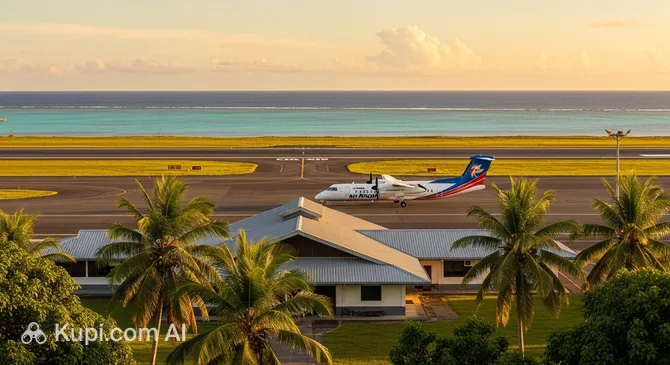
Kavieng Airport. Source: Kupi.com Binoculars

Kavieng Airport (KVG) is not just a transport hub, but a shining new gateway to the tropical paradise of the New Ireland Province. Following a major reconstruction that culminated in the opening of a new terminal in late 2022, this air harbour has transformed into one of the most modern facilities in the region, capable of accommodating comfortable jet liners. Located literally a stone's throw from the city, the airport welcomes travellers with views of the turquoise lagoons of the Bismarck Archipelago from the air, setting the mood for unforgettable diving or surfing. It is the ideal starting point for exploring the legendary Boluminski Highway and remote islands.

IATA Code KVG
ICAO Code AYKV
City Kavieng
Distance to Centre 2 km
Status Domestic (Regional Hub)
Annual Passengers No official data
Schedule Check airline websites

Airport Features and Highlights:

Kavieng Airport stands out among many regional airports in Papua New Guinea thanks to its recent modernisation and convenient location. Here are its key advantages:

  • New Modern Terminal: The terminal building, opened in November 2022, is equipped with a modern air conditioning system, a comfortable departure lounge with 200 seats, and baggage claim conveyor belts, ensuring a high level of comfort for passengers.
  • Jet Liner Capability: The runway has been extended to 2,200 metres, allowing the airport to accommodate medium-haul aircraft such as the Boeing 737. This makes flights from the capital faster and more stable.
  • Unique Market Complex: As part of the reconstruction, a special market pavilion was built next to the terminal. This is an excellent opportunity for tourists to buy fresh tropical fruits or local souvenirs right before departure.
  • Fantastic Accessibility: The airport is located just 2 kilometres from the centre of Kavieng. The journey to most hotels and guesthouses takes no more than 5 minutes by car, and some can even be reached on foot (although this is not recommended with luggage due to the heat).
  • High Safety Standards: The upgrade included the installation of modern navigational lighting equipment and secure perimeter fencing, significantly enhancing flight safety at any time of day.

Contact Information

Finding detailed and direct contact information for a small regional airport like Kavieng Airport can be challenging. The airport is managed by the National Airports Corporation (NAC) of Papua New Guinea, so most enquiries should be directed to this organisation.

  • Official Website: Kavieng Airport does not have its own separate website. Official information is published on the website of the management company — National Airports Corporation (NAC): www.nac.com.pg.
  • Help Desk Phone: There is no direct public phone number for Kavieng Airport. For general enquiries, you can use the contact number of the NAC head office: +675 324 4400.
  • Airport Address: Kavieng Airport, Kavieng, New Ireland Province, Papua New Guinea.
  • Email: For official enquiries, it is recommended to use the general NAC email address: info@nac.com.pg.
  • Social Media: The airport does not have its own social media pages. News and updates can be tracked on the official NAC Facebook page.
  • Lost Luggage Information: Issues regarding lost or damaged luggage are handled exclusively by the airlines. Please contact your carrier's support service directly.
  • Passenger Support Contacts: For all questions related to tickets, flight schedules, and check-in, you should contact the airline whose services you are using.

How to Get to the Airport

Getting to Kavieng Airport (KVG) from the city centre of Kavieng is effortless, as it is located just a few kilometres from the main hotels and guesthouses. Travellers in Papua New Guinea can choose from several convenient methods to reach their flight on time.

Taxi and Hotel Transfer is the most popular and reliable way to get to the airport. The trip from the city centre will take just 5-10 minutes. It is recommended to agree on the fare with the driver in advance, as taximeters are not always used. An even more convenient option is to book a transfer through your hotel. The staff can help organise a car, which is particularly useful if you have a lot of luggage or are travelling in a group.

Public Transport in Kavieng is represented mainly by minibuses known as PMVs (Public Motor Vehicles). This is the most budget-friendly option, but it may not be the most comfortable for tourists with suitcases. PMVs follow specific routes and may not pull up directly to the terminal. This method is suitable for experienced travellers wishing to immerse themselves in the local atmosphere.

Car Rental provides maximum freedom for exploring the island of New Ireland. Several local companies and some major hotels offer car rental services. If you plan to travel around the area extensively, this is an excellent choice. It is recommended to book a car in advance, especially during the tourist season. The road to the airport from the city is simple and well-marked.

Kavieng Airport has a parking area where you can leave a car for a short or long period. Given the small size of the airport, there are usually enough parking spaces for all passengers. This is a convenient option for those arriving in their own or a rented vehicle.

Overall, for most tourists, the most balanced option in terms of convenience and safety would be a taxi or a pre-booked transfer. Kavieng Airport is an important hub for further travel in the region, for example, to popular Rabaul or to Lihir Island.

Terminals and Map

The airport of Kavieng (KVG) is a small regional airport serving domestic flights within Papua New Guinea. Its structure is extremely simple and intuitive, making it very convenient for travellers unaccustomed to large and noisy aviation hubs. All airport infrastructure is housed in one compact terminal, which simultaneously serves both departing and arriving passengers.

The terminal layout is very simple: it is practically impossible to get lost here. Upon entering the building, you will immediately see several check-in counters. The departure and arrival zones are located within one small hall or adjacent rooms. There are no complex walkways, multi-level structures, or long corridors, which significantly simplifies navigation. After check-in, passengers proceed to a small waiting lounge, from where boarding takes place, often by walking across the airfield.

Arriving passengers also enter the same building, where baggage claim takes place in a separate area. The entire process takes minimal time. Since there is only one terminal, there is no need for transfers between them — everything is within walking distance.

Completing all formalities, including check-in and security screening, usually happens very quickly due to the low passenger traffic. Nevertheless, it is recommended to arrive at the airport approximately 60-90 minutes before departure to check in luggage and go through all procedures without haste. The main advice for navigation is to follow the few signs available and do not hesitate to ask airport staff, who are always ready to help.

Airport History

The history of Kavieng Airport (KVG) is closely intertwined with the dramatic events of World War II. The airfield was built by Japanese armed forces around 1942 following the capture of New Ireland island. From the very beginning, it was created not as a civilian facility, but as a strategically important military airbase, allowing control over sea and air routes in this region of the Pacific Ocean.

During the war years, Kavieng airfield became an arena of fierce fighting. It served as a staging ground for Japanese aviation and, consequently, was one of the main targets for massive bombardments by Allied forces, primarily American and Australian air forces. The goal of these attacks was to neutralise the base and weaken the Japanese presence in the region. By the end of the war, the airfield infrastructure was almost completely destroyed.

After the end of World War II, a new chapter began in the airport's history. The destroyed military facility was restored and converted for civilian use, becoming the main air gateway for the New Ireland Province. This was a crucial stage of development, transforming a former military base into a vital hub connecting the isolated island with the rest of Papua New Guinea and, in particular, with the capital, Port Moresby.

In recent history, the airport has undergone several stages of modernisation to meet modern aviation standards. Works have been carried out to improve the runway and navigational equipment, as well as to update the small passenger terminal. Today, Kavieng Airport bears no traces of its military past and is a key transport hub for locals, business travellers, and, crucially, for the growing stream of tourists coming here for world-renowned diving and surfing.

Services and Amenities

Kavieng Airport (KVG) is a small regional airport serving domestic flights. The infrastructure here is quite simple and oriented towards meeting the basic needs of passengers before departure. It is important to understand that the range of services at KVG differs significantly from large international hubs.

In the airport terminal, you will not find large restaurants or chain coffee shops. Options for a snack are usually limited to small kiosks or stalls where you can buy bottled water, soft drinks, light snacks, and perhaps local souvenirs. It is recommended to carry cash for payment.

A general waiting hall is equipped for passengers. There are no specialised VIP halls or business lounges at Kavieng Airport. Access to public Wi-Fi is generally unavailable, and the number of power outlets for charging electronic devices may be extremely limited. It is best to bring a portable power bank with you.

There are no bank branches, ATMs, or currency exchange points within the terminal building. All financial transactions, including currency exchange, are strongly recommended to be completed in advance in the city of Kavieng, where banking services are available.

Specialised services, such as a medical centre or a mother and child room, are absent at the airport. Passengers with reduced mobility should contact their airline in advance to organise necessary assistance during boarding and disembarking. Airport staff can provide basic assistance upon request.

There are no hotels or business centres on the airport territory. Various accommodation options, from guesthouses to resort hotels, are located in the city of Kavieng itself and its surroundings, which can be reached by taxi or transfer in a short time.

Dining

When planning a snack at Kavieng Airport (KVG), it is important to consider that this is a small regional airport serving the eponymous city in Papua New Guinea. Consequently, the choice of catering establishments here is very limited and designed to satisfy the basic needs of travellers before departure.

Typically, a small café or kiosk operates in the main and only terminal. It is located in the public zone (landside), accessible to all visitors before passing security control. Here you can have a quick bite, choosing from a standard assortment: sandwiches, pastries, chips, chocolate, as well as hot and cold drinks such as coffee, tea, and bottled water.

There are no full-service restaurants or bars with extensive menus at Kavieng Airport. Options for a full lunch should be sought in the city itself. Regarding local cuisine, it is unlikely to be found at the airport, except perhaps for some packaged local snacks. Specialised menus (vegetarian, vegan, gluten-free, or Halal) are unavailable, so travellers with specific dietary requirements are strongly advised to bring food with them.

The opening hours of the local café are usually synchronised with the flight schedule: it opens before departures and closes shortly after the last plane leaves. Prices for food and drinks, as in most airports, are slightly higher than in the city. Thus, Kavieng Airport offers only basic opportunities for a quick snack, and one should not count on gastronomic variety here.

Travel Tips

Travelling through Kavieng Airport, the gateway to New Ireland Province in Papua New Guinea, has its own unique features. To ensure your trip goes smoothly, use these tips, keeping in mind that this is a small regional airport with a basic set of services.

Arrival at the Airport and Check-in. For domestic flights, it is recommended to arrive at the airport at least 1.5-2 hours before departure. The check-in and security control processes here usually go faster than in major hubs, but it is better to have a time buffer. Keep your passport and ticket ready — this will speed up the procedure. Check-in counters may close strictly according to schedule.

Seat Selection and Hand Luggage. If possible, choose a window seat. Flights in this region offer breathtaking views of coral reefs and the islands of the Bismarck Archipelago. Pay special attention to your airline's hand luggage rules. Strict weight limits (usually 5-7 kg) often apply on domestic flights in Papua New Guinea. Sharp objects, flammable substances, and liquids in volumes greater than 100 ml per container are prohibited in hand luggage.

Transfers and Customs Control. Most connections from Kavieng are made via the capital's Port Moresby Airport. Ensure in advance that you have enough time between flights, as delays are possible. Kavieng Airport serves mainly domestic flights, so customs control is passed at the first airport of arrival in the country. However, be prepared for possible quarantine inspection regarding the transport of plants or animal products.

Saving Money and Unforeseen Situations. To save money, book flight tickets and accommodation in advance, especially during the tourist season. Travel light to avoid excess baggage fees. Carry some local currency (Kina) for small expenses, as card payment options may be limited. Flight delays due to weather conditions are not uncommon. In this case, keep a book, a charged power bank, and a light snack in your hand luggage, as amenities in the waiting area are minimal.

Reached the end of the page?

That means the route is fully explored