Support

Kiunga

About the Airport

Kiunga Airport is not merely a runway, but a true aerial gateway to one of the wildest and most unexplored places on the planet. Located on the banks of the mighty Fly River, it serves as a vital artery connecting the remote Western Province of Papua New Guinea with the rest of the world. For travellers seeking authentic adventures, ornithologists, and researchers, arrival here marks the beginning of a breathtaking journey into the very heart of the jungle.
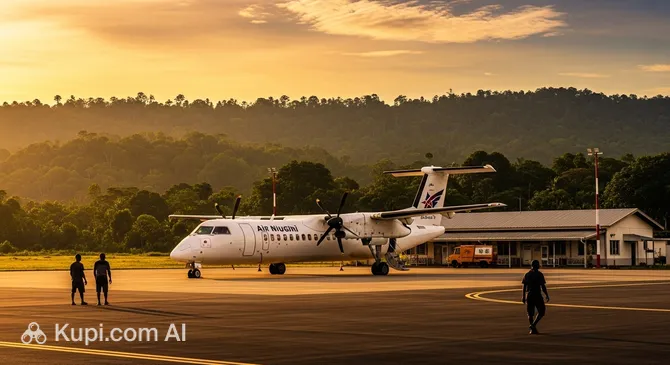
Kiunga. Illustration.
Source: Kupi.com AI
PropertyValue
IATA CodeUNG
ICAO CodeAYKI
CityKiunga
CountryPapua New Guinea (Niugini)
TimezonePacific/Port_Moresby
Top AirlinesAir Niugini
ScheduleOnline Timetable

The main feature of Kiunga Airport is its strategic importance rather than developed infrastructure. It is a small and highly functional airport consisting of one modest terminal and a single runway. You will not find duty-free shops or luxurious lounges here, but its significance for the region cannot be overstated. It serves not only local residents and tourists but also workers from the nearby major Ok Tedi mine.

For tourists, Kiunga Airport is the starting point for unique expeditions. Tours for observing rare birds of paradise, canoe trips along the Fly River and its tributaries, and introductions to the distinctive culture of local tribes begin here. Despite its simplicity, the airport reliably performs its main function — providing access to one of the most biologically diverse and culturally rich corners of the Earth.

Contact Information

It is important to understand that Kiunga Airport (UNG) is a small regional facility in Papua New Guinea, and many standard contact details found at major international airports may be unavailable here. Most issues are resolved through the airlines operating the flights.

  • Official Airport Website: Kiunga Airport does not have a separate official website. It is recommended to check up-to-date flight schedule information on the websites of the carriers (e.g., PNG Air) that serve this destination.
  • Information Desk Phone: There is no direct public telephone line for the airport. For information regarding flights, bookings, or schedule changes, please contact your airline directly.
  • Airport Address: Kiunga Airport, Western Province, Papua New Guinea.
  • Email: There is no dedicated email address for passengers.
  • Airport Social Media: The airport does not maintain official pages on social media.
  • Lost Luggage Information: For all inquiries related to searching for lost or damaged luggage, one should apply directly to the support service of the airline with which you flew.
  • Passenger Support Contacts: Passenger support for all matters (check-in, boarding, special needs) is provided by the staff of the airline whose services you are using.

How to Get to the Airport

Getting to the airport from the city centre of Kiunga is quite simple, as the town is small and the airport is located in its immediate vicinity. However, transport options have specific characteristics typical of remote regions in Papua New Guinea. A trip from any point in the town to the terminal usually takes no more than 10–15 minutes.

The most convenient and reliable way to get to the airport is by taxi or pre-arranged transfer. Most hotels and guesthouses offer transfer services to their guests, which is the most predictable option. You may also use the services of local private drivers, but in this case, it is strongly recommended to agree on the price of the trip in advance to avoid misunderstandings. Payment is generally made in cash.

Formal public transport, such as buses with fixed routes and schedules, is absent in Kiunga. Locals move around on so-called PMVs (Public Motor Vehicles) — a type of route taxi, often consisting of minibuses or trucks. However, they do not have a clear route to the airport and can be extremely inconvenient for travellers with luggage.

Opportunities for renting a car for self-driving in the town are practically non-existent. A more common practice is renting a vehicle with a local driver. Regarding parking, the airport has a small area where cars can stop for picking up or dropping off passengers. However, it is not intended for long-term vehicle storage and may not be guarded.

Terminals and Map

Kiunga Airport (UNG) is a small regional aviation hub, typical of remote districts in Papua New Guinea. Its infrastructure is simple and functional, making it convenient for passengers unaccustomed to the complex layouts of major airports.

The airport operates with one small terminal that handles all flights — both arrivals and departures. Due to its compact size, there is no need for transfers between terminals, and all navigation is intuitive. The check-in, security screening, waiting, and baggage claim zones are located in the same building, within walking distance of each other.

The terminal layout is extremely simple. Upon entry, you will immediately see the airline check-in counters. After receiving a boarding pass, passengers proceed to a small waiting area where they await the boarding call. The arrival zone is equally straightforward: after disembarking the aircraft, passengers enter the same part of the terminal to collect their luggage.

Completing all formalities, including check-in and screening, usually takes a minimal amount of time due to the low passenger flow. Nevertheless, it is recommended to arrive at the airport approximately 1-1.5 hours before departure to calmly check in luggage and pass through all procedures. The main advice for navigation is not to worry: it is practically impossible to get lost in Kiunga Airport, as all its functional zones are clearly visible.

Airport History

The history of Kiunga Airport (UNG) is, in essence, the history of developing one of the most inaccessible regions on the planet. The airport was built around 1982, and its emergence is inextricably linked to the development of the giant Ok Tedi copper mine. Located in the very heart of the dense jungles of the Western Province of Papua New Guinea, it became a vital transport artery from day one, without which the realisation of such a massive project would have been simply impossible.

The main construction phase took place in the early 1980s. In conditions where roads were completely absent, air transport was the only way to deliver heavy machinery, equipment, food, and thousands of workers to the deposit. Therefore, the airport was initially designed not as a passenger terminal in the usual sense, but as a key logistics hub capable of accepting both cargo aircraft and charter flights carrying personnel.

Speaking of records and achievements, the main success of Kiunga Airport lies not in passenger numbers, but in its unique role in supporting the operation of one of the world's largest and most complex mines. Its creation and uninterrupted operation in an absolutely isolated region represent a true engineering and logistical feat. It is thanks to this airport that not only mineral extraction became possible, but also the development of the entire economic and social infrastructure around the town.

Throughout its history, the airport has not undergone massive reconstructions comparable to major international hubs. Its development has focused on maintaining and modernising the runway and navigation equipment for the safe servicing of regional flights. An interesting fact lies in its transformation: initially a strictly industrial facility, it quickly became a "gateway to the world" for the local population, connecting isolated communities with the capital, Port Moresby, and the rest of the country.

Services and Amenities

Kiunga Airport (UNG) is a small regional airport serving domestic flights in Papua New Guinea. Given its size and purpose, the range of services for passengers is basic and focused on meeting essential needs before departure or upon arrival. Travellers should be prepared for minimal infrastructure here.

In the terminal building, you will not find large restaurants, cafes, or duty-free shops. Opportunities for snacks and shopping are extremely limited and may be confined to a small kiosk selling beverages and light snacks. It is recommended to bring food and water with you, especially if you are travelling with children.

Modern amenities such as public Wi-Fi, business centres, or conference rooms are absent at the airport. The number of electrical outlets for charging devices may also be very limited, so it is better to ensure your gadgets are fully charged in advance.

There are no bank branches, ATMs, or currency exchange points at Kiunga Airport. All financial transactions should be conducted beforehand in larger cities. Specialized medical points are also absent; only basic first aid may be available.

The airport has no VIP lounges or dedicated mother-and-child rooms. Passengers with reduced mobility or those requiring additional assistance during boarding must contact their airline in advance to arrange for accompaniment.

There are no hotels on the airport territory. The nearest accommodation options, such as guesthouses and lodges, are located in the town of Kiunga, which requires transport to reach.

Where to Eat

When planning a flight through Kiunga Airport (UNG), it is important to consider that this is a small regional aviation hub with very limited infrastructure. The terminal building lacks full-service restaurants, cafes, or dining establishments typical of major international airports. The catering system here is minimal and not designed for long waits.

Generally, opportunities for a snack are limited to small kiosks or local vendors that may be located near the airport building. Their assortment usually includes basic packaged snacks (crisps, biscuits), bottled water, and soft drinks. Sometimes local fruits are sold. Finding specialized meals, including vegetarian, gluten-free, or Halal options, is practically impossible here.

Travellers are strongly advised to eat before travelling to the airport or bring a sufficient amount of food and water with them. This is particularly important if you have specific dietary requirements or are flying with children. Such an approach will help avoid inconvenience and allow you to wait for your flight in comfort.

Travel Tips

Travelling through Kiunga Airport opens the gateway to the amazing and remote corners of Papua New Guinea. To ensure your experience is as comfortable as possible, use our tips compiled specifically for this small regional airport.

When to arrive at the airport? Despite the modest size of the terminal, it is recommended to arrive at least 2 hours before a domestic flight departure. Schedules can change due to weather, and check-in processes, though simple, may take longer than expected. Allowing extra time will help avoid unnecessary stress.

Check-in and security. Procedures at Kiunga Airport are quite standard but proceed at a more relaxed pace. Keep your ticket and identification ready. Security control includes a hand luggage check, so ensure in advance that you do not have prohibited items. Be prepared for the fact that most processes may be carried out manually.

Seat selection and hand luggage. Most flights from Kiunga are operated on small propeller aircraft. At check-in, ask for a window seat — breathtaking views of the jungle and the Fly River open up during the flight. regarding hand luggage, rules on regional flights may be stricter than on international ones. Check weight and dimension limits with your airline. Standard prohibitions apply to liquids in containers over 100 ml, sharp objects, and flammable substances.

Connecting passengers and control. Kiunga Airport is rarely used as a transit hub. If you have a planned connection in a larger airport, such as Port Moresby, allow sufficient time for it. Flights from remote regions may be delayed. There is no customs control for domestic flights, however, airport security may conduct random luggage checks for the transport of prohibited local plants or animals.

How to save time and money? The main way to save is to book tickets in advance, as their quantity is limited. To avoid paying for excess weight, pack your luggage as compactly as possible. The selection of food and drinks at the airport may be limited, so it is wise to bring a small bottle of water (which can be filled after screening) and light snacks.

If the flight is delayed. Delays and cancellations due to weather conditions are not uncommon in this region. Amenities at the airport are minimal, so be prepared to wait. Bring a book, a charged power bank, and headphones. Maintain contact with the airline representative to receive up-to-date information. The main thing is to remain calm and have a flexible travel plan.

Reached the end of the page?

That means the route is fully explored