Support

Momote Airport

About the Airport

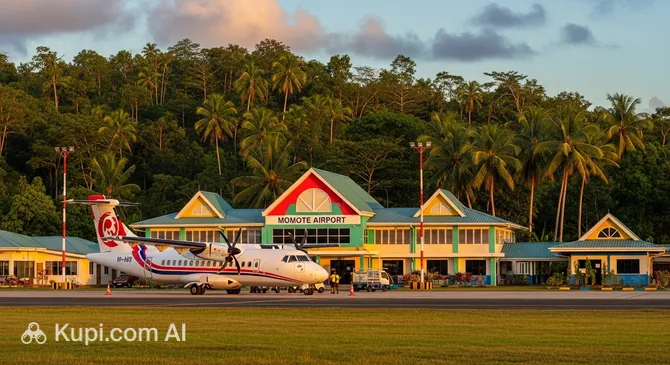
Momote Airport. Source: Kupi.com Binoculars

Momote Airport is not merely a transport hub, but a true gateway to the exotic world of the Admiralty Islands, where World War II history intertwines with tropical serenity. Located on the small island of Los Negros, this airport welcomes travellers with the unique architecture of its new terminal, shaped like a giant stingray. Following a recent large-scale reconstruction, the air harbour has transformed from a modest airfield into a modern hub, ready to welcome guests of Manus Province in comfort.

IATA CodeMAS
ICAO Code AYMO
City Lorengau (located on Los Negros Island)
Distance to centre ~24 km
Status Domestic
Annual Passengers No official data
ScheduleOnline board

Airport Features and Highlights

Momote Airport has undergone significant modernisation as part of the state aviation development programme and now offers passengers a qualitatively new level of service that stands out among many regional airports in the country.

Unique Terminal Design. The airport's main pride is the new passenger terminal, opened in 2022. The building is designed in the shape of a stingray — a symbol of the region's marine fauna. This is not only a functional structure but also an architectural landmark that immediately immerses tourists in the atmosphere of island life.

Modern Infrastructure. The renovated complex is equipped with everything necessary for waiting comfortably for a flight: a spacious departure hall with 139 seats, modern air conditioning systems, new check-in counters, and an automated baggage claim system. A VIP lounge is also provided for business travellers.

Technical Capabilities. The runway has been extended to 2010 metres and completely renovated. The airport is now capable of receiving jet liners such as the Boeing 737-800, ensuring more reliable and faster connections with the capital, Port Moresby, and other regions.

Historical Significance. The airport stands on the site of a legendary World War II airbase built by the US "Seabees" battalions. History enthusiasts will appreciate the fact that modern liners land exactly where military squadrons, which played a key role in the Battle of the Admiralty Islands, were once based.

Contact Information

If you need to contact the administration of Momote Airport (MAS), please use the following contact information. Please note that the airport is regional and is managed by the National Airports Corporation (NAC) of Papua New Guinea, so many inquiries are processed through their central office.

  • Official Website: Momote Airport does not have a separate website. Information about it is presented on the official portal of the managing company, National Airports Corporation (NAC): nac.com.pg.
  • Inquiry Service Phone: It is difficult to find a direct public phone number for Momote Airport. For operational questions, it is recommended to contact your airline directly or the NAC head office.
  • Airport Address: Momote Airport, Los Negros Island, Manus Province, Papua New Guinea. The airport serves the town of Lorengau.
  • Email: For general inquiries, you may use the contact email of the National Airports Corporation: info@nac.com.pg.
  • Social Media: Current news and updates can be tracked on the official NAC pages on social networks (e.g., Facebook), as Momote Airport does not have its own accounts.
  • Lost Luggage Information: For all issues related to lost or damaged luggage, you should contact the representative of the airline you flew with directly.
  • Passenger Support Contacts: Passenger support is primarily provided by air carriers. For general questions regarding airport operations, you can contact NAC via the contact form on their website.

How to Get to the Airport

Momote Airport (MAS) serves the town of Lorengau and the entire Manus Province in Papua New Guinea. It is located on the neighbouring island of Los Negros, approximately 20-25 km from the town. Given the remoteness of the region, the transport infrastructure has its peculiarities, and it is worth planning your trip to the airport in advance.

Taxi and Transfer. The easiest and most recommended way to get to the airport is to book a transfer. Most hotels and guest houses in Lorengau provide this service for their guests, which is the most reliable option. You will be picked up directly from your accommodation and delivered at the required time. You can also arrange a ride with local private drivers, but the cost is best discussed in advance. The journey by car from the centre of Lorengau to Momote Airport takes about 30-45 minutes.

Public Transport. The role of public transport is fulfilled by PMVs (Public Motor Vehicles) — local route taxis, usually in the form of minibuses or small trucks. This is the cheapest way to travel, but it is not suitable for travellers with large luggage and a tight schedule. PMVs do not have a strict schedule and depart as they fill up, and the trip may take significantly longer due to numerous stops along the way.

Car Rental and Parking. The possibility of renting a car in Lorengau is limited, and the service must be organised in advance through local tour agencies or hotels. This option is suitable for those planning to explore the island on their own. Momote Airport has a small unguarded car park where you can leave a car for a short time to drop off or pick up passengers. Long-term parking is not recommended.

Recommendations for Travellers. To arrive at the airport comfortably and on time, it is strongly recommended to arrange a transfer through your hotel. This will remove all worries about finding transport and help avoid unforeseen delays. The trip itself from Lorengau to the airport is very scenic, as the route passes over the bridge connecting Manus and Los Negros islands.

Terminals and Map

Momote Airport (MAS) is a small regional airport serving Manus Province. Its structure is extremely simple and intuitive, making navigation very easy even for first-time visitors.

The airport consists of one small terminal that handles all flights — both arrivals and departures. There is no separation into international and domestic sections, as the vast majority of flights are domestic. All infrastructure is located in one building, so transfers between terminals are not required.

The terminal layout is very straightforward. Upon entry, you immediately find yourself in the general area where the check-in counters are located. After check-in, passengers proceed to a small waiting area before the boarding gate. The arrivals area is equally compact and is located in the same building — after disembarking from the aircraft, passengers enter a small hall for baggage claim and then proceed immediately to the airport exit. All key points — from the entrance to the boarding gate — are within a few steps of each other.

Check-in and security screening procedures at Momote Airport are very quick due to the low passenger flow. Typically, all formalities take minimal time. Nevertheless, it is recommended to arrive at the airport approximately 60–90 minutes before departure to check in luggage and pass through security without haste. It is practically impossible to get lost in the airport, but staff are always ready to help and provide directions.

Airport History

The history of Momote Airport (MAS), the main air gateway to the town of Lorengau and Manus Province, dates back to World War II. Its foundation was not related to civil aviation — in 1942, it was built by Japanese forces as a military airfield. A key moment in its history was 1944, when, during the Battle of the Admiralty Islands, the airfield was captured and radically rebuilt by Allied forces. American engineering battalions significantly expanded and strengthened the runway, turning Momote into one of the most important airbases in the southwest Pacific at that time.

After the end of the war, the military base gradually lost its strategic importance and was converted for civil needs. This transition period marked a new era for the airport: it became a vital transport artery connecting the isolated island province of Manus with the main part of Papua New Guinea. For local residents, the airport turned into an indispensable hub, ensuring not only passenger transport but also the delivery of mail, medicines, and goods, and fostering connections with the rest of the world.

Throughout its post-war history, Momote Airport has repeatedly undergone modernisation to meet modern aviation standards. Reconstructions of the runway and passenger terminal have been carried out to ensure the ability to receive aircraft of the national carrier Air Niugini and other regional airlines. These improvements play a key role in supporting the local economy, serving administrative needs, and developing the tourism potential of the islands.

One of the most interesting facts about Momote Airport is its transformation from a purely military facility into a peaceful civil hub. Traces of its turbulent past can still be found in the vicinity in the form of war relics. Furthermore, it is curious that the airport is physically located on Los Negros Island, which is connected by a bridge to Manus Island, where the town of Lorengau is located. Thus, a trip from the airport to the town is a small journey between islands in itself.

Services and Facilities

Momote Airport (MAS) is a small regional air station serving Manus Province in Papua New Guinea. Given its size and remoteness, the range of services here is basic and aimed at satisfying the essential needs of travellers before departure or upon arrival.

Options for dining and shopping at the airport are quite modest. Typically, a small kiosk or café operates here, where you can purchase beverages, light snacks, and some locally made souvenirs. There are no full-service restaurants or duty-free shops. A general departure lounge is available for passengers waiting for flights; there are no special VIP halls here.

Modern amenities, such as public Wi-Fi or stationary charging stations for electronic devices, may be limited or unavailable. Travellers are advised to carry portable power banks. Financial services, including ATMs and currency exchange points, are not provided at the airport. It is best to handle all currency transactions in advance in the country's major cities.

Passengers with children and travellers with reduced mobility should contact their airline in advance to request assistance. Airport staff will provide basic assistance during boarding and disembarking. Specialised facilities, such as a mother and child room, are absent. There are no hotels within the airport building; the nearest accommodation options are in the town of Lorengau, accessible via transfer. Business services, including conference rooms, are not provided.

Where to Eat

When planning a departure from Momote Airport (MAS), it is important to correctly assess dining options. This is a small regional airport serving Manus Province in Papua New Guinea, so the choice of establishments here is quite limited and not comparable to major international hubs. There is no separation into terminals with separate food courts, and all services are concentrated in one main building.

Typically, one small kiosk or café operates at Momote Airport, located in the general area before security control. The assortment usually includes basic items for a quick snack: packaged snacks (crisps, biscuits), bottled soft drinks, and possibly simple hot coffee or tea. Do not expect full-service restaurants with hot meals and extensive menus. The opening hours of such a kiosk are usually tied to the flight schedule and may be limited.

Travellers with specific dietary requirements (vegetarians, vegans, as well as those requiring Halal or gluten-free options) are strongly advised to bring food with them. The best strategy would be to have a proper meal in the town of Lorengau before travelling to the airport and to stock up on your own snacks and water. This ensures that you will not go hungry while waiting for your flight.

Tips for Travellers

To ensure your journey through Momote Airport goes as smoothly as possible, take advantage of our tips. The airport serves the town of Lorengau and is a small regional hub, so many procedures here are simpler than in large international hubs.

Arrival Time and Check-in: Despite the modest size of the airport, it is recommended to arrive 60–90 minutes before the departure of a domestic flight. This time will be sufficient to check in, drop off luggage, and pass pre-flight screening without haste. Procedures here generally move faster than in major hubs, but always keep your passport and ticket ready.

Seat Selection and Hand Luggage: When travelling around the islands of Papua New Guinea, choose a window seat — you may be treated to stunning views of coral reefs and tropical landscapes. Regarding hand luggage, standard international rules apply: liquids in containers no larger than 100 ml, packed in a transparent bag, as well as a ban on carrying sharp objects and other dangerous substances.

Passengers with Connections: Momote Airport is rarely used for transit flights. If you have a connection planned, it will most likely be at a larger airport, such as Port Moresby. When checking in for the first flight, be sure to clarify whether you will need to collect and re-check your luggage at the transit point.

Customs Control: There is no customs control for domestic flights. However, strict rules regarding the import of food, plants, and animals apply when entering Papua New Guinea. Declare all such goods to avoid fines.

Saving Time and Money: The airport may have a limited selection of cafés and shops, so bring a water bottle (which can be filled after screening) and a light snack. It is also useful to carry some local currency (Kina) for small expenses. Pre-booked transfers or taxis will help save time upon arrival.

In Case of Flight Delay: Delays, especially due to weather conditions, are not uncommon in this region. Ensure your electronic devices are charged and bring a book or magazine. It is best to check flight status information directly with the airline representative, as electronic displays may be updated with a delay.

Reached the end of the page?

That means the route is fully explored