Support

Huanuco Airport

About the Airport

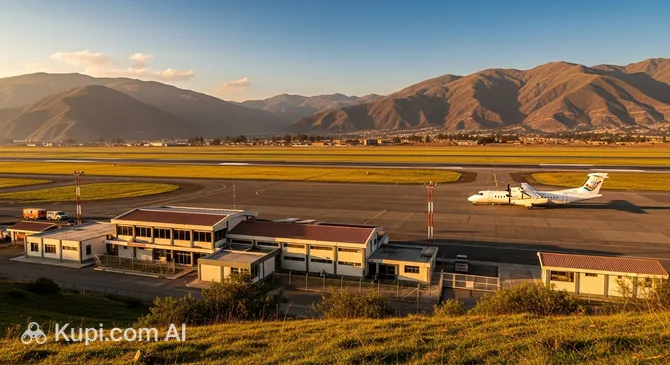
Huanuco Airport. Source: Kupi.com Binoculars
Huanuco Airport is not merely a transport hub, but a scenic aerial gateway into the heart of the central Peruvian Andes. Located in the Huallaga River valley, it welcomes travellers with breathtaking views of mountain peaks that seem to embrace the runway. This compact air terminal serves as the perfect starting point for exploring the "City of Eternal Spring" and the ancient mysteries of the Kotosh temple. From the very first moments of arrival, one can feel the calm and hospitable atmosphere of the region, which contrasts sharply with the hustle and bustle of capital city hubs.
IATA Code HUU
ICAO Code SPNC
City Huanuco
Distance to Centre ~4-6 km
Status Domestic
Annual Passengers Over 170,000
Schedule Check airline websites

Airport Features and Advantages

Despite its modest size, the David Figueroa Fernandini Airport plays a key role in the life of the region and offers a number of advantages for tourists.

Exceptional Accessibility. One of the main features of the airport is its proximity to the city. It is located just 4–6 kilometres from the main square of Huanuco (Plaza de Armas), allowing you to reach the centre by taxi or mototaxi in just 10–15 minutes. This saves travellers from long transfers and unnecessary expenses.

Scenic Approach. Flying into Huanuco is a visual adventure in itself. The aircraft descends into a narrow valley between high Andean ridges, revealing a stunning panorama of the Huallaga River and green mountain slopes. For lovers of beautiful photos, a window seat will be a true gift.

No Queues or Stress. Thanks to the low passenger traffic and compact terminal, all pre-flight formalities are completed very quickly. There are no confusing corridors or endless security queues here, making the beginning and end of your journey as comfortable and calm as possible.

Strategic Starting Point. The airport serves as a convenient hub not only for visiting Huanuco itself but also for trips to the jungles of Tingo Maria or to the high-altitude plateaus. Following the recent modernization of the runway, the airport has begun accepting more modern aircraft, ensuring a stable connection between the region and the country's capital.

Contact Information

Below is the main contact information for Huanuco Airport (HUU), also known as Alférez FAP David Figueroa Fernandini Airport. Please note that this is a regional airport, and some contact details may be general for all airports managed by CORPAC S.A.

  • Official Website: The airport does not have a separate website. It is managed by the state-owned company CORPAC S.A. Current information is published on their portal: www.corpac.gob.pe.
  • Information Desk Phone: You can contact the airport administration by phone: +51 (062) 513369.
  • Airport Address: Carretera Central Km 5.5, Huánuco, Perú.
  • Email: For general inquiries and appeals to the airport operator, use the email: atencionalciudadano@corpac.gob.pe.
  • Social Media: Official news and updates from the operator CORPAC S.A. can be found on their social media pages (e.g., Facebook).
  • Lost Luggage Information: For all issues related to lost or damaged luggage, you should contact the airline directly whose services you used. Airport staff do not handle luggage tracing.
  • Passenger Support Contacts: For assistance with tickets, flight check-in, or schedules, please contact your airline. For questions regarding airport infrastructure, please call the number listed above.

How to Get to the Airport

Getting to the airport of Huanuco (IATA: HUU) is quite simple, as it is located just a few kilometres from the centre. The main modes of transport here are taxis, mototaxis, and public transport in the form of "colectivo" vans, which are characteristic of Peru. The trip from the city centre to the airport usually takes no more than 10-15 minutes, depending on traffic conditions.

The most convenient and fastest way to get to the airport is by taxi or mototaxi. A taxi ride will cost approximately 10–15 Peruvian Soles (PEN) and provides maximum comfort, especially if you are travelling with luggage. You can order one at your hotel or hail one on the street. Mototaxis (three-wheeled motorized rickshaws) are a cheaper and more exotic option for travelling light; the cost will be around 5–7 Soles. Important tip: always agree on the price with the driver before starting the trip, as meters are rarely used here.

For budget travellers, there is the option to travel by "colectivo" — local shared taxis. These are minibuses or passenger cars plying specific routes and departing as they fill up. The trip will cost only 1–2 Soles, making this the most economical method. However, it can be inconvenient with a lot of luggage and requires more time waiting for transport.

If you prefer independence in your movements, you can rent a car at one of the rental agencies in the city. This will give you the freedom not only for the trip to the airport but also for exploring the picturesque surroundings of Huanuco. There is parking at the airport where you can leave your car, but it is worth remembering that the number of spaces may be limited as the airport is small.

When planning a route through Peru, it is useful to know about other airports in the region that may be a convenient alternative. The nearest is Tingo Maria Airport (TGI), located approximately 69 km away. Other options include Anta Airport (ATA) at a distance of about 164 km and Jauja Airport (JAU), 225 km from Huanuco. Further away are Mazamari (Manuel Prado) Airport (MZA) and the larger Captain Rolden Airport (PCL) in Pucallpa, which serves a significantly larger number of flights.

Terminals and Map

Huanuco Airport (HUU) is a small regional air terminal distinguished by its compactness and simple structure. All its operations are concentrated in a single passenger terminal, which serves both departing and arriving flights. This significantly simplifies navigation for travellers.

The airport layout is extremely simple. The terminal building is a single space where departure and arrival zones are located under one roof. Upon entering the terminal, you find yourself in the main hall with check-in counters. After passing check-in and pre-flight security, passengers proceed to a small waiting room with a boarding gate. Since there is only one terminal, there is no need to transfer between different buildings.

Due to its modest size and low passenger traffic, all formalities at Huanuco Airport are completed quite quickly. Usually, check-in and security take no more than 30-40 minutes. Nevertheless, the standard recommendation is to arrive at the airport 1.5-2 hours before departure to calmly check your luggage and wait for boarding.

Navigating the terminal is very easy. All key points — from check-in counters to the boarding gate — are within a few steps of each other. Signage is intuitive, but even without it, it is practically impossible to get lost here. This simplicity makes Huanuco Airport a convenient and calm point for starting or ending your journey through Peru.

Airport History

The history of Huanuco Airport (HUU), officially known as FAP Lieutenant David Figueroa Fernandini Airport, is a story of gradual development and transformation into a key transport hub for the homonymous region of Peru. Although the exact founding date is not widely known, its creation was dictated by the need to connect this difficult-to-access mountain region with the rest of the country.

The airport is named after David Figueroa Fernandini, a pilot of the Peruvian Air Force and a local hero, highlighting his importance to the region. For decades, it functioned as an airfield with a dirt runway, which imposed restrictions on the types of aircraft it could accept and made flights highly dependent on weather conditions. Operating in such conditions was one of the main challenges of its early history.

A key moment in the airport's development was the large-scale reconstruction completed in the mid-2010s. During these works, the runway was fully paved, the passenger terminal was modernized, and infrastructure was improved. This event was a real breakthrough: it allowed for the reception of more modern aircraft, such as the Airbus A319, and ensured the regularity of flights, which significantly increased transport accessibility to Huanuco.

Today, Huanuco Airport does not break records for passenger traffic, but its main achievement is the stable and reliable connection of the region with Lima and other cities. It plays an important role in the development of tourism, opening access for travellers to the Kotosh archaeological complex and other attractions, as well as supporting local business. Its history is a vivid example of how the modernization of a small air harbour can radically change the life of an entire region.

Services and Amenities

Huanuco Airport (HUU) is a small regional airport serving domestic flights in Peru. The terminal infrastructure is focused on meeting the basic needs of passengers before departure and upon arrival. Given its compact dimensions, the range of services here is standard for airports of this type and differs from large international hubs.

Dining and Shopping. Opportunities for shopping and dining at the airport are limited. Typically, there is a small kiosk or café where you can buy light snacks, sandwiches, sweets, and drinks. There are no full-service restaurants, so it is recommended to eat beforehand in the city of Huanuco. Souvenir shops may also be absent or offer a very modest assortment.

Waiting Areas, Wi-Fi, and Charging. A general waiting hall is available for passengers. Specialized VIP halls or business lounges are not provided at Huanuco Airport. Access to free Wi-Fi may be limited or unavailable, so it is better to rely on mobile data. The number of outlets for charging electronic devices may also be small, so having a portable power bank will be very useful.

Financial and Medical Services. There are no bank branches, ATMs, or currency exchange points in the terminal. All financial transactions, including money exchange, should be done in advance in the city. There is also no permanent medical centre, but airport staff are ready to provide first aid and call specialists if necessary.

Additional Amenities. Services for passengers with children, such as play areas or mother and child rooms, are not provided. Passengers with reduced mobility are recommended to notify their airline in advance regarding the need for escort and assistance for comfortable movement through the airport. There are no hotels on the airport territory; the nearest accommodation options are in the city of Huanuco. Business centres and conference rooms are also absent from the airport infrastructure.

Dining

Dining options at Huanuco Airport (HUU) correspond to its status as a small regional hub. You will not find a wide variety of restaurants here as you would in international hubs, however, a few cosy cafés and kiosks offer everything necessary to have a snack before departure or after arrival.

It is important to know that practically all food outlets are concentrated in the public zone (landside), before passing security and ID checks. Therefore, if you plan to have a full meal, it is better to do so before entering the departure zone. In the sterile zone (airside), the choice is usually limited to a small kiosk with drinks and packaged snacks or vending machines.

For a quick snack, local appetizers, which can often be found in the airport's main café, are perfect. Look out for empanadas — popular Peruvian pastries with various fillings, for example, meat or cheese. You can also buy sandwiches, pastries, and, of course, the famous national drink Inca Kola here, to enjoy the taste of Peru one last time.

One should not count on a full hot lunch of several courses at the airport; the menu is focused on quick and filling snacks. regarding dietary restrictions, the choice for vegetarians usually comes down to pastries with cheese or vegetable sandwiches. Specialised vegan, gluten-free, or Halal dishes are generally not represented here. Passengers with strict dietary requirements are advised to bring food with them.

Prices in airport establishments are predictably higher than in the city but remain within reasonable limits. The opening hours of cafés and kiosks are directly tied to the flight schedule — they open shortly before the first departure and close after the departure of the last aircraft, so passengers always have the opportunity to drink coffee or buy water.

Travel Tips

To ensure your journey through the airport of Huanuco city goes as smoothly as possible, take advantage of these tips. The airport mainly serves domestic flights, which makes it quite simple to navigate, but preparation is never superfluous.

Arrival at the Airport and Check-in. For domestic flights within Peru, it is recommended to arrive at the airport approximately 2 hours before departure. This time is sufficient to pass check-in and security without rushing. If possible, complete online check-in — this will save you time. Security checkpoints at regional airports are usually less busy than at major hubs, but safety rules are standard.

Seat Selection and Hand Luggage. Given Huanuco's location in the mountains, we strongly advise choosing a window seat. Views of the Andes during takeoff and landing can be one of the most memorable impressions of the trip! Standard rules for hand luggage apply here too: liquids in containers up to 100 ml (packed in a transparent bag), and no sharp objects or flammable substances.

Transfers and Customs. Huanuco Airport is not a transit hub. If you have a connecting flight (for example, in Lima), be prepared for the fact that you will likely have to collect your luggage and check it in again for the next flight. Customs control is only passed when entering the country. Since Huanuco receives mainly domestic flights, there is no customs here. You will go through all formalities at your first international airport of arrival in Peru.

Savings and Unforeseen Situations. To save money, order a taxi from and to the airport via trusted apps or arrange a transfer with your hotel in advance. Prices for food and drinks in small airports can be inflated, so bring an empty water bottle (you can fill it after security) and a light snack. In case of a flight delay, have a portable charger, a book, or downloaded movies with you, as leisure opportunities in the terminal are limited. Contact your airline representative to find out about the flight status and your rights to compensation or rebooking.

Reached the end of the page?

That means the route is fully explored