Support

Tingo Maria

About the Airport

Tingo Maria Airport is not just a runway, but a true gateway to the very heart of the Peruvian Amazon. Located in a picturesque valley, it welcomes travellers with lush greenery and the promise of incredible adventures. It is from here that the introduction to the amazing city of Tingo Maria, known as the "Door to the Amazon", and the unique nature of Peru begins. Landing here is a breathtaking spectacle in itself, opening a panorama of the "Sleeping Beauty" mountain range.
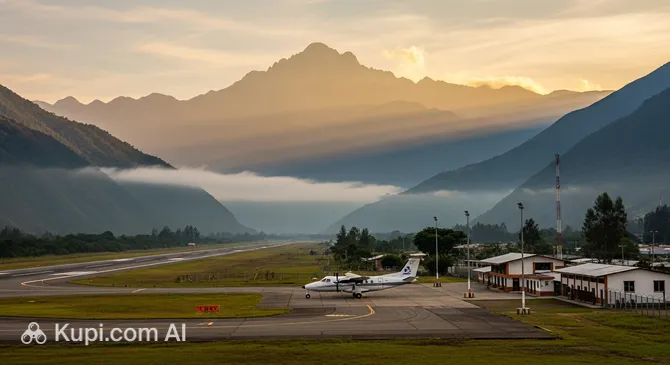
Tingo Maria. Illustration.
Source: Kupi.com AI
PropertyValue
IATA CodeTGI
ICAO CodeSPGM
CityTingo Maria
CountryPeru
TimezoneAmerica/Lima
ScheduleOnline Timetable

The main advantage of Tingo Maria Airport is its compactness and convenient location. Thanks to its small size, all procedures from check-in to baggage claim are very quick, without the long queues and bustle characteristic of major aviation hubs. The airport is located just a few minutes' drive from the city centre, allowing travellers to dive into exploring local beauties almost immediately after arrival.

The airport is a key transport hub for eco-tourists. It mainly serves domestic flights, connecting the region with the country's capital. Despite the modest infrastructure, which includes a small waiting area, it is the ideal starting point for trips to Tingo Maria National Park, the famous Cave of Owls (Cueva de las Lechuzas), and numerous waterfalls. Please note that due to the mountainous climate, flight schedules may change, so always check information with your airline.

Contact Information

Here is the essential contact information for Tingo Maria Airport (TGI), which you may need when planning your journey to this region of Peru:

  • Official Website: The airport is managed by the state-owned company CORPAC S.A. Current information about its operations is usually published on the operator's general portal: www.corpac.gob.pe.
  • Information Desk Phone: +51 62 562081. Please keep in mind that this is a local number; international rates may apply when calling from abroad.
  • Airport Address: Aeropuerto de Tingo María, Carretera a Monzón, distrito de Rupa-Rupa, provincia de Leoncio Prado, Huánuco, Perú.
  • Email: For general enquiries, you can use the central email of the CORPAC operator: atencionalciudadano@corpac.gob.pe.
  • Social Media: The airport does not have separate social media pages. It is recommended to follow news on the official channels of the operator CORPAC S.A.
  • Lost Luggage Information: For all issues related to lost or damaged luggage, you must contact the airline you travelled with directly.
  • Passenger Support Contacts: To resolve issues regarding tickets, schedules, or flight check-in, please contact your airline's support service. For general questions about terminal operations, you may call the phone number listed above.

How to Get to the Airport

Tingo Maria Airport is located in close proximity to the city of the same name, making the journey to the terminal quick and convenient. Regardless of your budget and preferences, you will easily find a suitable way to get to your departure point.

The most popular and convenient option is a taxi or its local variety, the mototaxi. These agile three-wheeled motorcycles have become a true hallmark of many cities in Peru. The trip from the centre of Tingo Maria to the airport usually takes no more than 10–15 minutes. The cost of the trip is low, but we strongly recommend agreeing on the price with the driver in advance to avoid misunderstandings.

For budget travellers, public transport is a good choice. Minibuses, known as colectivos, run along the city's main streets, and some of them pass near the airport. This is the cheapest way to travel, but it may not be very convenient if you have a lot of luggage. Also, note that you will likely have to walk a short distance from the stop to the terminal entrance.

If you value freedom of movement, you can use a car rental service. This is particularly relevant for those planning to explore the famous Tingo Maria National Park and other natural beauties of the region. The airport usually has parking where you can leave a rented or private vehicle.

Many hotels and guest houses offer their guests an organised transfer service. This is a comfortable and reliable way to get to the airport without unnecessary hassle, especially if you have an early flight. We recommend checking the availability and cost of such a service with your hotel in advance.

When planning your trip, it is useful to know about alternative air hubs. The closest airport to Tingo Maria is Huanuco Airport (HUU), located approximately 69 km away. A larger transport hub is Captain Rolden Airport (PCL) in Pucallpa, which is about 187 km away and often serves as a starting point for travels in this part of the Amazon region.

Terminals and Map

Tingo Maria Airport (TGI) is a small and compact air station serving domestic flights within Peru. It consists of one terminal, which makes navigation extremely simple and intuitive. This terminal simultaneously functions as both the departure and arrival zone, providing all necessary services for passengers.

The airport layout is very simple. Upon entering the building, you immediately find yourself in the general area where airline check-in counters are located. After receiving a boarding pass and checking in luggage, passengers proceed to the security screening area, behind which lies a small waiting hall with a boarding gate. The arrival area is equally compact: after disembarking the plane, passengers enter the baggage claim hall, which is just a few steps from the main airport exit. All functional zones — check-in, security, waiting, and baggage claim — are located within walking distance of each other.

Thanks to the airport's modest size and the small number of flights, passing through all pre-flight formalities usually takes minimal time. Queues for check-in and security screening are typically small or non-existent. Nevertheless, it is recommended to arrive at the airport approximately 1–1.5 hours before departure to complete all procedures without haste.

The main advice for navigation at Tingo Maria Airport is not to worry about getting lost. The entire infrastructure is located in one small building, and signage and staff will help orient you if questions arise. Transitions between zones take literally a couple of minutes, making travel through this airport as comfortable as possible.

Airport History

The history of Tingo Maria Airport (TGI) began on 15 October 1942, when it was officially opened as part of a national plan to develop aviation connectivity in Peru. Its creation was of strategic importance as it allowed the isolated Huanuco region, located in the so-called "high jungle" (Selva Alta), to be connected with the capital and other parts of the country.

From 1965, management of the airport passed to the state company CORPAC S.A., which is responsible for most of Peru's air hubs. This marked the beginning of its gradual development. However, at the end of the 20th century, during a difficult period for the region, regular commercial air service was temporarily disrupted, but with the stabilisation of the situation, it resumed, giving impetus to the growth of tourism.

The most significant stage in the airport's development occurred in the 2010s. As a result of a large-scale reconstruction completed in 2016, the air harbour was radically transformed. An asphalt runway 2,500 metres long was built, along with a modern passenger terminal and a new control tower. These improvements allowed for increased safety levels and the accommodation of modern aircraft types.

Today, Tingo Maria Airport serves as a modern aerial gateway, playing a key role in the economy and tourist appeal of the region. It ensures stable connections with Lima and serves as a starting point for travellers eager to see Tingo Maria National Park and the famous "Sleeping Beauty" mountain. Thanks to its location, the airport offers passengers unforgettable views of the jungle and mountains right during landing.

Services and Amenities

Tingo Maria Airport (TGI) is a small regional airport serving domestic flights. The level of comfort and range of services here are basic and correspond to its size. Passengers should prepare in advance for the fact that the choice of amenities will be limited.

Within the terminal, you will find a small kiosk or café where you can buy light snacks, sandwiches, sweets, and beverages. This is a good place to have a bite before departure. There is no assortment of duty-free shops or major retail outlets, so it is better to make all necessary purchases in the city.

Opportunities for rest and work at the airport are minimal. Specialised VIP halls or business lounges are not provided here. Free Wi-Fi may be unavailable or work intermittently, and the number of sockets for charging electronic devices is limited. It is recommended to carry a portable charger. Bank branches, ATMs, and currency exchange points are generally absent from the airport building, so financial matters should be settled in advance in Tingo Maria.

Basic services are provided for passengers with special needs. The airport is equipped for access by passengers with reduced mobility; however, it is recommended to contact your airline well in advance for assistance with boarding and disembarking. There are no special playrooms for children, but standard restrooms are available. A first aid post can provide basic assistance for minor ailments.

There are no hotels directly on the airport grounds, but plenty of accommodation options can be found in the city of Tingo Maria itself, which is a few minutes' drive away. Conference rooms and business centres for holding business meetings are not equipped at the airport.

Where to Eat

Tingo Maria Airport (TGI) is a small regional air hub, so the choice of catering establishments here is quite limited. Passengers should plan their meals in advance, especially if there is a lot of time before departure. Nevertheless, basic options for a snack are provided at the airport.

Usually, a small café or snack bar operates in the airport's single terminal. Typically, such establishments are located in the public area before security control (landside), making them accessible to both departing passengers and those seeing them off. Opening hours are most often tied to the flight schedule: the café opens a few hours before departure and closes shortly after the last plane departs.

The assortment mainly includes beverages, light snacks, and pastries. Here you can buy coffee, tea, soft drinks, including the popular Inca Kola in Peru, as well as sandwiches, biscuits, and crisps. Sometimes the menu may include local specialities, for example, empanadas (pastries with filling) or other simple baked goods. This is a good option for a quick snack to satisfy light hunger.

Passengers with special dietary requirements (vegetarians, vegans, as well as those looking for gluten-free or halal meals) are strongly recommended to bring food with them. Finding suitable options at Tingo Maria Airport is practically impossible. For a full lunch or dinner, it is better to choose one of the numerous cafés in the city of Tingo Maria before travelling to the airport. Prices in the airport café are moderate but may be slightly higher than in the city.

Travel Tips

Travelling through Tingo Maria Airport is your first step to discovering the amazing nature of the high-altitude jungles of Peru. To make your experience as comfortable as possible, use these tips. Tingo Maria Airport is small and serves mainly domestic flights, so processes here are faster than in major hubs. It is recommended to arrive 1.5–2 hours before departure. This time will be sufficient for check-in, baggage drop-off, and security control without unnecessary haste.

Check-in and security procedures at this airport usually proceed quite quickly. However, always keep your ID and boarding pass ready. The staff are polite and ready to help, but knowing a few phrases in Spanish may simplify communication. To save time, complete online check-in if your airline offers this option.

When choosing a seat on the plane, prefer a window seat. Flights to and from this region open up breathtaking views of the "Sleeping Beauty" (Bella Durmiente) mountain range and the endless expanses of the Amazon jungle. The views during takeoff and landing can become one of the most vivid impressions of the trip.

Hand luggage rules are standard: liquids in containers up to 100 ml must be packed in a transparent bag, and sharp or cutting objects are prohibited. Pay special attention to the transport of agricultural products. Peru has strict controls (SENASA) on the movement of fruits, vegetables, and plants between regions to prevent the spread of pests. Clarify the rules before putting an exotic fruit in your bag.

Since Tingo Maria Airport mainly serves flights to Lima, most transfers take place there. If you have a connecting flight in Lima, especially an international one, allow at least 3–4 hours for the transfer. You will likely need to collect your luggage, check in again for the next flight, and pass all necessary controls.

Customs control is only undergone by passengers on international flights. Since you will arrive in Tingo Maria on a domestic flight (most likely from Lima), you will pass all customs formalities at the first airport of arrival in the country. On domestic flights, the main focus is on the agricultural control mentioned above.

To save money, book flight tickets in advance, especially during the high tourist season. For trips around the city and to the airport, use local transport — mototaxis. This is an inexpensive and authentic way of getting around that will allow you to save money compared to a regular taxi. Always agree on the trip price in advance.

Flight delays in this region sometimes happen due to weather conditions, especially during the rainy season. Be prepared for this: keep a portable charger, a book, or downloaded films with you. In case of a delay, contact your airline representative for information on the flight status and your rights as a passenger. Infrastructure in the small airport is limited, so it is better to have a bottle of water and a light snack with you.

Attractions

Reached the end of the page?

That means the route is fully explored