Support

Tawitawi Airport

About the Airport

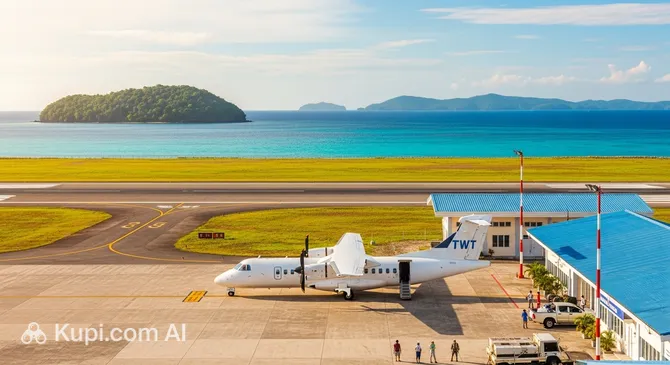
Tawitawi Airport. Source: Kupi.com Binoculars

Tawitawi Airport, also known as Sanga-Sanga Airport, is not just a transport hub but a true aerial gateway to one of the most mysterious and picturesque corners of the Philippine archipelago. Located on an island connected by a bridge to the city of Bongao, it welcomes travellers with incredible views of turquoise lagoons and emerald islands even during the aircraft's descent. Despite its status as a small provincial airfield, this air harbour possesses a special charm, where tropical relaxation is combined with its vital role as a connecting link for the country's southernmost province.

IATA Code TWT
ICAO Code RPMN
City Bongao
Distance to Centre ~6 km
Status Domestic
Annual Passengers Over 120,000
Schedule Daily morning flights

Features and Advantages of the Airport

The main pride of Tawitawi Airport is its recently modernised runway. Thanks to large-scale reconstruction and the extension of the runway, the airport is now capable of receiving medium-haul jet liners such as the Airbus A320, which has significantly improved flight comfort compared to the small turboprop aircraft used previously. This has opened the region to a greater number of tourists and improved transport accessibility.

Another distinctive feature is the incredibly scenic approach for landing. Flying over the Sulu Archipelago gives passengers the opportunity to see unique coral reefs and traditional water villages from a bird's-eye view. The terminal itself, though compact, is organised simply and logically, allowing formalities to be completed in a matter of minutes without the tiring queues typical of capital hubs.

Contact Information

Finding accurate and centralised contact information for small regional airports like Tawitawi (TWT) can be challenging, as they often do not have dedicated public services. Below is the main available information and recommendations for communication.

  • Official Website: As a rule, such airports do not have their own website. The airport is managed by the Civil Aviation Authority of the Philippines (CAAP), and general information can be found on their portal.
  • Inquiry Phone Number: A direct public enquiry number for the airport is not provided. For all flight-related questions, it is recommended to contact the airline you are flying with directly.
  • Airport Address: Sanga-Sanga Airport, Bongao, Tawi-Tawi, Philippines.
  • Email: There is no dedicated email address for passengers. Use your airline's contact details for booking or flight enquiries.
  • Social Media: The airport does not maintain official pages on social networks.
  • Lost Luggage Information: If your luggage has been lost or damaged, you must contact your airline's representative at the airport. It is the air carrier that is responsible for handling such requests.
  • Passenger Support Contacts: Assistance to passengers is provided by airline staff at check-in counters or boarding gates.

How to Get to the Airport

Getting to Tawitawi Airport (Sanga-Sanga Airport, TWT), which serves the city of Bongao, is quite simple due to its close proximity to the main districts. The transport system here reflects the local flavour of the Philippines and differs from what one might find in major metropolises.

Public Transport

The main and most popular mode of transport in Bongao is tricycles. These are motorcycles with an attached passenger cabin that operate throughout the city. You will easily find them on any street. A ride on a tricycle is not only a budget-friendly but also an authentic way to travel. Simply hail a vacant tricycle and tell the driver "airport". There are no classic bus routes, trains, or metro in Bongao.

Taxi and Transfer

There are no standard taxi services with meters here. The role of taxis is performed by the same tricycles or private cars/vans that can be hired for an individual trip. Always agree on the fare with the driver before the trip begins. The most convenient and reliable option for tourists is to order a hotel transfer. Most hotels offer this service for a fixed fee or even include it in the accommodation cost. It is recommended to book a transfer in advance to avoid unnecessary hassle upon arrival or departure.

Car Rental

Major international car rental companies are not represented in Bongao. However, one can find local private offers for renting a car or van, most often with a driver. This option is suitable for those travelling in a group or with a large amount of luggage who value comfort. Self-driving can be difficult due to the peculiarities of local traffic and road conditions.

Travel Time and Cost

The trip from the centre of Bongao to the airport usually takes from 15 to 30 minutes depending on the departure point and traffic conditions.

  • Tricycle: The most budget-friendly option. The cost of the trip will be low, but it needs to be agreed upon in advance. Be sure to carry small cash in Philippine Pesos (PHP).
  • Private Transfer/Rental: The cost will be significantly higher but still affordable. This is a good choice for a comfortable trip without transfers.

Parking at the Airport

Tawitawi Airport has a simple open-air parking area. It is suitable for short-term parking if someone is dropping you off or picking you up. Leaving a car for a long period is not recommended, as there are no specialised guarded car parks.

Terminals and Map

Tawitawi Airport (TWT), also known as Sanga-Sanga, is a small regional airport serving the province of Tawi-Tawi in the Philippines. Its structure is very simple and straightforward, making navigation for passengers as easy as possible.

The airport operates one passenger terminal, which handles both departing and arriving flights. The terminal building is compact, and all key zones are within walking distance of each other. There is no complex layout or need for transfers between different buildings, as all operations are concentrated under one roof.

The Departure Zone and Arrival Zone are separated but located in the same building. The process for departing passengers is as follows:

  • The entrance to the terminal leads to the airline check-in counters.
  • After receiving a boarding pass and checking in luggage, passengers undergo pre-flight security screening.
  • Beyond the security checkpoint is a small waiting hall (pre-departure area) where one can wait for boarding.

The arrival zone is a separate small hall where passengers enter after disembarking from the aircraft. Luggage claim is organised very simply here — it is either brought out manually or delivered on a small belt.

Given the modest size of the airport and the low passenger traffic, check-in and security procedures usually proceed quite quickly. Nevertheless, it is recommended to arrive at the airport at least 1.5–2 hours before departure to complete all formalities without rushing. Navigation through the terminal is intuitive, and you are unlikely to get lost. In case of questions, airport staff are always ready to assist.

Airport History

The history of Tawitawi Airport, also known as Sanga-Sanga Airport, is closely intertwined with key events of the 20th century. Its story begins during World War II, when it was built by the Imperial Japanese Army as a strategic airfield. This military past laid the foundation for the future aviation hub, which today serves as the gateway to the southernmost province of the Philippines.

A pivotal moment in the airport's history was April 1945, when the airfield was captured and restored by American forces. After the war ended, the facility was transferred to civil administration and began to play a decisive role in connecting the remote archipelago with the rest of the country. For decades, it functioned as a small airfield capable of receiving only light propeller aircraft, which limited its potential.

A real breakthrough in the airport's development occurred in the 2010s thanks to a massive modernisation programme. Within the framework of the project, the runway was significantly lengthened and strengthened, which became the main achievement in its modern history. This reconstruction allowed the airport to receive larger modern liners, such as the Airbus A320. The terminal building and navigation equipment were also updated, which substantially increased the level of safety and comfort for passengers travelling to the city of Bongao and its surroundings.

Interesting fact: despite its modest size, Tawitawi Airport is one of the few airports in the country with such a rich military past that has successfully transformed into an important civil facility. Today, it is not just a transport hub, but a symbol of the region's development and openness, contributing to the growth of tourism and trade in this unique and picturesque part of the Philippine archipelago.

Services and Amenities

Tawitawi Airport (TWT), also known as Sanga-Sanga Airport, is a small regional airport serving the province of the same name. Given its size and status, the range of services and amenities for passengers is basic and focused on meeting essential travel needs. When planning a trip through this airport, it is worth preparing in advance for the fact that its infrastructure differs significantly from major international hubs.

Dining, Shopping, and Waiting Areas. At Tawitawi Airport, you will not find large restaurants or fast-food chains. Options for a snack are usually limited to small kiosks or stalls where you can buy drinks, snacks, and perhaps local souvenirs. There are no specialised duty-free shops here. A general hall is provided for waiting for flights, and VIP lounges or lounges for business class passengers are absent.

Technical and Financial Services. Access to Wi-Fi in the terminal building is generally not provided. The number of electrical outlets for charging devices is very limited, so it is strongly recommended to bring a portable charger (power bank) with you. There are no bank branches or currency exchange points at the airport. All financial transactions, including money exchange, should be done in advance in larger cities.

Additional Amenities and Accommodation. The airport does not possess specialised amenities such as playrooms for children or business centres with conference rooms. Passengers with disabilities are recommended to contact the airline in advance to organise necessary assistance. There are no hotels within the airport territory; the nearest accommodation options can be found in the city of Bongao, which is the administrative centre of the province. A basic medical post may be available for first aid, but for serious cases, it is necessary to go to city medical institutions.

Where to Eat

Tawitawi Airport (TWT), also known as Sanga-Sanga, is a small regional airport, so the choice of dining establishments here is limited and reflects local flavour rather than the variety of major international terminals. Here you will not find chain restaurants or large cafes, but you will be able to have a snack before departure while experiencing authentic cuisine.

The main part of the food offerings is concentrated in the main and only terminal, usually in the general area before passing security control (landside). These are several small kiosks and eateries in the `carinderia` format (traditional Philippine cafe), offering simple and inexpensive dishes. Since Tawi-Tawi is located in a region with a predominantly Muslim population, most available dishes are Halal.

In the menu, you can usually find:

  • Quick Snacks: Local pastries, fried bananas (`banana cue`), chips, and other snacks.
  • Full Meals: Simple rice dishes with chicken or fish, which are cooked on-site. This is a good option for a hearty lunch.
  • Drinks: Bottled water, carbonated drinks, and local coffee.

Prices at Tawitawi Airport are very democratic and oriented towards locals. Specialised vegetarian, vegan, or gluten-free dishes are practically impossible to find. Passengers with strict dietary restrictions are strongly recommended to bring food with them. Establishments operate in accordance with the flight schedule — opening before the first departures and closing after the departure of the last aircraft.

Travel Tips

Travelling through Tawitawi Airport (Sanga-Sanga Airport), serving the picturesque city of Bongao, can be a simple and pleasant start or end to your adventure in the Philippines. Here are a few tips that will help you navigate this small but important regional airport.

Arrival Time at the Airport: Since this is a small airport serving mainly domestic flights, there are no long queues here like in major international hubs. Nevertheless, it is recommended to arrive at Tawitawi Airport at least 1.5–2 hours before your flight departure. This time will be sufficient to calmly complete check-in, drop off luggage, and pass security control without unnecessary rushing.

Check-in and Security: Check-in and security control procedures here are standard but usually proceed faster. Most airlines offer online check-in, which can save you time. When passing through screening, be ready to present electronic devices and remember the rules for carrying liquids. Friendly staff are always ready to help if you have questions.

Customs Control: An important point for travellers — since Tawitawi Airport serves predominantly domestic flights, customs control for passengers travelling within the country is not conducted here. This procedure is relevant only when crossing international borders. Thus, after security screening, you can proceed immediately to the departure waiting area, which significantly simplifies and speeds up pre-flight formalities.

Seat Selection on the Plane: Flights to this region are famous for incredible views. If you want to enjoy the panorama of the Sulu Archipelago with its turquoise waters and scattering of islands, choose a window seat. For greater comfort and the ability to stand up freely during the flight, an aisle seat is suitable.

Hand Luggage: Standard security rules apply here as well. Liquids can be carried in containers up to 100 ml, packed in a single transparent bag. Sharp objects, flammable substances, and other dangerous materials are prohibited. Always check your airline's rules, as there may be additional restrictions on the weight and size of hand luggage.

Passengers with Connections: Tawitawi Airport is not a major transit hub. Most passengers fly here as a final destination. If you have a self-transfer to another flight, ensure you have enough time (at least 3-4 hours) between flights to collect luggage, check in again, and pass all pre-flight formalities.

Saving Time and Money: To save money, book tickets in advance and watch for airline promotions. Save time by checking in online. To avoid excess baggage fees, travel light or pay for baggage allowance in advance on the air carrier's website. There may be a limited selection of food and drinks at the airport, so you can bring a small snack and an empty water bottle, which can be filled after passing control.

Flight Delays: In case of a flight delay or cancellation, first contact your airline representative. They will provide up-to-date information and explain your rights to compensation (for example, vouchers for food or drinks). It is useful to have a portable charger, a book, or headphones in your hand luggage to brighten up the wait.

Reached the end of the page?

That means the route is fully explored