Support

Mactan-Cebu International Airport

About the Airport

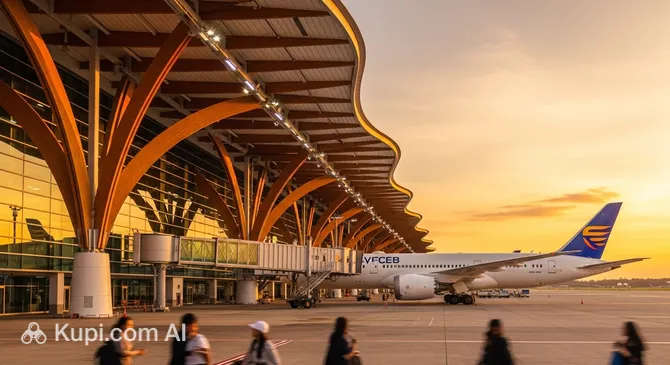
Mactan-Cebu International Airport. Source: Kupi.com Binoculars

Mactan-Cebu International Airport is not just a transport hub, but a true "resort gateway" to the Philippines, where the feeling of relaxation embraces you from the very first seconds. Instead of the usual glass and concrete, a tropical bungalow atmosphere reigns here: high wooden arches, warm lighting, and a design inspired by ocean waves. It is the country's second-busiest airport, which, thanks to its unique architecture and the friendliness of the staff, turns waiting for a flight into a pleasant part of the journey, setting a relaxed rhythm for the entire vacation.

The airport is located on Mactan Island and serves as the main hub for the Central Visayas region, opening the way for tourists to famous beaches, waterfalls, and diving spots. Terminal 2, opened in 2018, became an architectural sensation: its structure resembles the inverted hulls of traditional "bangka" boats, and the interiors are decorated with natural materials. Everything here is designed to minimize stress: from intuitive navigation to cozy relaxation zones where you can forget the hustle and bustle and enjoy the anticipation of adventure.

IATA Code CEB
ICAO Code RPVM
City Lapu-Lapu (serves Cebu City)
Distance to center ~15 km
Status International
Annual Passengers Over 11.3 million (2024)
Schedule Available on the official website

Airport Features and Highlights:

The world's first "Resort" airport. The design of Terminal 2 has won numerous international awards. Its main feature is the massive glued laminated timber arches, creating a sense of spaciousness and lightness. Rattan and mother-of-pearl are used in the finishing, reminiscent of the region's natural riches, while sunlight penetrating through panoramic windows creates a warm golden hue inside.

"Silent Airport" Concept. Mactan-Cebu adheres to a noise reduction policy (Silent Airport). Voice announcements are kept to a minimum and relate only to emergency situations. All flight information is promptly updated on numerous display boards, allowing passengers to enjoy silence or calm background music without constant audio alerts.

Ideal location for tourists. The airport is located on Mactan Island, which itself is a popular resort area. Many luxury hotels and beaches are located just a 15–20 minute drive from the terminal. This means you can take a dip in the sea almost immediately after landing without spending hours on a long transfer.

Filipino Hospitality. The atmosphere of friendliness is felt in everything here: from the smiles of the staff to their uniforms, designed in a light resort style. The airport offers a wide selection of shops with local souvenirs, including famous pearls and Cebu delicacies, allowing you to buy gifts at the last minute in a comfortable setting.

Contact Information

For your convenience, we have gathered the main contact information for Mactan-Cebu International Airport (CEB).

  • Official Website: You can always find the most up-to-date information on flights, rules, and available services on the official airport website.
  • Help Desk Phone: For immediate information and inquiries, you can call the main number: +63 32 340 2486.
  • Airport Address: Lapu-Lapu Airport Rd, Lapu-Lapu City, 6016 Cebu, Philippines. The airport is located on Mactan Island, near Cebu City.
  • Email: For general questions and feedback, you can write to the customer support address: customerservice@gmcac.ph.
  • Social Media: It is convenient to follow news and important announcements on the official airport page on Facebook.
  • Lost Luggage Information: If your luggage was lost during the flight, you must first contact your airline's representative. If you lost personal items within the terminal, contact the airport's Lost & Found service.
  • Passenger Support Contacts: Information desks are located in the departure and arrival halls. Airport staff are ready to help with navigation and answer any questions that may arise.

How to Get to the Airport

Mactan-Cebu International Airport (CEB) is located on the island of Mactan, which is connected to the main part of Cebu City by two bridges. Because of this, as well as heavy traffic, travel time from the city center to the terminal can vary greatly. On average, the trip takes from 45 minutes to 1.5 hours, but during peak hours, it may take longer. When planning your departure, always allow extra time for the road.

The most budget-friendly way to get to the airport is to use the modern and comfortable MyBus buses. They operate on a fixed route, with one of the main stops located at the large SM City Cebu shopping mall. This is an excellent option for travelers without a large amount of luggage. The buses are equipped with air conditioning, and the fare is low. However, it is worth remembering that they, like cars, depend on the traffic situation.

Taxi is a more convenient and faster way to get to the airport. In Cebu City, there are both regular city taxis (white) and accredited airport taxis (yellow), which usually cost slightly more. The most popular and convenient option is to book a car via the Grab app, which is widely used in the Philippines. This allows you to know the cost of the trip in advance and avoid the need to haggle. A taxi ride will cost significantly more than the bus but ensures "door-to-door" comfort.

If you plan to travel actively around the island or prefer complete freedom of movement, you can rent a car. Counters of international and local rental companies are located directly at the airport. For those arriving in their own or rented car, the airport provides paid parking offering both short-term and long-term parking options.

The main advice for those flying out of Mactan-Cebu Airport is to leave early. The traffic situation in the city is unpredictable, and it is better to spend an extra hour in the comfortable terminal than to miss your flight. Although Cebu Airport is a key transport hub for the central part of the country, for travel to neighboring islands, you can consider flights to other airports in the region, for example, to Bohol-Panglao to get to Bohol Island, or to Dumaguete Airport on Negros Island.

Terminals and Map

Mactan-Cebu International Airport (CEB) has two passenger terminals, making its structure clear and convenient for travelers. Each terminal performs a distinct function: one serves domestic flights, and the other serves international flights, which helps passengers orient themselves easily upon arrival.

Terminal 1 (T1) is designated exclusively for domestic flights. It is an older but modernized building that provides comfortable service for passengers traveling within the Philippines. Here you will find check-in counters for local airlines, security screening zones, and waiting lounges. Despite its compactness, the terminal offers all necessary services, including cafés and shops.

Terminal 2 (T2) is a modern and architecturally expressive complex that receives and dispatches all international flights. Its calling card is the impressive wave-shaped roof and high arches made of glued laminated timber, creating a sense of space and the atmosphere of a tropical resort. Departure and arrival zones are conveniently separated on different levels: check-in and passport control for departing passengers are on the upper floor, while the arrival zone with baggage claim is on the lower floor.

Movement between terminals is well organized. A free shuttle bus runs for passengers. Additionally, the terminals are connected by a covered pedestrian walkway, a stroll along which will take about 5–10 minutes. This is a convenient option if you have little luggage and do not want to wait for transport.

When planning your time, allow a sufficient margin for completing all procedures. For domestic flights in Terminal 1, it is recommended to arrive 2 hours before departure. For international flights in Terminal 2, it is better to arrive 3-4 hours in advance, especially during peak hours, to pass through check-in, immigration control, and security screening without rushing. Navigation in both terminals is simplified thanks to clear signs in English and information desks.

Airport History

The history of Mactan-Cebu International Airport is a journey from a military airbase to one of the most modern and beautiful airports in Southeast Asia. Its story began in the 1950s when the Mactan US Air Force Base was built on Mactan Island. After the withdrawal of American troops in the 1960s, the base was converted into a civilian airport to serve the growing flow of tourists and business travelers to Cebu City and the central region of the Philippines.

A key stage of development was the construction of the first passenger terminal. However, with the growing popularity of Cebu as a tourist destination, the airport faced the need for large-scale expansion. A real breakthrough in its history was the opening of Terminal 2 in 2018. This project was not just an expansion—it completely changed the look and status of the airport. The terminal, designed for international flights, received numerous architectural awards for its unique design with high timber arches and a wave-shaped roof, creating the atmosphere of a tropical resort.

The airport also played an important role in critical moments of the country's history. For example, in 2013, it became a key logistics center for international humanitarian missions following the devastating Typhoon Haiyan (known in the Philippines as "Yolanda"), coordinating aid delivery to affected regions.

Today, Mactan-Cebu International Airport is not just a transport hub, but a true landmark of the region. An interesting fact: it is often called the "world's first resort airport" thanks to its design, abundance of greenery, and relaxing atmosphere that greets travelers immediately upon arrival. Modernization continues, and the airport is constantly improving to match the status of one of the best in the world.

Services and Amenities

Mactan-Cebu International Airport (CEB) offers passengers a wide range of services and amenities to make their wait for a flight as comfortable as possible. In the airport terminals, you will find numerous restaurants and cafés where you can try both local Filipino dishes and familiar international snacks. For those who want to dedicate time to shopping, Duty Free shops are open, as well as souvenir stalls where you can purchase gifts and goods for the road.

For the convenience of travelers, free Wi-Fi is available throughout the airport, and numerous charging stations for electronic devices are equipped in the waiting halls. Financial matters can be resolved at bank branches, using ATMs or currency exchange points, which are conveniently located in arrival and departure zones.

Passengers wishing to relax in a quieter environment can use the services of premium lounges (VIP lounges). Here they offer snacks, drinks, fresh press, and comfortable places for work or relaxation. For business travelers, conference rooms and business centers may be available, allowing you to hold a meeting or work in silence.

The airport cares for all categories of passengers. For travelers with children, mother and child rooms are provided, and for people with disabilities, a barrier-free environment has been created, including ramps, elevators, and specially equipped restrooms. If necessary, you can request an escort service. In case of feeling unwell, passengers can contact the medical center, which operates around the clock.

If you have a long layover or an early flight, you will easily find a suitable option for an overnight stay. Several hotels are located in the immediate vicinity of the airport, offering comfortable rooms and, in some cases, free transfers to the terminals.

Where to Eat

Waiting for a flight at Mactan-Cebu International Airport (CEB) is an excellent opportunity to refresh yourself before flying. The airport offers diverse dining options, from quick snacks to full-service restaurants located both in Terminal 1 (domestic flights) and the futuristic Terminal 2 (international flights).

For those who want to enjoy local cuisine one last time before departure, the airport offers establishments with authentic dishes. This is your chance to try the famous Cebuano lechon (traditional roast) or other classic dishes of the Philippines. Most full-service restaurants with local cuisine are located in the area before security control (landside), which gives more choice to those seeing off passengers and arriving travelers.

If you prefer something more familiar or are in a hurry, numerous international fast-food chains and coffee shops are at your service. Establishments like Starbucks, Burger King, and The Coffee Bean & Tea Leaf can be found in both zones—before (landside) and after (airside) passing passport control. They are ideal for having a coffee, eating a sandwich, or a burger.

For a full lunch or dinner, restaurants in the public area (landside) are best suited, where the selection is usually wider. Here you can find establishments offering not only Filipino but also Asian and European cuisine. After passing control (airside), the selection is somewhat smaller, but there are still cafés and lounges where you can comfortably spend time waiting for boarding.

Regarding special dietary needs, finding certified Halal or gluten-free dishes might be challenging. However, many establishments are ready to accommodate: coffee shops have plant-based milk, and restaurants can prepare a vegetable dish upon request. We recommend clarifying the ingredients of dishes with the staff. The price range varies from budget options in food courts to average and above-average in full-service restaurants.

Most establishments operate according to the flight schedule. In international Terminal 2, many cafés and eateries are open around the clock or until the last flight. If you are short on time, the best choice would be to get takeaway food from one of the fast-food chains. If time permits, enjoy a leisurely dinner at one of the restaurants in the airport's public zone.

Travel Tips

To ensure your journey through Mactan-Cebu International Airport, serving Cebu City and the entire region, goes smoothly and without unnecessary stress, use these proven tips.

Arrival Time: The airport can be quite busy, especially during peak hours. It is recommended to arrive 2-3 hours before domestic flights and 3-4 hours before international ones. This will give you a sufficient margin of time for check-in, baggage drop, and passing security control without rushing.

Check-in and Control: The easiest way to save time is online check-in for the flight. If you are traveling only with carry-on luggage, this allows you to head straight to the security screening zone. Keep your passport and boarding pass ready, as you may be asked to present them at various stages.

Seat Selection: Want to enjoy stunning views of the numerous islands of the Philippines from a bird's eye view? Choose a window seat. If freedom of movement and the ability to stretch your legs are more important to you, your choice is an aisle seat.

Carry-on Luggage: Standard security rules apply here as well. All liquids, gels, and aerosols must be in containers of no more than 100 ml and packed in a single transparent resealable bag. Sharp objects, weapons, and flammable substances are prohibited. Always check the specific rules of your airline before departure.

For Transfer Passengers: Mactan-Cebu Airport has two terminals: T1 serves mainly domestic flights, and T2 serves international ones. If you have a connecting flight, check in advance if you need to collect your luggage and check it in again, and from which terminal your next flight departs. Shuttles run between the terminals.

Customs Control: Upon arrival on an international flight, you will need to fill out a customs declaration. Honestly declare all imported goods to avoid unnecessary questions and possible fines. If you are unsure whether an item is subject to declaration, it is better to clarify this with a customs officer.

Saving Time and Money: Bring an empty reusable water bottle with you—after security screening, you can fill it at drinking fountains. Food prices at the airport are generally higher, so a budget-friendly option is to have a snack before arriving at the airport. When leaving the airport, compare prices for taxis and ride-hailing services to choose the most advantageous option.

In Case of Flight Delay: Remain calm and contact your airline's representative counter for current information. Depending on the cause and duration of the delay, you may be provided with vouchers for food or drinks. Clarify what rights are guaranteed to you by the airline's rules and your fare.

Reached the end of the page?

That means the route is fully explored