Support

Roxas City Airport

About the Airport

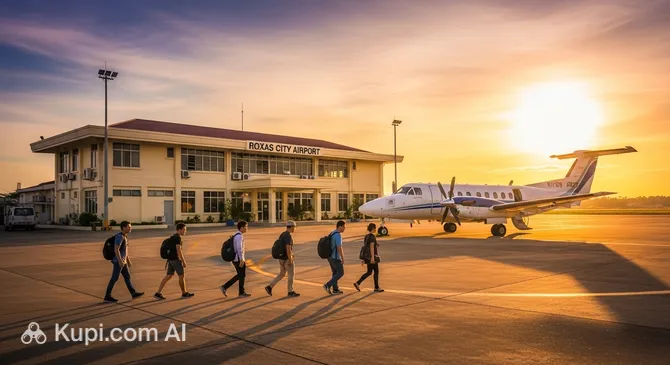
Roxas City Airport. Source: Kupi.com Binoculars

Welcome to the aerial gateway of the "Seafood Capital" of the Philippines! Roxas Airport (RXS) is not just a transit point, but your first introduction to the hospitable province of Capiz, where the fresh sea breeze is felt immediately upon stepping off the plane. This cosy regional hub, surrounded by tropical greenery, offers travellers a relaxed atmosphere that contrasts sharply with the hustle and bustle of capital hubs. It is from here that your immersion into the world of mystical legends, pristine white beaches, and gastronomic discoveries of Panay Island begins.

IATA Code RXS
ICAO Code RPVR
City Roxas City
Distance to Centre 2–3 km
Status Domestic
Annual Passengers ~280,000
Schedule Flight Schedule

Features and Advantages of the Airport

The main advantage of Roxas Airport is its incredible proximity to the city. It is located practically within the limits of Roxas City, making the journey to the centre or your hotel exceptionally short and affordable. Unlike many other airports where transfers take hours, here you will find yourself in the heart of the action just 10–15 minutes after collecting your luggage. This is particularly appreciated by tourists looking to save time on logistics.

The airport is distinguished by its compactness and lack of queues. Thanks to the modest passenger flow and efficient organization of space, all procedures — from check-in to boarding — are completed very quickly. The staff here are known for their friendliness and willingness to help, creating a sense of home-like comfort. Recent modernisation, which allowed for the reception of night flights, has made the air harbour even more convenient for travel planning, opening up new slots for arrival and departure in the evening.

Contact Information

  • Official Website: Roxas Airport (RXS) is managed by the Civil Aviation Authority of the Philippines (CAAP). The airport does not have its own separate website, but general information can be found on the CAAP portal.
  • Help Desk Phone: For information regarding flights and airport services, you may call: +63 (36) 621-6277. Please note that the line may be busy.
  • Airport Address: San Roque Street, Roxas City, Capiz Province, 5800, Philippines.
  • Email: There is no official public email address for general inquiries. It is recommended to use the telephone for communication.
  • Social Media: At present, Roxas Airport does not have official pages on social media. News can be followed on the resources of the Civil Aviation Authority of the Philippines.
  • Lost Luggage Information: For all issues related to lost or damaged luggage, please contact your airline's representative directly at the airport. Airport services do not handle baggage tracing.
  • Passenger Support Contacts: For general questions regarding terminal operations, please contact the help desk at the number provided. If your query is related to tickets, schedules, or carriage regulations, please contact your airline directly.

How to Get to the Airport

Roxas Airport (RXS) is conveniently located just a few kilometres from the city centre of Roxas City, making the journey there quick and simple. Regardless of your budget and preferences, you will easily find a suitable way to reach the terminal.

Public Transport. The most popular, authentic, and budget-friendly mode of transport in this part of the Philippines is the tricycle (a motorcycle with a passenger sidecar). A trip from the city centre to the airport by tricycle will take just 10-15 minutes and costs very little. It is best to agree on the price with the driver in advance, although fares for short distances are usually quite standard. This is an excellent choice for solo travellers and couples with light luggage.

Taxi and Transfer. For greater comfort, especially if you have many suitcases or are travelling with family, it is better to choose a taxi. There are several taxi services operating in the city that offer trips by meter or at a fixed rate. The ride will cost more than a tricycle but ensures comfort and air conditioning. Also, many hotels offer airport transfer services, which can be booked in advance for maximum convenience.

Car Rental and Parking. If you plan to explore Capiz province on your own, you can rent a car. Several rental agencies have representatives in the city. The airport has a parking area where you can leave your car for a short or long period, although the number of spaces may be limited.

It is worth noting that although Roxas Airport serves domestic flights, many travellers arrive in the region via larger international airports, such as Kalibo International Airport (KLO) or Mandurriao Airport (ILO) in Iloilo, and from there travel to Roxas City by bus or van, which takes several hours.

Terminals and Map

Roxas Airport (RXS) is a small regional airport, so its structure is very simple and convenient for passengers. There is only one passenger terminal functioning here, which serves both arriving and departing flights. Thanks to this, navigating the airport is very easy, and the risk of getting lost is minimised.

The terminal layout is extremely logical. Upon entering the building, you immediately find yourself in the common area where airline check-in counters are located. After receiving a boarding pass and checking in luggage, passengers undergo pre-flight security screening and enter the departure lounge. The arrival area is located in another part of the same building and consists of a small baggage claim area and an exit to the city. All key points — from the entrance to the boarding gate — are within walking distance of each other.

Since there is only one terminal, transfers between zones are not required. Check-in and security procedures at Roxas Airport usually proceed quite quickly, as it is not overloaded with a large number of flights. Typically, all formalities take no more than 30-40 minutes. Nevertheless, it is recommended to arrive at the airport in advance, approximately 1.5–2 hours before your flight departure, to avoid rushing.

To navigate the airport, simply follow the few signs available. The main advantage of the terminal is its compactness. You will not have to walk long distances from the check-in counter to the gate or from the baggage claim area to the taxi stand. This simplicity makes travelling through Roxas City airport maximally comfortable, especially for those who dislike the bustle of major aviation hubs.

Airport History

The history of Roxas City Airport (RXS) begins during the Second World War, making it one of the oldest in the Philippines. It was built in 1943 by the US Army Corps of Engineers as a military airfield and was originally named Moret Field. During the war, it played a vital strategic role, serving as a base for American fighters and bombers participating in operations against Japanese forces.

After the war ended, the airfield was handed over to the government of the Philippines. In 1949, it was officially converted into a national civil airport and renamed in honour of Manuel Roxas — the first president of the independent Republic of the Philippines and a native of this city. This was a key moment in its transformation from a military facility into an important transport hub for civil aviation.

Over the decades, Roxas Airport has been modernised repeatedly to meet the growing needs of the region. Significant stages of reconstruction occurred in the 2000s, and in the late 2010s, a large-scale infrastructure improvement programme was launched. Under this programme, works were carried out to expand and modernise the passenger terminal, as well as to extend the runway. The main goal was to ensure the capability to accommodate larger modern aircraft, such as the Airbus A320, which significantly expanded the tourism and economic prospects of Capiz province.

Today, Roxas Airport not only serves domestic flights, connecting the province with Manila and other major cities, but is also an important gateway for tourists wishing to explore the culture and natural riches of the region known as the "Seafood Capital of the Philippines". Its rich military past and successful development into a modern civil airport make its history truly interesting.

Services and Facilities

Roxas Airport (RXS) is a small regional airport serving domestic flights. The infrastructure here is quite compact but offers a basic set of services necessary for a comfortable wait before departure.

Dining and Shopping: Within the terminal, there are several small eateries and cafes where you can buy drinks, light snacks, and local cuisine. There are also souvenir shops offering handmade goods, delicacies, and memorable gifts to bring back from your trip.

Lounges and Wi-Fi: There are no specialised VIP lounges at the airport; however, a general waiting hall is available for all passengers. Access to Wi-Fi may be limited or provided for a fee. The number of power outlets for charging electronic devices may also be small, so it is recommended to carry a portable power bank.

Financial Services: ATMs for cash withdrawals may be available in the terminal. Currency exchange points are generally absent, as the airport primarily serves domestic routes. It is best to exchange money in advance in major cities or banks.

Additional Services:

  • For passengers with reduced mobility, ramps and specially equipped restrooms are provided. Assistance with boarding and disembarking can be requested in advance through the airline.
  • There is a medical station at the airport for first aid in emergencies.
  • There are no dedicated play areas for children, but some restrooms may have mother-and-child rooms with changing tables.

Accommodation and Business: There are no hotels directly on the premises of Roxas Airport, but many accommodation options can be found in Roxas City itself, which is a few minutes' drive away. Conference rooms and business centres are not provided in the terminal.

Where to Eat

Roxas Airport (RXS), serving Roxas City and Capiz province, is a compact regional airport. Dining options here correspond to its size — they are modest but sufficient for passengers to have a snack and drink coffee before departure. Do not expect a large food court or fine dining restaurants here as you would in major international hubs.

All catering establishments are concentrated in the main and only terminal, primarily in the public area before security control (landside). Usually, these are a few small cafes or food kiosks offering a standard selection: soft drinks, bottled water, coffee, sandwiches, crisps, pastries, and other light snacks. Simple hot local dishes can also be found here.

Since Capiz province is known as the "Seafood Capital of the Philippines", local eateries sometimes offer seafood dishes or popular Filipino snacks. This is a great opportunity to try something authentic, even if it is a simple but tasty snack. Most establishments are oriented towards quick service, which is convenient for passengers with limited time.

Specialised dietary options, such as vegetarian, vegan, gluten-free, or Halal dishes, are likely to be unavailable at Roxas Airport. Travellers with strict dietary restrictions are advised to eat beforehand or bring food with them. Prices in local cafes are usually moderate and not significantly inflated compared to the city.

Opening hours of establishments are generally tied to the flight schedule. They open a few hours before the first morning departure and close after the last evening flight departs. This ensures that passengers on any flight can at least purchase drinks and snacks.

Travel Tips

To ensure your journey through Roxas City airport goes as smoothly as possible, take advantage of these tips. Roxas Airport (RXS) is a small regional hub serving mainly domestic flights, making it quite convenient to navigate.

Arrival Time and Check-in. For domestic flights within the Philippines, it is recommended to arrive at the airport 1.5–2 hours before departure. This is enough time to check in luggage, pass security control, and reach the boarding gate without rushing. Check-in and screening procedures here usually go faster than in major international airports, but it is better to have a buffer of time. To save time, use online check-in if your airline provides this option.

Seat Selection and Hand Luggage. If you want to enjoy scenic views of the islands during take-off or landing, choose a window seat. An aisle seat is suitable for those who value the ability to stand up freely and exit the plane first. Standard rules for hand luggage apply here: liquids in containers up to 100 ml must be packed in a transparent bag. If you are carrying local delicacies, such as dried fish or specific fruits, it is better to clarify the carriage rules with the airline or check them in as luggage to avoid issues due to strong odours.

Transfers and Customs Control. Roxas Airport mainly serves direct flights to Manila and Cebu, so international transfers here are unlikely. If you have a connecting flight at another, larger airport, allow sufficient time for the transfer, especially if a change of terminal is involved. You will most likely undergo customs and passport control at the first international airport of arrival in the country. In Roxas, these procedures do not exist for domestic flights.

Economy and Flight Delays. To save money, you can bring a light snack and an empty water bottle, which can be filled after passing security. Cafe options in a small airport may be limited. In the event of a flight delay, remain calm and contact your airline representative for information. Given the modest size of the terminal, the range of entertainment is limited. Ensure your electronic devices are charged, and have a book or downloaded movies with you to pass the waiting time.

Reached the end of the page?

That means the route is fully explored