Support

Kostroma Airport

About the Airport

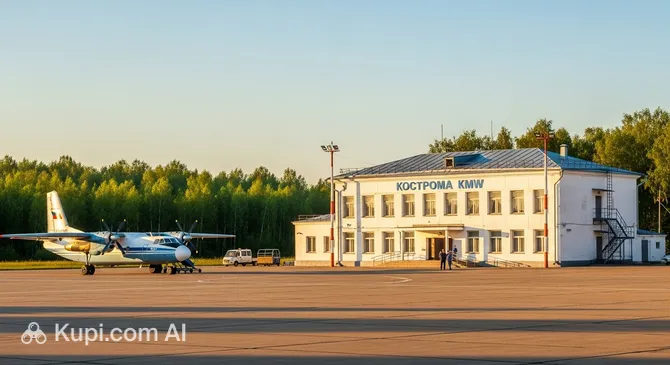
Kostroma Airport. Source: Kupi.com Binoculars

Kostroma Airport (Sokerkino) is not just a transport hub, but a true portal into the history of national aviation, preserving its unique, almost "vintage" atmosphere. This small and homely air terminal welcomes guests to the ancient Russian city, offering a rare opportunity to travel on legendary aircraft that are rarely seen on regular flights today. Located practically within the city limits, it allows travellers to forget about long transfers and begin exploring the pearl of the "Golden Ring" almost immediately after landing.

IATA Code KMW
ICAO Code UUBA
City Kostroma
Distance to Centre 6 km
Status Domestic
Annual Passengers ~8,000 (based on 2022 data)
Schedule Please check the official website

Features and Advantages of the Airport:

Kostroma Airport stands out against modern giants due to its intimacy and special local colour. The main "highlight" of the air harbour is the "Kostroma Aviation Enterprise" based here, which operates flights on reliable An-26 turboprop aircraft. For many tourists, a flight on such a liner becomes a separate adventure and a chance to gain new impressions from air travel.

Thanks to the compact size of the terminal, all pre-flight procedures take a minimum amount of time — there are practically no queues here. Logistics are also maximally convenient: a public transport stop is within walking distance of the entrance, and a taxi ride to the city's main attraction — the Fire Watchtower — will take no more than 15–20 minutes.

Contact Information

  • Official Airport Website: kostroma-avia.ru
  • Inquiry Service Phone: +7 (4942) 49-22-13
  • Airport Address: 120 Kostromskaya St., Kostroma, 156012
  • Email: koao@bk.ru (reception), perevozki@kostroma-avia.ru (transport service)
  • Lost Luggage Information: +7 (4942) 48-14-97 (transport organisation service)
  • Passenger Support Contacts: +7 (4942) 51-73-22 (ticket office and booking), +7 (4942) 49-22-13 (inquiry)

How to Get to the Airport

Due to the fact that the airport is located within the city limits (Sokerkino district), getting to it is much easier and cheaper than to most capital city air hubs. There is no need to adjust to the schedule of high-speed airport trains — the trip will take very little time, whichever method you choose.

Public Transport

There is no metro in Kostroma, but the ground transport network is well developed. Regular city buses run to the airport. The stop is simply called "Airport" (Aeroport), and it is located literally 200 metres from the terminal building.

  • Buses: Travellers most often use routes No. 13 (goes through the city centre, from the Solnechny district) and No. 15 (from the Panovo district). Buses No. 21 and 99 also travel in this direction.
  • Travel Time: From the central Susaninskaya Square, the journey will take about 25–35 minutes, taking stops into account.
  • Cost: The ticket price is standard for city transport (about 30–35 rubles). Payment is possible both in cash and by bank card.

Taxi and Transfer

This is the most convenient and fastest way to get to the location, especially if you are travelling with luggage. Popular aggregators (for example, Yandex Go) and local dispatch services operate in the city.

  • Travel Time: You can drive from the city centre in 15–20 minutes, provided there is no serious traffic.
  • Cost: The trip will be quite budget-friendly — on average from 200 to 400 rubles, depending on the time of day and demand.

Personal Car and Parking

If you prefer to travel by your own car or rent a vehicle, orient yourself towards Kostromskaya Street. The air terminal is located directly by the road, so it is difficult to miss.

The parking zone is located right in front of the airport building. Given the intimate nature of the air harbour, there are no huge multi-level car parks here. The parking lot is a small open area. As a rule, leaving a car for a short time to drop off passengers is possible for free or for a nominal fee (we recommend checking current rates at the entrance with the security service, as rules may change).

Alternative Airports Nearby

Since Kostroma Airport receives a limited number of flights, tourists often use neighbouring cities as transit points, getting to Kostroma from there by bus or train. The nearest major transport hub is Yaroslavl (Tunoshna Airport), located less than 60 km away.

Travellers can also consider flight options through Ivanovo Airport (about 100 km) or Vologda Airport. For residents of distant regions, flights to Cherepovets or the large international airport Strigino in Nizhny Novgorod may be convenient, from where you can continue the journey by land.

Terminals and Map

Kostroma Airport is, perhaps, one of the most cosy and understandable air hubs for a passenger. There are no confusing labyrinths of corridors, multiple floors, or complex transition systems here. The air terminal complex consists of one passenger terminal, located in a historic single-storey building. This compact structure serves all domestic flights, both for departure and arrival.

Terminal Map and Navigation

Navigating inside the terminal is incredibly simple: all key zones are within visual range of each other. Entering the building through the central entrance, you almost immediately find yourself in the general hall, where the check-in counter and security screening area are located. Navigation signs are not even required here — the passenger's route is intuitively clear and linear:

  • Check-in Zone: Located right in the main hall. Due to the small number of flights, large queues rarely accumulate here.
  • Waiting Zone: Located after passing pre-flight security. This is a small room with seating, from where boarding takes place.
  • Arrival Zone: There is no separate complex sector for arrivals. After exiting the aircraft, passengers proceed to the baggage claim area, which is also located most conveniently for a quick exit to the city.

Service Features and Transfers

Since there is only one terminal, there are no transfers between buildings. One of the colourful features of Kostroma Airport is the absence of jet bridges ("sleeves") and apron buses for most flights. Most often, passengers, having passed the boarding pass check, walk to the aircraft on foot accompanied by aviation security staff. This adds a special romance of small aviation to the start of the journey.

Procedure Times

The main advantage of compactness is speed. Unlike large hubs, you do not need to allocate hours for formalities here.

  • Check-in and Security: Usually take from 10 to 20 minutes. However, check-in closes strictly according to the schedule (usually 40 minutes before departure), so it is not worth being late.
  • Baggage Claim: The process of issuing suitcases happens very quickly after the aircraft lands, as the distance from the board to the terminal is minimal.

Recommendations for Passengers

Despite the relaxed atmosphere and lack of queues, it is recommended to arrive at the airport approximately 1–1.5 hours before departure. This will allow you to calmly check in your luggage and pass security without rushing. Note that the infrastructure inside the "sterile area" (after security) is quite modest, so if you need specific goods or pharmaceutical products, it is better to purchase them in the city in advance.

Airport History

The history of Kostroma Airport is a fascinating chronicle of the development of civil aviation in the very heart of Russia. The official birth date of the air harbour is considered to be 1944. This event was not accidental: it coincided with the formation of the Kostroma Region, which required reliable communication with remote district centres, often cut off from the regional capital by impassable forests and swamps.

The first pages of the chronicle were written at the airfield located in the area of the current Mira Avenue. Legendary Po-2 biplanes were based here. However, the city grew rapidly, and in the 1950s, the aviation detachment changed its address, moving to its modern location — in the place called Sokerkino. From this moment, an era of active development began: the fleet was replenished with An-2 and Yak-12 aircraft, and the route network covered the entire region with a dense web of regular flights.

The Golden Era and Times of Trial

The most important stage of modernisation was the construction of an artificial runway. This engineering solution took the airport to a new level, allowing it to receive more serious equipment — Yak-40 and L-410 aircraft. Kostroma received direct air connections with Moscow, Leningrad, and other key cities of the Soviet Union. In those years, life here was bustling: the intensity of local aviation flights was so high that the airport was rightfully considered the main transport gateway of the region.

In the difficult 1990s, which became fatal for many small airfields in the country, the Kostroma Aviation Enterprise showed surprising resilience. Thanks to the efforts of the team and regional support, the airport not only survived but also retained the status of a state enterprise, preserved the flight personnel and technical base, while others turned into warehouses or trading platforms.

The modern history of the airport, which began in the 2010s, was marked by large-scale reconstruction. Major repairs were carried out on the runway, lighting equipment was updated, and the facade of the air terminal was renovated. Remarkably, with all the updates, the management carefully preserved the historical appearance and atmosphere of the terminal, which today is its main highlight.

Interesting Facts and Achievements:

  • Living History of Aviation: Kostroma is one of the rare places on the planet where reliable Soviet An-26 aircraft are still operated on regular passenger flights (specifically to St. Petersburg). For aviation travellers, a flight on such a liner is a unique chance to touch the "golden age" of national aviation.
  • Screen Star: Thanks to its authentic exterior and interior, which has preserved the spirit of the mid-20th century, the airport often becomes a filming location. Historical films and series are shot here, where it is required to recreate the atmosphere of a provincial Soviet airfield without using sets.
  • Geographical Curio: The airport inherited the name "Sokerkino" from a nearby village. And although urban development has long absorbed this settlement, the historical name is firmly entrenched for the air harbour in people's memory and aviation directories.
  • Rescue Service: Throughout all decades of operation, the airport remains a crucial base for air ambulance services. Helicopters flying out of Sokerkino save hundreds of lives annually, evacuating patients from the most inaccessible corners of the Kostroma Region.

Services and Amenities

The infrastructure of Kostroma Airport (Sokerkino) fully corresponds to its status as a regional air hub with low passenger traffic. Here you will not find multi-storey shopping galleries or food courts familiar to capital hubs. The set of services is minimal but quite sufficient for comfortably waiting for a flight, considering that pre-flight procedures take place very quickly here.

Dining and Shops

Gastronomic opportunities in the terminal are limited. A small buffet operates in the terminal building, where passengers can have a snack before departure. The assortment usually includes tea, coffee, soft drinks, pastries, chocolate, and light snacks. There are no full-service restaurants with hot meals inside.

Duty Free shops and large souvenir shops are absent. A small assortment of travel goods (water, press) can be found at a kiosk or buffet. If you plan to purchase famous Kostroma souvenirs (cheese, linen, or jewellery), we recommend doing this in the city in advance.

Waiting Lounges and VIP Services

A general waiting hall is available for all passengers, located in the "sterile" zone after passing security. This is a small room with chairs.

For those who value increased comfort and privacy, the airport offers the services of a VIP Lounge (often referred to as the Hall for Officials and Delegations). The service is paid and includes:

  • A separate comfortable hall with soft furniture;
  • Passing check-in and security screening out of the general queue;
  • Delivery to the aircraft board on separate transport (or priority boarding).

Communication and Finances

  • Wi-Fi and Charging: The public Wi-Fi network may work unstably or be absent. It is recommended to rely on mobile internet, as the airport is located within the city limits and mobile operator coverage is excellent here. There are few power outlets for charging gadgets in the general hall, so it is better to have a charged power bank with you.
  • ATMs: An ATM (usually Sberbank) may be located in the terminal building, but it is recommended to ensure you have cash in advance. There are no full-fledged bank branches or currency exchange points in the terminal.

Medical Services

A health post operates at the airport, where qualified personnel are ready to provide first aid in case of illness or an emergency situation before departure.

Passengers with Children

There is no specialised mother and child room or play area in the terminal due to its compact size. However, thanks to the absence of crowds and queues, waiting with children passes quite calmly. Airport staff, as a rule, treat passengers with little ones with understanding, trying to speed up the document processing.

Passengers with Reduced Mobility

The historic single-storey terminal building is convenient because it completely lacks stairs and lifts, which simplifies movement. However, specialised high-tech equipment (ambulifts) for boarding small aircraft like the An-26 may not be available. Boarding and disembarking of passengers with reduced mobility are carried out with the help of airport staff.

Important: you should inform the airline or airport staff about the need for assistance in advance (at least 48 hours) so that comfortable accompaniment can be organised for you.

Hotels and Business Services

There are no hotels directly on the airport territory, and there is no acute need for them. Thanks to the location within the city limits, the journey to the nearest hotels in Kostroma takes only 10–15 minutes by taxi.

Conference halls and business centres are also absent in the terminal. For business meetings and negotiations, it is recommended to use the infrastructure of hotels in the city centre.
Where to Eat

The gastronomic map of Kostroma Airport (Sokerkino) is as concise and cosy as the terminal itself. Passengers accustomed to huge food courts at international hubs should adjust their expectations in advance: here you will not find chain coffee shops, fine dining restaurants, or gastropubs. The food system at the airport is arranged on the principle of "necessary and sufficient" for a short wait for a flight.

Cafes and Food Points

One main catering point operates in the single passenger terminal. This is a classic airport buffet, preserving the atmosphere of the good traditions of national aviation.

  • Location: The buffet is located in the general zone (landside), before passing pre-flight security. This means that both departing passengers and those seeing them off can use it.
  • Menu: The assortment consists of simple and understandable items. Here you can order hot tea or instant coffee, purchase soft drinks, juices, and water. Food usually includes fresh pastries (pies, buns), sandwiches, chocolate, cookies, and light snacks (chips, croutons).
  • Opening Hours: The establishment opens according to the flight schedule. As a rule, the buffet starts working 1.5–2 hours before departure and closes after the aircraft departs.
  • Price Range: Prices are quite democratic and comparable to mid-level city cafes. A light snack with a drink will cost on average 200–350 rubles.

In the "sterile" zone (airside), where passengers enter after security, dining options are even more limited. Usually, a vending machine with coffee and snacks is installed here, or a small kiosk with water and chocolate operates. Given that the time spent in the holding area before boarding is minimal (usually 20–30 minutes), this is usually enough.

Special and Dietary Food

Due to the small flow of passengers and the limited format of the buffet, specialised menu options (vegan, Halal, gluten-free) are not represented at the airport.

If you follow a strict diet or are travelling with small children who require special food, we strongly recommend taking food with you. Aviation security rules (for flights within the Russian Federation) are usually lenient towards baby food and small snacks in hand luggage if they are packed properly (liquids — in containers up to 100 ml).

Recommendations for Passengers

The main advice for those flying out of Kostroma is to have lunch in the city. The airport is located so close to the centre (only 15–20 minutes by taxi) that there is no sense in coming here early for lunch.

  • For a full lunch: Enjoy local cuisine in Kostroma restaurants before leaving. Be sure to try the famous Kostroma cheeses (for example, as a cheese platter or baked cheese), green cabbage soup ("shchanitsa") or Volga fish. This will be an excellent gastronomic conclusion to the trip.
  • For a quick snack: If you didn't have time to eat in the city, the airport buffet will save you from hunger with a fresh pie and a cup of tea, but you should not count on a hot meal (soup or main course) here.

Thus, dining at Kostroma Airport is more of a way to pass 15 minutes before check-in than a full gastronomic experience. Plan your time so as to enjoy culinary delights in the city itself, and arrive at the airport full and ready for the flight.

Travel Tips

Travelling through Kostroma Airport (Sokerkino) is a unique experience that differs greatly from flying through major international hubs. An atmosphere of calmness and retro-aviation reigns here, but there are also technical nuances related to the operation of small turboprop aircraft. To make your flight as comfortable as possible, we have collected several important recommendations.

Optimal Arrival Time

Despite the lack of queues, do not arrive at the airport at the last moment. Check-in for flights usually closes 40 minutes before departure.

  • Recommended Time: Arrive 1 hour 15 minutes — 1 hour 30 minutes before departure. This time is enough to calmly check in luggage, pass security and, if desired, drink coffee in the buffet.
  • Why not earlier? The infrastructure of the waiting hall is modest, and spending 2–3 hours there can be boring.
  • Why not later? There are only one or two check-in counters, and the processing is manual. If you run in 45 minutes before departure, you may make both yourself and the staff nervous.

Check-in and Seat Selection

The main feature of Kostroma flights is the use of An-26 aircraft. This is a classic of Soviet aviation, which has a specific cabin layout.

  • Seat Selection: Online check-in may be unavailable or work with restrictions. Seats are often allocated at the check-in counter at the airport. If you have preferences (window or aisle), politely ask the staff member about this when checking in luggage.
  • Noise and Comfort: The An-26 is quite a noisy aircraft, especially in the propeller zone. If you are sensitive to sounds, we recommend choosing seats in the tail section of the cabin (it is slightly quieter there) and be sure to bring earplugs or noise-cancelling headphones.
  • View: Since the An-26 has a high-wing configuration (the wing is located on top), the view from the window is not blocked by the wing. Excellent panoramas open up from any window seat, especially considering the low flight altitude.

Hand Luggage and Baggage Nuances

Overhead bins in the An-26 cabin are structurally different from shelves in modern Airbus or Boeing aircraft. They are open mesh racks and are intended only for light items.

  • What to take into the cabin: Small backpacks, handbags, briefcases with a laptop, outerwear.
  • What to avoid: Rigid Cabin Size suitcases (even the smallest ones) simply will not fit on the shelf, and there is little space under the seat. Most likely, upon boarding, you will be asked to hand over such a suitcase to the luggage compartment, even if it passes as hand luggage by weight.
  • Packing: Since luggage is handled manually (without automatic belts), we recommend using protective covers or film for suitcases to preserve their appearance.

Passengers with Connections

Kostroma Airport is not a transit hub. There is no transfer zone here where you can change from flight to flight without collecting luggage.

  • If you are planning a complex route (for example, Kostroma – St. Petersburg – Kaliningrad), you will have to collect your luggage at the arrival airport and check in again for the next flight.
  • Allocate enough time for the connection at the arrival airport (usually Pulkovo) — at least 2–3 hours, as small aviation flights are more sensitive to weather conditions and may be delayed.

Customs Control

At the moment, the airport serves only domestic flights within Russia. There is no customs or border control here. The procedure is limited to checking the passport and pre-flight security screening. Liquids in hand luggage are permitted according to standard rules (containers up to 100 ml, total volume up to 1 litre), however, in practice, screening can be quite strict, but fast.

How to Save Time and Money

  • Taxi: Do not use the services of private drivers offering rides at the exit. Ordering via an official aggregator app will cost 1.5–2 times cheaper.
  • Food: Have a substantial meal in the city. Prices at the airport are not astronomical, but the choice of food is extremely limited (usually pastries and snacks).
  • Transport: If you have few belongings, feel free to take bus No. 13 or No. 15. This will save you money on a taxi, and you will lose no more than 10–15 minutes difference in time.

Actions in Case of Flight Delay

Small aviation and small airports depend heavily on weather conditions (fog, strong crosswind, snowfall).

  • In case of a delay, listen carefully to voice announcements — there may be few electronic boards in the hall.
  • If the delay is long, remember your rights: when waiting for more than 2 hours, you are entitled to soft drinks, more than 4 hours — a hot meal. Contact the airline representative (usually found at the check-in counter).
  • Given the small capacity of the waiting hall, with a very long delay (more than 4–5 hours), it makes sense to return to the city if the airline does not provide a hotel, as it is only a 15-minute drive to the centre.

Reached the end of the page?

That means the route is fully explored