Support

Fagali I Airport

Airports in the city

About the Airport

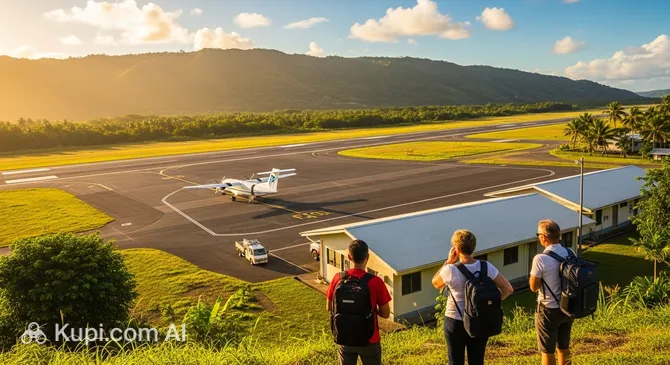
Fagali'i Airport. Source: Kupi.com Binoculars

Fagali'i Airport is a unique air gateway located literally a few minutes' drive from the centre of the Samoan capital. Unlike the main Faleolo International Airport, which is situated on the other side of the island, this compact airfield offers travellers a cosy atmosphere and exceptional accessibility. Following its recent reopening, it has once again become a key link in the famous "air bridge" between Western and American Samoa, serving short and scenic flights over the ocean.

IATA CodeFGI
ICAO Code NSFI
City Apia
Distance to Centre ~4-5 km
Status Regional (flights to American Samoa)
Annual Passengers Approx. 60,000 (serves the shuttle route)
ScheduleOnline board

Features and Advantages of the Airport:

  • Proximity to the Capital: The main advantage of Fagali'i is its location. The journey to Apia city centre takes just 5–10 minutes by taxi, whereas the transfer from the main Faleolo Airport can take about an hour.
  • Scenic Approach: The airfield is located in a suburb, amidst lush tropical greenery and residential homes. Take-off and landing here offer passengers breathtaking bird's-eye views of Upolu Island and the surrounding villages.
  • "Air Taxi" Specialisation: The airport is known as the base for flights to Pago Pago (American Samoa). The flight takes just 25–30 minutes, making it ideal for day trips or quick transit between the two parts of the archipelago.
  • Intimate Atmosphere: Thanks to its small size, all procedures here are completed quickly and without the hustle and bustle typical of large hubs. Passengers appreciate the lack of long queues and the simple navigation.

Contact Information

  • Official Airport Website: www.samoaairports.com (Resource of the Samoa Airport Authority).
  • Help Desk Phone: +685 22173 (Direct line to Fagali'i Terminal) or +685 23201 (Head Office).
  • Airport Address: Fagali'i Airport Road, Fagali'i, Apia, Samoa.
  • Email: enquiries@saa.ws (General enquiries for the Airport Authority).
  • Airport Social Media: Official Samoa Airport Authority Facebook page (latest news on flight status).
  • Lost Luggage Information: This matter is handled by the operating airline. It is recommended to contact the Samoa Airways office on +685 22172 or speak personally to staff at the counter in the terminal.
  • Customer Support Contacts: Complaints and suggestions are accepted via the feedback form on the Samoa Airport Authority website or by email at enquiries@samoaairports.com.

How to Get to the Airport

Thanks to its convenient location in the immediate vicinity of the capital, getting to Fagali'i Airport is much easier and faster than reaching the country's main international air gateway. The journey from the centre of Apia takes minimal time, making this airfield the ideal choice for quick regional flights.

Taxi

This is the most common and comfortable way to get to the terminal. A trip from the city centre (Downtown Apia) will take just 5–10 minutes. Taxis in Samoa are easy to recognise, but it is worth remembering an important detail: most cars are not equipped with meters. It is strongly recommended to agree on a fixed price with the driver before boarding. The fare is usually low due to the short distance, but may vary depending on the time of day.

Transfer from the International Airport

Many passengers use Fagali'i as a transit hub for flights to American Samoa immediately after arriving on the island from other countries. In this case, you will need a transfer from the main air gateway — Faleolo Airport. The distance between the two airports is about 30 km. The journey by taxi or shuttle will take approximately 45–60 minutes and runs along the picturesque coast, allowing you to immediately enjoy the beauty of Upolu Island.

Public Transport

To immerse yourself in the local atmosphere, you can use the famous Samoan buses with wooden bodies, painted in bright colours. There are no direct routes entering the airport territory, but any bus going from Apia in an easterly direction (towards the villages of Letogo or Fagali'i) is suitable. You need to ask the driver to stop at the turnoff to the airport, after which you must walk about 5–7 minutes to the terminal. This option is very cheap, but suitable only for those travelling light.

Car Rental and Parking

If you are travelling in a rental car, follow the Main East Coast Road and turn at the sign for Fagali'i Airport. There is a small parking area in front of the terminal building. Since the airport serves short "air taxi" style flights with rapid passenger turnaround, parking here is mainly used for short-term stops (dropping off and picking up passengers). Leaving a car for a long period is not recommended due to the limited number of spaces.

Useful Recommendations

  • If you are heading to Pago Pago International Airport, be sure to weigh your luggage in advance. Flights are operated on small aircraft (like the Twin Otter), where strict weight restrictions apply, and every extra kilogram can be an issue.
  • When planning a departure on a Sunday, please note that public transport practically does not run on this day due to the country's religious traditions. On weekends, it is better to book a taxi or hotel transfer in advance.

Terminals and Map

The infrastructure of Fagali'i Airport (FGI) is a model of compactness and island minimalism. The airport complex consists of a single terminal serving both departing and arriving flights. There are no multi-level walkways, aerobridges, or complex gate systems here, making navigation extremely simple even for inexperienced travellers.

Layout and Zoning

The terminal building is a small single-storey structure where all necessary services are literally within walking distance of each other. The internal space is organised logically and functionally:

  • Check-in Zone: Located immediately at the main entrance. Here you will find the airline counters (predominantly Samoa Airways) and scales. An important feature of local flights: due to the use of small aircraft, not only luggage is subject to weighing, but often hand luggage and sometimes the passengers themselves to accurately calculate the aircraft's centre of gravity.
  • Passport Control and Security: Located immediately behind the check-in counters. Despite the modest size of the airport, full international security rules apply here, as flights to American Samoa require border crossing.
  • Waiting Hall: A small zone (Gate area) with seats, offering a view of the runway. Passengers wait for boarding in immediate proximity to the exit onto the apron.
  • Arrivals Zone: Arriving passengers walk from the aircraft to the immigration control entrance. Baggage claim is organised as simply as possible: suitcases are unloaded manually and delivered to the collection area, which is located next to the exit into the city.

Features and Amenities

The terminal does not boast luxurious duty-free shops or business lounges typical of large hubs. The atmosphere here is more reminiscent of a cosy station than a noisy airport. A minimal set of services is available for passengers: a small retail point with drinks and snacks, restrooms, and a covered area for greeters outside.

Procedure Times

Thanks to the airport's small size, all formalities take minimum time. Queues for security and passport control are usually short. However, tourists should remember to be disciplined:

Although the screening process itself takes 10–15 minutes, flight check-in closes strictly according to schedule (usually 30–45 minutes before departure). Arriving even a couple of minutes late may result in being denied boarding, as pilots must receive the final load sheet in advance.

Navigation Recommendations

It is impossible to get lost in Fagali'i — the entire path from the taxi to the seat in the plane is less than 50 metres. The main advice for travellers: keep your documents ready and follow the staff's instructions. Boarding is done by walking across the airfield, so passengers are asked not to wander away from the accompanying staff member and to watch their step.

Airport History

The history of Fagali'i Airport is full of dramatic turns, political decisions, and triumphant returns. As the "younger brother" of the country's main international airport, this small airfield has always played a critically important role in ensuring connectivity between the two Samoas, repeatedly proving its necessity for locals and tourists alike.

Origins and Establishment

Initially, Fagali'i emerged in the mid-20th century as a simple grass airstrip cleared amidst palm plantations in the suburbs of Apia. Its "golden age" occurred in the 1970s and 80s, when the growth of tourism and commercial ties demanded rapid connections with American Samoa. The airfield became the home base for Polynesian Airlines, and the hum of propellers over the capital became a symbol of travel accessibility.

Chronicle of Closures and Revivals

The airport's fate is unique in that it has been closed and opened several times, with infrastructure upgrades occurring each time.

  • 2005–2009: The airport was closed for the first time due to safety concerns and noise complaints. However, four years later, the government acknowledged that moving all flights to the remote Faleolo Airport was inconvenient for short flights, and after a $1.2 million renovation, Fagali'i became operational again.
  • 2019–2023: At the end of 2019, the airport ceased operations once more. The runway was deemed non-compliant with safety standards, and the facility was mothballed. The pause lasted for four years, causing much debate about the facility's future.

A New Chapter: The 2023 Opening

The most significant event in recent history was the official resumption of operations in May 2023. This was not just an opening of doors, but the result of large-scale work to rectify past shortcomings. During preparation for the launch:

  • The runway was not only repaired but also extended to improve take-off and landing safety.
  • The terminal building underwent complete renovation, receiving an updated waiting hall and a VIP zone.
  • The fire station and perimeter fencing systems were modernised.

Now, the renewed Fagali'i once again serves Samoa Airways flights, significantly relieving the country's main airport.

Interesting Historical Facts

Over decades of operation, Fagali'i has accumulated many stories that make it a legendary place in Pacific aviation:

  • "Time Travel": Historically, this is the main departure point for flights "into yesterday". The flight to Pago Pago (American Samoa) crosses the International Date Line, so departing Fagali'i, for example, on Tuesday morning, passengers land at their destination on Monday.
  • Extreme Landing: Before the latest renovations, the approach at Fagali'i was considered a test of skill for pilots. Planes approached the runway through a gorge, flying so low over the hills that it seemed to passengers as if the landing gear was touching the tops of coconut palms.
  • STOL Only: The airport's history is inextricably linked with Short Take-Off and Landing (STOL) aircraft. Due to the difficult terrain and short runway (about 700 metres), large liners have never landed here. The symbol of the airport became the reliable Twin Otter — the "air minibus" of Polynesia.

Services and Amenities

The infrastructure of Fagali'i Airport (FGI) is entirely subordinate to its concept of "fast transit". Since passengers' time in the terminal is usually minimal (check-in closes shortly before departure, and the flight lasts less than half an hour), one should not look for the scale of major international hubs here. Services and amenities are of a basic nature, providing travellers with the necessary comfort before a short hop across the ocean.

Dining and Shopping

There are no gastronomic zones or full-service restaurants in the terminal. Passengers have access to a small kiosk (snack bar) where soft drinks, water, crisps, chocolate, and light snacks can be purchased. This is quite sufficient for a quick bite before boarding.

Full-fledged Duty-Free shops are absent. The retail assortment is limited to necessities and basic souvenirs. If you are planning serious shopping or buying gifts, it is recommended to do so in Apia city beforehand.

VIP Halls and Comfort

During the recent reconstruction completed in 2023, the premium comfort zone in the terminal was updated. The Fagali'i Airport VIP Lounge is a small but cosy space intended for official delegations, government officials, and passengers in priority service classes of Samoa Airways. Access may be limited depending on ticket status.

Connectivity, Finance, and Electronics

  • Wi-Fi and Internet: Free public Wi-Fi may be unstable or unavailable. However, thanks to its location within the city limits, mobile internet from local operators (Digicel, Vodafone) works excellently on the airport territory.
  • Charging Stations: There are few specialised stands for charging gadgets. It is recommended to fully charge phones and cameras before leaving the hotel or to carry a power bank.
  • Banks and Currency Exchange: There are no bank branches or currency exchange points within the terminal building itself. Given that the trip to the capital's centre takes only 5–10 minutes, tourists are advised to resolve financial matters at banks in Apia.

Medical Assistance and Safety

Security staff trained in first aid are on duty at the airport. There is no full medical centre in the terminal, but the proximity to the capital allows for an ambulance to be called from the Tupua Tamasese Meaole National Hospital, which is just a few minutes' drive away, in case of an emergency.

Services for Passengers with Children and Special Needs

The airport's compactness is its main advantage for passengers with reduced mobility and parents with children:

  • Barrier-Free Environment: The terminal is single-storey; there are no stairs, escalators, or lifts. Movement from the entrance to the check-in counter and further to the aircraft occurs on one level, which is very convenient for wheelchair users.
  • Boarding Assistance: Since there are no aerobridges, and boarding small aircraft (Twin Otter) requires climbing airstairs, ground service staff are always ready to provide physical assistance when boarding to passengers with disabilities or families with pushchairs.
  • Mother and Child Rooms: There are no specialised play areas, but there is enough space in the general waiting area to settle down with a child. Restrooms are equipped with basic amenities.

Hotels and Accommodation

There are no hotels directly on the airport territory, and they are not necessary due to FGI's unique location. The airfield is effectively integrated into the suburbs of the capital.

The nearest accommodation options are in the city of Apia (5–10 minutes' drive):

  • Taumeasina Island Resort — a luxury resort hotel located very close to the Fagali'i area.
  • Insel Fehmarn Hotel — a popular mid-range option, convenient for transit passengers.
  • Many guest houses and motels in the city centre are also available for an overnight stay before an early flight.

Business Services

Conference halls and business centres are absent from the terminal building. For holding business meetings or working with documents, it is best to use the infrastructure of hotels in Apia or business centres in the capital before arriving at the airport.

Dining

The dining scene at Fagali'i Airport (FGI) fully reflects its intimate format and "air taxi" nature. Travellers should note in advance that there are no food courts, chain restaurants, or juice bars here, as is common in large international hubs. Catering infrastructure is kept to a necessary minimum, designed so that a passenger can buy water or a light snack before a short 30-minute flight.

Cafés and Food Points

A small kiosk-buffet (Snack Bar) operates in the airport's single terminal. This is the only place where food and drinks can be purchased immediately before departure.

  • Assortment: The main focus is on packaged goods with a long shelf life. Usually available are bottled water, sweet fizzy drinks, carton juices, crisps, chocolate bars, biscuits, and crackers. Hot drinks typically include instant coffee or tea.
  • Location: The kiosk is located in the general area of the terminal (landside), next to the check-in counters and the waiting area. Both departing passengers and well-wishers have access to it.
  • Opening Hours: The food point opens by the start of check-in for the first morning flight and operates until the departure of the last aircraft (usually from early morning until daylight ends, as night flights are not operated).

Local Cuisine and Specialities

Due to the lack of a full kitchen, hot Samoan dishes (such as oka or baked fish) are not prepared in the terminal itself. However, sometimes fresh local pastries can be found on the counter, for example, Keke Pua'a (traditional steamed pork buns), which are supplied from city bakeries. This is a great option for a hearty and inexpensive snack in the island spirit.

Dietary Requirements (Vegetarian, Halal, Gluten-Free)

A specialised menu is absent at the airport.

  • Vegetarians and Vegans: Selection is limited to simple snacks (nuts, fruit chips, if in stock).
  • Special Needs: Passengers with strict diets, gluten allergies, or a requirement for Halal food are strongly recommended to take care of food in advance and bring a snack with them. Finding suitable certified products in the kiosk may be problematic, and some items (like the buns mentioned above) may contain non-Halal ingredients.

Price Range

Prices at the airport kiosk are moderate and only slightly exceed the cost of similar goods in city shops.
The average bill for a drink and a light snack will be about 5–15 WST (Samoan Tala).

Recommendations for Passengers

Given the airport's unique location just 5–10 minutes' drive from the capital's centre, the best dining strategy looks like this:

  • For a Full Meal: It is best to eat at one of the numerous cafés or restaurants in Apia city before taking a taxi to the airport. There you will find a wide selection of dishes featuring fresh seafood and local exotic flavours.
  • For a Quick Snack: If you did not have time to eat in the city, buy water and a sandwich at a supermarket on the way to the airport. This will ensure a greater selection and quality than the assortment at the terminal kiosk.
  • Important to Remember: The flight to American Samoa takes less than half an hour, and meals are not provided on board the small aircraft (Twin Otter) — usually only water, and not always. Therefore, a substantial meal before departure is a good idea.

Travel Tips

Travelling through Fagali'i Airport is a completely distinct experience, differing from the usual international flights on large liners. To ensure your flight on the "air taxi" goes smoothly, we have prepared a list of practical recommendations considering the specifics of small aircraft and the island pace of life.

Arrival Time and Planning

Despite the airport appearing quite domestic, punctuality here is critically important. It is recommended to arrive at the terminal 1 hour before departure. Check-in usually closes 30–45 minutes before take-off. This time is necessary not only for checking documents but also for compiling the final aircraft weight and balance sheet, without which the pilot cannot begin preparations for take-off. Late passengers are generally not waited for.

Check-in Features: Prepare to be Weighed

Be mentally prepared for a procedure that might surprise newcomers: absolutely everything is subject to weighing. Staff will ask you to place not only suitcases on the scales but also hand luggage, and then will ask you to step onto the scales yourself (sometimes holding your items). This is not an airline whim, but a strict safety requirement for small Twin Otter aircraft. Please treat this calmly and with understanding.

Hand Luggage: What You Can Take into the Cabin

Forget about the usual 'cabin size' suitcases. In the cabin of aircraft flying from Fagali'i, there are no overhead luggage bins. Space is extremely limited.

  • Permitted: A small handbag, a folder with documents, a camera, or a book. These items will have to be held on your lap or placed under the seat in front (if there is space).
  • Prohibited: Backpacks, sports bags, and shopping bags. All of these will be taken from you at boarding and placed in the luggage compartment in the tail or nose of the aircraft.
  • Tip: Keep valuables, money, passports, and fragile electronics with you in your pockets or a small belt bag.

Seat Selection and Best Views

Specific seats are often not indicated on tickets. Seating may be free, but the final word always rests with the crew: pilots may ask you to move to ensure the correct weight balance of the vessel.

  • If seating is free, try to take a seat immediately behind the cockpit. In the Twin Otter, the partition is often absent or transparent, allowing you to watch the pilots at work — it is a captivating sight.
  • For the best views of the Upolu coast during take-off, sit on the right, and for a panorama of Pago Pago harbour upon landing, sit on the left (although the route may change depending on the wind).

Important for Transit Passengers: The International Date Line

If you are flying to American Samoa, remember the region's main geographical trap. The International Date Line runs between the two Samoas. The flight lasts just 25 minutes, but you will land "yesterday". For example, departing Fagali'i on Friday morning, you will arrive in Pago Pago on Thursday morning. Take this into account when booking hotels and connecting flights.

If you are arriving at the main Faleolo Airport and planning a transfer to a flight from Fagali'i, allow at least 3–4 hours between flights. You will need time to clear immigration, collect luggage, and make the one-hour taxi journey between airports.

Customs and Control

Flights to American Samoa are international. Check visa requirements in advance (visiting American Samoa often requires a special Entry Permit, distinct from a US visa).
Strict Rule: Do not attempt to carry fresh fruits, vegetables, or seeds. Bio-security in the Pacific Islands is extremely strict to protect the ecosystem, and products will be confiscated, potentially resulting in a fine.

How to Save Time and Money

  • Food: Have a substantial meal in Apia before leaving. There is nowhere particular to buy food at the airport, and no meals are served on board.
  • Taxi: Always agree on the price of the trip to the airport before you get into the car. There are no meters, and a fixed agreement will save your budget.
  • Cash: Carry some local currency for small expenses, as payment terminals may not work.

In Case of Flight Delay

Small aviation is very sensitive to weather conditions. Heavy tropical rain or crosswinds can delay departure. There is no Wi-Fi or entertainment in the Fagali'i terminal, so:

  • Download films, music, or books to your phone in advance.
  • Take the waiting philosophically. You are in Polynesia, where no one rushes anywhere. Use this time to chat with locals — Samoans are very friendly and love telling stories.
Airports in nearby cities

Reached the end of the page?

That means the route is fully explored