Support

King Khaled International Airport

About the Airport

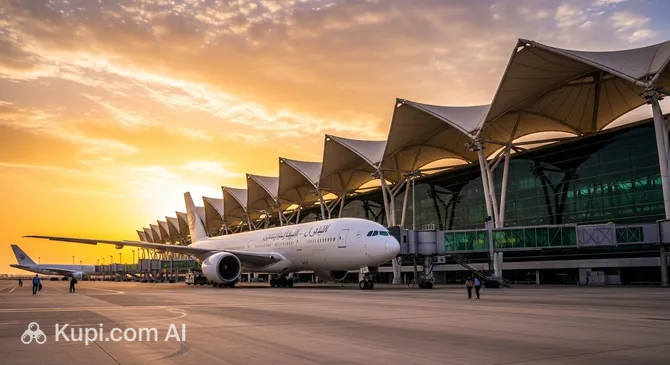
King Khaled International Airport. Source: Kupi.com Binoculars

King Khaled International Airport is not merely a transport hub, but a true architectural gateway to the heart of the Arabian Peninsula. Designed as an oasis amidst the desert, this grand complex impresses with a harmonious blend of ultra-modern technology and traditional Islamic motifs. The vast territory of the airport, once even considered as an alternative landing strip for space shuttles, today welcomes travellers with spacious terminals adorned with fountains and gardens.

IATA Code RUH
ICAO Code OERK
City Riyadh
Distance to Centre 35 km
Status International
Passengers per Year Over 37 million
Schedule Available on live flight board

Airport Features and Highlights

Riyadh's airport is renowned for its unique architecture: the terminals are shaped like triangles, symbolising openness and hospitality. At the centre of the complex lies one of the largest airport mosques in the world, accommodating thousands of worshippers and serving as an important spiritual centre for transit passengers. For the convenience of travellers, the new Terminal 5 was recently opened to serve domestic flights, alongside the launch of the renovated international Terminals 3 and 4, offering a high level of comfort and modern lounge areas.

Getting to the city has become easier thanks to the new metro line (Yellow Line), which connects the airport with the King Abdullah Financial District. Furthermore, the premises feature numerous duty-free shops, restaurants, and car rental services, making the wait for your flight as comfortable as possible.

Contact Information

For your convenience, we have compiled the essential contact information for King Khaled International Airport (RUH).

  • Official Website: www.kkia.sa
  • Information Desk Phone: +966 9200 20090
  • Address: Airport Road, King Khalid International Airport, Riyadh 13458, Saudi Arabia
  • Email for General Inquiries: customercare@riyadhairports.com
  • Social Media: Current information and news can be tracked on the airport's official pages on X (formerly Twitter), Instagram, and Facebook (usually under the handle @RuhKkia).
  • Lost Luggage: If you have lost your belongings on board the aircraft, please contact your airline's representative first. For items lost within the airport terminals, contact the Lost & Found service. Contact details and the claim form are usually available on the official website.
  • Passenger Support Service: For most inquiries, you can receive consultation via the main information desk phone number or through the feedback form on the airport website.

How to Get to the Airport

King Khaled International Airport (RUH) is located approximately 35 kilometres north of the centre of Riyadh. To get to or from the airport, travellers have several convenient options available, varying in cost, speed, and comfort level. Planning your trip to the airport in advance will help avoid unnecessary stress and ensure you reach your flight on time.

Taxis and Ride-Hailing Services are the most popular and convenient way to reach the airport. Official taxis are easily recognisable by their green colour. Additionally, Uber and Careem apps are widely used in the city and often offer more competitive rates. The journey from the centre of Riyadh to the airport typically takes between 30 and 50 minutes depending on traffic conditions. The estimated cost will range from 70 to 100 Saudi Riyals (SAR).

For a more budget-friendly journey, you can use public transport. Riyadh Bus has launched special express bus routes connecting the airport with key points in the city. This is an economical option, though travel time may be longer than by taxi. Furthermore, the airport is connected to the Metro (Line 4), making it one of the fastest ways to travel. Before your trip, it is recommended to check the current schedule and routes on the transport company's official website.

Car Rental is an excellent choice for those who value independence and plan to travel actively across Saudi Arabia. At King Khaled Airport, counters for both international and local rental companies are available. If you are driving to the airport in your own or a rented vehicle, several parking zones are at your disposal. Options for both short-term and long-term parking are available, located in immediate proximity to the terminals.

For maximum comfort, especially if travelling with family or a large amount of luggage, you can book a private transfer. This service can be arranged online in advance through numerous services or your hotel. It is slightly more expensive than a taxi but guarantees a car on time and a fixed price. When planning your route across the country, it is worth considering other major transport hubs, such as King Fahd International Airport in Dammam or Prince Naif bin Abdulaziz Regional Airport in Buraidah, which may be more convenient for trips to the eastern or central regions of the country.

Terminals and Map

King Khaled International Airport (RUH) in Riyadh is a large and modern transport hub with a well-thought-out structure. Currently, five main terminals are used for passenger transport, each having its own specialisation. It is important to check in advance which terminal your flight departs from, as they serve different airlines and destinations.

Terminals 1, 2, 3, and 4 are designated for international flights, while Terminal 5 is exclusively for domestic flights within Saudi Arabia. Terminals 1 and 2 have historically served the majority of international airlines, while the recently renovated and expanded Terminals 3 and 4 have taken on a portion of international flights, significantly increasing the airport's capacity. Architecturally, all terminals are interconnected, which facilitates movement.

All passenger terminals are connected by covered walkways with travelators (moving walkways), making movement between them convenient and quick. Navigation inside the airport is intuitive thanks to clear signage in Arabic and English. The layout is standard for major airports: departure zones are usually located on the upper levels, while arrival and baggage claim zones are on the lower levels. Despite its large size, it is difficult to get lost here.

For check-in and pre-flight security screening, it is recommended to arrive at the airport well in advance. For international flights — at least 3 hours before departure, and for domestic2 hours. During peak hours, especially during Hajj or the tourist season, waiting times may increase. Modern equipment and a large number of check-in counters and security checkpoints help minimise queues, but it is always better to have time in reserve.

Main navigation tip: always check your terminal number on your ticket or the airline's website before travelling to the airport. Terminals for international flights are distributed among different airlines, and your carrier will be assigned to a specific building. If you arrive at the wrong terminal, do not panic — use the convenient walkways to reach the correct one.

Airport History

The history of King Khaled International Airport (RUH) is a reflection of the rapid growth and ambitions of the capital of Saudi Arabia, the city of Riyadh. The airport was officially opened for flights at the end of 1983, replacing the old city airport, which could no longer cope with the growing passenger traffic. The design was undertaken by the renowned American architectural firm Hellmuth, Obata & Kassabaum (HOK), and at the time of opening, RUH was one of the largest airports in the world by land area, which in itself was a record and a demonstration of the scale of national development.

King Khaled International Airport. Source: Kupi.com Binoculars

One of the unique features of the project was its architecture. Four main passenger terminals (initially two were used) were designed in the shape of triangles connected by walkways. Rising in the centre of the complex is a magnificent mosque, capable of accommodating up to 5,000 worshippers inside and another 5,000 in the plaza outside. Its elegant design with stained glass and a monumental dome made it not just a religious facility, but a true architectural symbol of the airport that has impressed travellers since its opening.

The airport also played an important role in world events. In the early 1990s, during Operation Desert Shield, it served as one of the key bases for coalition forces. A lesser-known but equally interesting fact: thanks to its long runways (two measuring 4,260 metres), King Khaled Airport was included in the list of reserve landing sites for NASA space shuttles, highlighting its strategic importance and technical capabilities.

In recent years, the airport is undergoing a new stage of massive modernisation under the Saudi Vision 2030 programme. Terminals 3 and 4 were opened after reconstruction, significantly increasing capacity and allowing for the attraction of new international airlines. These updates aim to transform Riyadh into a leading logistics and tourism hub, ready to welcome millions of guests from around the world, continuing the glorious history of one of the Middle East's most iconic airports.

Services and Amenities

King Khaled International Airport in Riyadh offers passengers modern infrastructure and a full range of services to make waiting for flights as comfortable as possible. Here you will find numerous restaurants and cafes to suit every taste — from fast food outlets to restaurants offering local and international cuisine. For shopping enthusiasts, numerous shops are open, including duty-free zones where you can purchase souvenirs, perfumes, electronics, and much more.

For comfortable rest before departure, the airport provides VIP lounges and premium waiting areas, access to which can be obtained for a fee or through airline loyalty programmes. Free Wi-Fi is available throughout the terminals, and numerous mobile charging stations allow you to stay connected at all times. Business travellers can utilise business centre services and rent conference rooms for meetings.

Practical matters are easily resolved at the airport: ATMs, currency exchange points, and bank branches are at your service. In case of illness, a medical centre operates around the clock to provide first aid. For passengers with children, play areas and mother-and-child rooms are equipped, where you can care for little ones in a quiet environment.

The airport is fully adapted for passengers with reduced mobility: wheelchairs are provided, and there are ramps, lifts, and specially equipped restrooms. Airport staff are always ready to provide necessary assistance. If you have a long layover or an early flight, a hotel is located directly on the airport grounds, and several other hotels are situated in close proximity to the terminals, offering convenient shuttle transfers.

Where to Eat

At King Khaled International Airport (RUH) in Riyadh, passengers have access to a wide selection of venues to suit any taste and budget. Regardless of which terminal you are in and how much time you have before departure, you will easily find a suitable place for a snack or a full meal.

The majority of cafes and restaurants are concentrated in the `airside` departure zone, meaning after passing passport control and security screening. However, there are also several options in the public `landside` zone. Here you will find globally renowned fast-food chains (such as McDonald's, Subway) and coffee shops (Starbucks), as well as restaurants offering local and international cuisine.

For those wishing to experience the gastronomy of Saudi Arabia, the airport provides an excellent opportunity. Look out for establishments serving traditional dishes such as Kabsa (rice with meat and spices) or Shawarma. Be sure to try aromatic Arabic coffee with dates — it is a wonderful way to feel the local atmosphere before departing. It is important to note that virtually all food at the airport is `Halal`.

Passengers with special dietary preferences will also find plenty to choose from. Vegetarians can order salads, hummus, falafel, and other Middle Eastern mezze appetisers. It is best to check for vegan or gluten-free options directly with the staff at the venue. Generally, employees are ready to help and suggest suitable dishes.

The price range at the airport varies: from budget options in food courts to more expensive ones in full-service restaurants. Most establishments in international departure zones operate `24/7`, which is particularly convenient for passengers on night flights. If you are short on time, coffee and pastries at one of the coffee shops would be the ideal choice. If you have time to spare, you can dine leisurely in one of the restaurants, enjoying the comfortable atmosphere.

Tips for Travellers

To ensure your journey through King Khaled International Airport goes as smoothly as possible, use these practical tips. Proper preparation will help avoid stress and make your stay at the airport comfortable.

Arrival Time and Check-in. The international airport in Riyadh is a large and modern hub, so it is recommended to arrive at least 3 hours before departure for international flights, and 2 hours for domestic ones. This will give you enough time to complete all formalities without rushing. To save time, complete online check-in and print your boarding pass in advance if your airline offers this facility.

Security and Hand Luggage. Be prepared for thorough screening. Pack liquids up to 100 ml in a transparent bag. It is important to remember that strict rules apply when travelling to Saudi Arabia: the import of alcohol, pork and pork products, as well as materials that may be considered offensive from a religious or cultural perspective, is categorically prohibited. This rule applies to both checked baggage and hand luggage.

Seat Selection and In-Flight Comfort. If you want to enjoy the views, choose a window seat. An aisle seat will provide more legroom and allow you to stand up freely. For long flights, it is worth studying the aircraft layout on specialised websites in advance to avoid being near the toilets or galley.

Transfer Passengers. If you have a long layover, check if you need a transit visa to exit into the city. Within the airport itself, there are plenty of shops, cafes, and comfortable lounge areas where you can rest. The airport is well-equipped, so waiting for your next flight will not be tiresome.

Customs Control. When entering or leaving, be prepared to declare large amounts of cash and expensive items. Remain calm and answer customs officers' questions politely. Ensure you do not have any prohibited items to avoid complications.

Saving Time and Money. Book a taxi in advance through official apps or use the counters in the arrival hall to avoid inflated prices. There are ATMs and currency exchange points at the airport, but the exchange rate may be less favourable than in the city. Bring an empty reusable water bottle with you — after passing security control, it can be filled at drinking fountains.

If Your Flight is Delayed. In case of a flight delay or cancellation, contact your airline representative immediately. They are obliged to provide you with information and, depending on the length of the wait, provide meals or hotel accommodation. Also, check the terms of your travel insurance — it may cover such cases.

Reached the end of the page?

That means the route is fully explored