Support

Jouf Airport

About the Airport

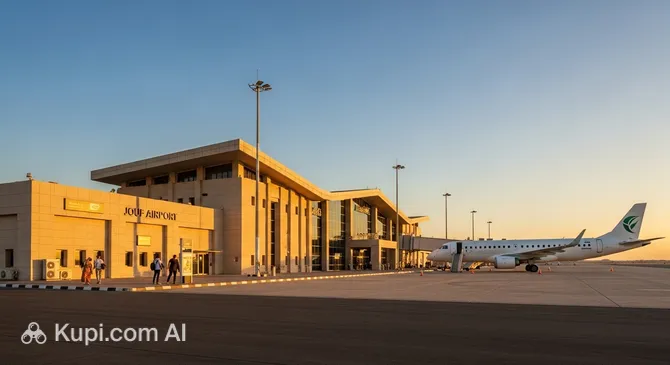
Jouf Airport. Source: Kupi.com Binoculars

Welcome to Al Jouf Airport (AJF) — the aerial gateway to the historic region in the north of Saudi Arabia. This airport serves as the starting point for exploring the province of the same name, known for its olive groves and ancient archaeological sites. Located near the city of Sakaka, it handles both domestic and international flights, connecting this unique corner of the country with major cities across the Middle East. Despite its regional status, the airport is constantly developing to ensure a comfortable start and end to your journey through this distinctive land.

IATA Code AJF
ICAO Code OESK
City Sakaka
Distance to center About 21 km
Status International
Annual Passengers About 595,000 (based on 2022 regional data)
Popular Airlines Saudia, Flynas, Air Arabia
Schedule online flight status "Al Jouf Airport"

Al Jouf Airport offers travelers key amenities for a comfortable wait. The terminal features the Hayyak Lounge, where passengers can relax in a peaceful atmosphere. The airport serves flights from several major airlines, including the national carrier Saudia and popular low-cost carriers Flynas and Air Arabia, providing convenient connections to cities such as Riyadh, Jeddah, Dubai, and Sharjah. Thanks to a runway over 3,600 meters long, the airport is capable of accommodating various types of aircraft. Although the airport is not a massive international hub, its role as a regional transport node is of great importance for the development of tourism and the economy of the Al Jouf province.

Contact Information

Below is the contact information for Al Jouf Airport (AJF). It is important to note that many domestic airports in Saudi Arabia are managed centrally through the General Authority of Civil Aviation (GACA), so most official contacts lead to their support services.

  • Official Website: Currently, Al Jouf Airport does not have a separate official website. Up-to-date information on flights and services can be found on the General Authority of Civil Aviation (GACA) portal or on airline websites.
  • Information Desk Phone: For information, it is recommended to use the unified GACA call center: 8001168888 (toll-free within Saudi Arabia) or +966 11 525 3333 (for international calls).
  • Airport Address: Al-Jouf Domestic Airport (AJF), Sakaka 75431, Al-Jouf Province, Saudi Arabia.
  • Email: The official address of the GACA support service, which handles inquiries for all airports in the country: gacacare@gaca.gov.sa.
  • Social Media: Questions can be asked via official GACA accounts on X (formerly Twitter): @gaca_sa (general news) and @gacacare_sa (customer support).
  • Lost Luggage Information: For issues related to lost or damaged checked baggage, you must contact your airline directly. If you have lost personal items within the terminal, please contact the airport information desk.
  • Passenger Support Contacts: The main channels for passenger support are the GACA call center and social media listed above. Also, upon arrival at the airport, you can approach the information desk.

How to Get to the Airport

There are several ways to get to Al Jouf Airport (AJF), located approximately 25 kilometers southeast of the city of Sakaka. The choice of the best option depends on your budget, time, and comfort preferences.

Taxis and ride-hailing apps are the most popular and convenient way to reach the airport. The trip from the city center takes on average 20-30 minutes. The estimated cost is between 60 and 80 Saudi Riyals (SAR) depending on demand and time of day. You can use local taxi services or book a car through apps popular in Saudi Arabia, such as Uber or Careem. This allows you to know the exact cost in advance and avoid the need to negotiate the price with the driver on site.

For travelers who value independence and plan to explore the region, car rental is an excellent solution. Counters for international and local rental companies are located both at the airport and in the city. It is worth noting that the rental cost directly depends on the car class, rental duration, and the specific company. By booking a car online in advance, you can not only choose the best price option but also save time upon arrival. The road to the airport follows modern highways with clear navigation.

Regarding public transport, it is important to note that there are currently no direct bus routes from the center of Sakaka to Al Jouf Airport. Therefore, tourists should not rely on this mode of transport and should opt for a taxi or a rental car instead.

If you arrive at the airport in your own or a rented car, parking is at your service. The airport grounds feature zones for short-term and long-term parking, located in immediate proximity to the passenger terminal. This is a convenient option for those seeing off or meeting passengers, as well as for travelers leaving their car for the duration of their trip.

Terminals and Map

Al Jouf Airport (AJF) is a modern and compact aviation hub distinguished by a simple and clear structure for passengers. The airport operates one passenger terminal, which serves both domestic and international flights. Thanks to this, you won't have to worry about complicated transfers or searching for the right building — all processes are concentrated in one place.

The terminal layout is logical and intuitive. The space is clearly divided into departure and arrival zones. Upon entering the building, you immediately find yourself in the main hall, where airline check-in counters are located. After receiving a boarding pass and checking in luggage, passengers proceed to the security screening area. A separate passport control zone is provided for international flights. Since the terminal is small, all key points — from check-in counters to boarding gates — are within walking distance of each other.

Check-in and security procedures at Al Jouf Airport usually take significantly less time than at major international hubs. Nevertheless, it is recommended to adhere to standard rules: arrive at the airport at least 2 hours before a domestic flight and 3 hours before an international flight. This time will be sufficient to complete all formalities without rushing, even during periods of high traffic.

For convenient navigation throughout the terminal, signs are installed in Arabic and English. Getting lost here is practically impossible. The main advice for travelers is to follow the signs, and you will easily find the zone you need. The compactness of the airport makes it particularly convenient for families with children and passengers with reduced mobility, as all movements take minimal time and effort.

Airport History

The history of Al Jouf Airport (AJF) is closely linked to the development of the northern region of Saudi Arabia. The airport was founded and opened for flights in 1974. Its primary task was to ensure reliable air connectivity for the residents of Al Jouf province, connecting the city of Sakaka and its surroundings with major economic and cultural centers of the country, such as Riyadh and Jeddah.

Initially, the airport functioned as a domestic hub, serving flights within the Kingdom. Over time, as the economic and strategic importance of the region grew, its infrastructure began to develop. A key stage was obtaining the status of a regional international airport. This allowed for the launch of flights to neighboring countries, which significantly contributed to the development of tourism and business ties.

In recent years, Al Jouf Airport has been undergoing a new round of modernization within the framework of the Saudi Vision 2030 national development program. Large-scale expansion projects have been launched, including the construction of a new passenger terminal. The main goal of the reconstruction is to increase capacity to accommodate more passengers and improve the level of comfort through modern waiting lounges, new check-in counters, and an improved service area.

Although the airport's history does not abound with loud records or dramatic events, its main achievement is stable and reliable operation over decades. It plays a key role in the life of the province, known for its rich historical heritage and agriculture. Al Jouf Airport is an important logistical node that supports economic growth and the accessibility of this unique corner of Saudi Arabia for travelers from all over the world.

Services and Amenities

Al Jouf Airport (AJF), despite its relatively small size, offers passengers all the essential services necessary for a comfortable wait before departure. Conditions have been created here so that your journey begins without unnecessary hassle.

Within the terminal, you will find several cafes and snack bars where you can grab a quick bite, drink coffee, or have refreshments. There are also small shops offering travel essentials, souvenirs, and press. For those looking for a quieter environment, a VIP Lounge is available with comfortable seating, snacks, and beverages.

To stay connected, passengers can use the free Wi-Fi available throughout the airport. Special stands and power outlets are provided in the waiting halls for charging mobile phones and other gadgets.

The airport operates ATMs and currency exchange points, allowing you to easily solve financial matters upon arrival or before departure. In case of unforeseen health situations, there is a first aid station in the terminal.

Rooms for mothers and children are equipped for passengers traveling with infants. The airport also provides services for travelers with reduced mobility, including assistance with escorting through the terminal and boarding the flight. It is recommended to notify the airline in advance about the need for special assistance.

There is no hotel located within the airport building itself, but the nearest hotels can be found in the city of Sakaka, which is easily accessible by taxi. There are no dedicated business centers or conference rooms at the airport, but basic conditions for work can be found in the quiet of the VIP Lounge.

Dining

Al Jouf Airport (AJF) is a regional air terminal, so the choice of dining establishments here is quite modest and oriented towards basic passenger needs. Do not expect a wide variety of restaurants, but you can find everything necessary for a snack before departure.

The main food outlets are represented by small cafes and coffee shops. typically, one or two establishments are located in the general area before security control (landside), where you can have coffee with people seeing you off. Another small cafe is usually found in the secure area, in the departure lounge (airside), for those who have already completed all formalities. There are no full-service restaurants with à la carte menus at the airport.

The assortment in local cafes is standard: hot and cold drinks (coffee, tea, juices), fresh pastries, sandwiches, and packaged snacks (chips, nuts, chocolate). If you want to try something with local flair, look for traditional Arabic coffee and dates, which are often offered as a compliment or sold in sets. All food at the airport is halal. Vegetarians will likely manage to find a cheese sandwich or meat-free pastries, but the selection will be limited. Specialized vegan or gluten-free dishes are unlikely to be available.

For a quick snack, coffee and a croissant or sandwich are ideal. If you are counting on a full lunch or dinner, it is better to do so before arriving at the airport. Prices in Al Jouf Airport establishments are average for air terminals — slightly higher than in the city, but quite acceptable. Cafe opening hours are usually tied to the flight schedule, so they are open to serve passengers for both morning and evening departures.

Travel Tips

To ensure your journey through Al Jouf Airport in the city of Sakaka goes as comfortably as possible, there are several points to consider. It is recommended to arrive at the airport at least 2 hours before a domestic flight and 3 hours before an international flight. This time will be sufficient to go through all procedures without rushing. To save time, use online check-in if your airline provides this option — this will allow you to proceed immediately to baggage drop or the security screening zone.

Passing security control at Al Jouf Airport is standard. Be prepared to present your boarding pass and passport, as well as place electronic devices and liquids in separate trays. Please be reminded that in carry-on luggage, liquids are permitted in containers up to 100 ml, packed in a transparent bag. Sharp objects, weapons, and flammable substances are prohibited. When choosing a seat on the plane, be guided by your preferences: window seats offer beautiful views during takeoff and landing, while aisle seats provide more freedom of movement.

When entering Saudi Arabia, customs control is thorough. The import of alcohol, pork and pork products, narcotics, and materials contrary to Islamic norms is strictly prohibited. Declare all high-value items and large amounts of cash to avoid misunderstandings. If you are flying in transit, check in advance whether you need to collect your luggage and check it in for the next flight, and estimate the time needed for the transfer.

In case of a flight delay, remain calm. Contact a representative of your airline for information on the new departure time and possible compensation (water, meals, hotel accommodation for long delays). Information screens in the waiting hall and airline mobile apps will help track the status of your flight. To save money, you can bring an empty water bottle and fill it at drinking fountains after passing security, as well as take care of light snacks in advance.

Reached the end of the page?

That means the route is fully explored