Support

Tabuk Regional Airport

About the Airport

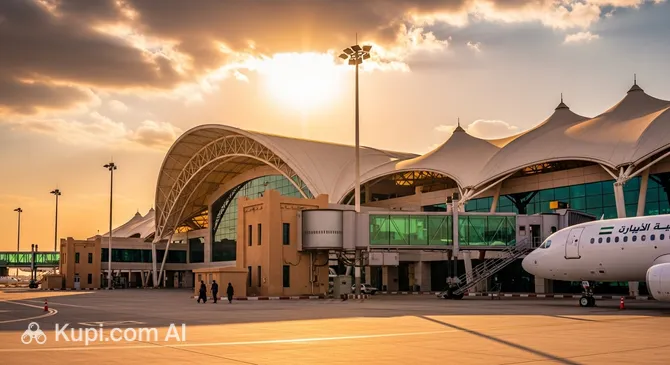
Tabuk Regional Airport. Source: Kupi.com Binoculars

Tabuk Airport, also known as Prince Sultan Bin Abdulaziz International Airport, is a key air gateway to the northwestern part of Saudi Arabia. This modern transport hub, which received international status in 2011, plays a vital role in the region's development by connecting it with major cities within the country and abroad. Located near the border with Jordan, the airport serves as a starting point for travellers wishing to explore the historical and natural attractions of the Tabuk province.

IATA Code TUU
ICAO Code OETB
City Tabuk
Distance to Centre Approx. 6 km
Status International
Annual Passengers ~1.78 million (2019)
Popular Airlines Saudia, Flynas, Air Arabia
Schedule "Tabuk Airport" Online Board

Tabuk Airport offers passengers all necessary amenities for a comfortable journey. The single terminal houses cafes and shops, ATMs, a currency exchange, as well as prayer rooms and a business lounge. For the convenience of passengers with reduced mobility, ramps and specially equipped restrooms are provided. The city centre, located approximately a 10-minute drive away, can be reached by taxi or via a pre-booked transfer. Additionally, several car rental companies, including Budget, Hanco, and Alrehali, operate offices within the airport building, making it easy to organise further independent travel across the region.

Contact Information

  • Official Website: The most up-to-date information about Tabuk Airport (Prince Sultan Bin Abdulaziz) can be found on the General Authority of Civil Aviation (GACA) portal: gaca.gov.sa.
  • Help Desk Phone: For general enquiries, you can call: +966 14 422 1300. We recommend checking the official website for the most current number before calling.
  • Airport Address: Prince Sultan Bin Abdulaziz International Airport (TUU), Tabuk, Saudi Arabia.
  • Email: A direct email address for general enquiries is usually not published. To contact the airport administration, it is recommended to use the feedback form on the official website.
  • Social Media: Official news and updates are typically published on GACA accounts or pages dedicated to Saudi Arabian airports.
  • Lost Luggage Information: If your luggage has been lost or damaged, you should first contact your airline's representative at the airport. For items left within the terminal building, please contact the Lost & Found service via the main help desk number.
  • Passenger Support Contacts: For on-site assistance and advice, please approach the information desks in the terminal or call the help desk number listed above.

How to Get to the Airport

Tabuk Airport (TUU) is located in close proximity to the city, so getting there from the centre of Tabuk or your hotel is straightforward. Several convenient transport options are available to travellers, allowing you to plan your trip according to your budget and preferences.

Taxis and Transfers

The easiest and most popular way to reach the airport is to use a taxi or book a ride via mobile apps (such as Uber or Careem, which are widely used in Saudi Arabia). The journey from the city centre usually takes no more than 10–15 minutes. This is a reliable and convenient option, especially for travellers with luggage. The cost of the trip is typically between 30 and 50 Saudi Riyals (SAR). It is recommended to agree on the price in advance or ensure the driver uses the meter.

Car Rental and Parking

For those who prefer independence in movement and plan to explore the region, renting a car is the ideal solution. Many international and local rental companies have counters both at the airport and in the city itself. Prices for renting an economy class car start from approximately 120–150 SAR per day. Tabuk Airport provides zones for short-term and long-term parking, which is convenient if you arrive in your own or a rented vehicle that can be returned right before departure.

Public Transport

Public transport options, such as city buses, may be limited and do not always offer a direct route to the airport, making them a less convenient choice for tourists. Currently, there is no direct rail or metro connection to the airport. Therefore, to save time and ensure comfort, it is recommended to choose a taxi or car rental.

Terminals and Map

Tabuk Airport (TUU), also known as Prince Sultan Bin Abdulaziz Airport, is a modern and compact aviation hub. Its structure is simple and intuitive, making navigation convenient even for those visiting for the first time. The airport operates one main terminal that serves both domestic and international flights.

The terminal layout is logical and well-thought-out. Since all operations are concentrated in one building, passengers do not need to worry about transfers between terminals. The building is nominally divided into two main sections: for domestic and international flights. Departure and arrival zones are clearly demarcated. The departure area houses check-in counters, security screening points, and passport control (for international flights). After clearing all formalities, passengers enter the airside area featuring departure lounges, several cafes, and duty-free shops.

The arrival zone is also organised efficiently. International passengers first go through passport control, then proceed to the baggage claim hall and pass through customs inspection. For domestic flights, the procedure is simpler — after collecting suitcases, one can immediately exit into the general arrival hall, where representatives of taxi services and car rental companies are located.

It is recommended to arrive at the airport well in advance to complete all pre-flight procedures. For domestic flights, 1.5–2 hours is usually sufficient, while for international flights, it is better to allow 2.5–3 hours. The airport is not overcrowded, so queues for check-in and security generally move quickly. Clear signage in Arabic and English is installed throughout the terminal, significantly facilitating orientation.

Airport History

The history of Tabuk Airport is closely tied to the development of the entire northwestern region of Saudi Arabia. Initially, it functioned primarily as a military airfield, serving as part of a significant Royal Saudi Air Force base. With the growth of Tabuk city and the increasing demand for passenger transport, the airport gradually began servicing civil flights, evolving into a key hub for domestic connectivity.

A turning point in the airport's history was 2011. Following extensive reconstruction and the construction of a new terminal, it received international status. In honour of the late Crown Prince Sultan bin Abdulaziz, who made a tremendous contribution to the development of the country's aviation and defence, the airport was named after him — Prince Sultan bin Abdulaziz International Airport. This event marked a new era in the development of the region's air gateway.

The large-scale modernisation included the erection of a modern passenger terminal equipped with jet bridges, spacious waiting lounges, and all necessary infrastructure to service international flights. The airport's capacity increased manifold, allowing it to receive aircraft from Middle Eastern countries and other parts of the world. Today, the airport is an important element in the realisation of major national projects, such as the futuristic city of NEOM, and contributes to the growth of tourism in the region.

An interesting fact: Tabuk Airport maintains its dual function to this day, simultaneously servicing civil flights while remaining an active military base. Its strategic location near the borders with Jordan and Egypt makes it not only a gateway for tourists wishing to explore ancient monuments and the natural beauty of the country's northwest but also an important transit point for pilgrims.

Services and Amenities

Tabuk Airport (TUU) offers passengers all necessary services for a comfortable wait for their flight. Although the airport is not large in size, one can find everything needed for convenience before departure or after arriving in one of the picturesque regions of Saudi Arabia.

For those wishing to have a bite to eat, several cafes and snack bars operate in the terminal, where you can drink coffee, eat a sandwich, or try local sweets. There are also small shops selling souvenirs, press, and essential items. This is a convenient opportunity to buy gifts or something you forgot to pack for the journey.

A VIP Lounge is available at the airport, where passengers can relax in a quieter atmosphere, enjoying snacks and drinks. Access to the lounge is usually paid or provided to holders of certain airline cards and loyalty programmes. Free Wi-Fi is available throughout the terminal, and charging stations for mobile devices are installed in the waiting halls.

For financial transactions, the airport has ATMs and currency exchange points. A first aid station is provided in case of illness. Families with small children can use mother and child rooms to care for their little ones.

The airport is equipped to serve passengers with reduced mobility: there are ramps and specially equipped toilets. To receive assistance, such as a wheelchair, it is recommended to notify your airline in advance. There are no hotels directly within the airport building, but many accommodation options are located in the city of Tabuk itself, just a few minutes away by taxi.

There are no specialised conference rooms or business centres at Tabuk Airport; however, for business travellers who need to work in silence, the VIP Lounge can be a suitable alternative.

Dining

Tabuk Airport (TUU) offers passengers a basic but sufficient selection of establishments to have a snack before departure. Do not expect a large food court here like in capital city airports, but finding a place for a cup of coffee or a full meal is certainly possible.

Most cafes and snack bars are concentrated in the main departure hall. Options are available both in the public area (landside) and in the area after passport control and security screening (airside). Typically, these are small coffee shops of international and local chains, as well as several fast-food outlets. Opening hours generally align with the flight schedule, but choices may be limited during the night.

For a quick snack, coffee shops are ideal, where you can order sandwiches, pastries, and drinks. If you have time for a full lunch, look for quick-service restaurants offering more substantial meals, such as burgers, pizza, or chicken dishes. Although the selection of exotic dishes is small, you can try traditional Arabic coffee and dates here, which are often offered as a compliment or sold in shops.

The entire range of food at the airport is Halal, complying with local standards. Vegetarians have access to standard options: vegetable sandwiches, salads, French fries, and pastries. Finding specialised vegan or gluten-free dishes may be difficult, so if you have strict dietary restrictions, it is better to carry a suitable snack with you. Prices for food and drinks at the airport are higher than in the city, which is standard practice for air hubs.

Travel Tips

To ensure your journey through Tabuk Airport goes smoothly and without unnecessary stress, follow our tips. Advance preparation will help save time, money, and nerves, especially if you are flying to Saudi Arabia for the first time.

Arrival Time and Check-in. We recommend arriving at the airport at least 2 hours before a domestic flight and 3 hours before an international one. This time is sufficient to complete all formalities without rushing. To save time, complete online check-in for your flight if your airline offers this option. This will allow you to proceed straight to bag drop or security screening if you are travelling with hand luggage only.

Passing Security Control. Be prepared for a thorough screening. Keep your passport and boarding pass handy. In some airports in the country, there may be separate queues for men and women, so pay attention to the signs. Remove all metal items from your pockets in advance, and take laptops and other large electronics out of your bags.

What is Allowed and Prohibited. Saudi Arabia has strict customs regulations. The import of alcohol, pork and pork products, as well as any materials that may be considered contrary to Islamic norms, is strictly prohibited. Restrictions on carrying liquids in hand luggage are standard: no more than 100 ml per container, and all must be packed in a transparent bag.

Choosing a Seat on the Plane. If you have the opportunity to choose a seat during check-in, consider your preferences. Window seats will give you the chance to admire impressive desert landscapes during takeoff and landing. Aisle seats provide more legroom and allow you to stand up freely without disturbing your neighbours.

Transfer Passengers. If Tabuk is your transit point, check with your airline in advance whether you need to collect and re-check your luggage. Also, verify visa requirements: even if you do not plan to leave the airport, a visa might be required to exit the transit zone.

In Case of Flight Delay. If your flight is delayed, first contact your airline's representative at the airport. They will provide up-to-date information and, depending on the length of the delay, may offer vouchers for food or hotel accommodation. Keep all receipts for unforeseen expenses — they may be needed to claim compensation from the airline or via travel insurance.

Reached the end of the page?

That means the route is fully explored