Support

Turaif Airport

About the Airport

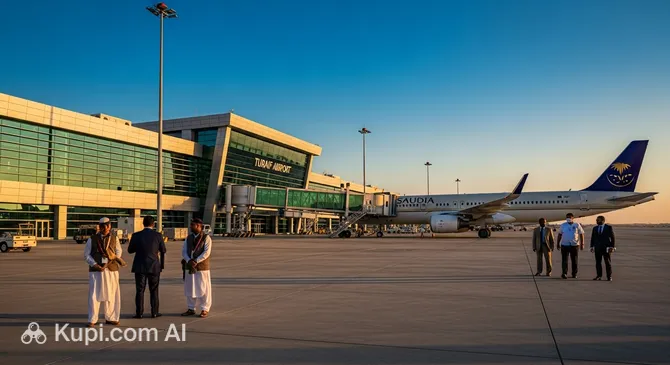
Turaif Airport. Source: Kupi.com Binoculars

Turaif Airport (TUI) serves as a key aerial gateway to the city of the same name in northern Saudi Arabia, near the border with Jordan. Despite its modest size, this airport plays a vital role in the region's transport system, providing connections to the country's major business and cultural hubs. For many travellers, their introduction to the unique atmosphere of the Northern Borders Province begins right here, in a modern and compact terminal offering everything needed for a comfortable start or end to a journey.

IATA Code TUI
ICAO Code OETR
City Turaif
Distance to centre approx. 6 km
Status domestic
Annual passengers no exact data available
Popular Airlines Saudi Arabian Airlines, Flynas
Schedule online flight board "Turaif Airport"

Turaif Airport specialises in handling domestic flights, making it an important link in Saudi Arabia's national air transport network. The main airlines operating flights from this airport are the national carrier Saudi Arabian Airlines and the budget airline Flynas. They connect Turaif with major cities such as Riyadh and Jeddah, giving residents and visitors of the region access to international connections and business opportunities in the capital. The airport is equipped with one runway and offers basic services for passengers, ensuring quick and convenient processing of all pre-flight formalities.

Contact Information

To obtain up-to-date information regarding the operation of Turaif Airport (TUI), flight status, and available services, please use the following contact details. Please note that this is a regional airport, and many communication channels are centralised through the management company.

  • Official Website: Turaif Airport does not have its own dedicated website. It is managed by Saudi Airports (MATARAT). General information for passengers and news can be found on the official MATARAT portal or on the website of the General Authority of Civil Aviation of Saudi Arabia (GACA).
  • Help Desk Phone: For direct communication with the airport, you can call +966 14 652 1450. There is also a unified contact centre for Saudi airports: 920011233 (for calls within the country).
  • Airport Address: King Abdullah Rd, Turaif 75311, Saudi Arabia.
  • Email: A direct email address for the airport is not published. For written enquiries, it is recommended to use the contact forms on the MATARAT management company's website.
  • Social Media: Important updates regarding the country's airports are published on official Saudi Airports accounts (e.g., @Matarat_KSA on X).
  • Lost Luggage Information: If issues arise with your luggage, you should first approach your airline's representative counter at the airport. If assistance is required from airport services, you may call the help desk.
  • Passenger Support Contacts: For general questions related to your time in the terminal, please contact the main airport number at +966 14 652 1450.

How to Get to the Airport

Getting to Turaif Domestic Airport (TUI), serving the city of the same name in the north of Saudi Arabia, is quite simple due to its close proximity to the centre. A trip from the central part of Turaif to the terminal usually takes no more than 10-15 minutes, depending on traffic conditions.

The most convenient and popular way to get to the airport is by taxi or private transfer. You can use local taxi services or book a car through mobile apps popular in the country, such as Uber or Careem. This is a fast and relatively inexpensive option that saves you the hassle of handling luggage. It is recommended to agree on the fare in advance or ensure the driver has switched on the meter.

For travellers who value independence and plan to explore the surroundings, car rental is an excellent solution. Many rental companies have offices both in the city and directly at the airport, allowing you to return the car right before your flight. Turaif Airport has parking where you can leave a vehicle for both short and long terms. This is a convenient option for those arriving in their own transport.

As for public transport, it is poorly developed in a small city like Turaif. There are no specialised express buses, trains, or metro lines to the airport. Although local buses may operate in the city, their routes are unlikely to be convenient for tourists with suitcases, and they do not guarantee a direct connection to the passenger terminal. Therefore, for a comfortable and timely trip to the airport, it is strongly recommended to choose a taxi or a rental car.

Terminals and Map

Turaif Airport (TUI) is a small and modern regional airport distinguished by a structure that is simple and easy for passengers to understand. It is designed to ensure maximum convenience and speed in clearing all pre-flight formalities.

The airport operates one passenger terminal, which handles both departing and arriving flights. This compact organisation eliminates the need for complex transfers between different buildings—all zones are under one roof within walking distance of each other. This makes navigation intuitive even for those visiting for the first time.

The terminal layout is very logical. Upon entry, you immediately find yourself in the public area where check-in counters are located. After receiving a boarding pass and checking in luggage, passengers proceed to the security screening area, and then to a small but comfortable departure lounge with several boarding gates. The arrivals area with the baggage claim belt is located in the same building but in a separate section so that passenger flows do not cross.

Thanks to the airport's small size and lack of international traffic, passing through check-in and security control here typically takes significantly less time than in major aviation hubs. Nevertheless, it is recommended to arrive at the airport 1.5-2 hours before departure to go through all procedures without rushing. It is practically impossible to get lost in Turaif Airport: all signs are clear and duplicated in English, and staff are always ready to assist with any questions.

Airport History

The history of Turaif Airport (TUI) is closely intertwined with the industrial development of Saudi Arabia. The airport was founded in 1951 and was not originally intended for civil aviation. Its main task was to service the Trans-Arabian Pipeline (Tapline), one of the largest infrastructure projects of that time. In the first decades of its existence, it functioned as an important logistics hub for the company, ensuring the transport of personnel and cargo.

Over time, as the city of Turaif grew and its importance in the Northern Borders Region increased, the need for regular passenger services arose. The airport was transferred to the management of the General Authority of Civil Aviation of Saudi Arabia (GACA) and gradually transformed into a fully-fledged domestic airport. This became a key stage in its development, opening up access for the region's residents to other major cities in the Kingdom, such as Riyadh and Jeddah.

The most significant modernisation in the airport's history occurred quite recently. As part of a large-scale programme to develop the country's aviation infrastructure, the old terminal was replaced by a completely new one, which was inaugurated in 2021. The new building features a modern design, an increased capacity of up to 100,000 passengers per year, and an enhanced level of comfort. This reconstruction was not just an update, but a complete rebirth of the airport, turning it into a modern aerial gateway for the region.

Interesting fact: the airport owes its birth to the oil industry, reflecting the history of many cities and infrastructure facilities in Saudi Arabia. Today, Turaif Airport plays a dual role: it not only connects the local population with the rest of the country but also supports major industrial projects, contributing to the economic growth of the northern territories.

Services and Amenities

Turaif Airport (TUI), serving domestic flights within Saudi Arabia, offers passengers all necessary amenities for a comfortable wait before departure. Before a flight, you can have a snack or drink coffee in one of the small cafes and eateries. Also operating within the terminal are shops where you can purchase travel essentials, drinks, and souvenirs to remember your trip to Turaif.

For those who need to stay connected, free Wi-Fi is available at the airport. Charging stations for electronic devices are provided in the waiting halls. In addition to general rest areas, prayer rooms are equipped for worshippers. Specialised VIP lounges are generally absent in an airport of this size, but the standard waiting halls provide a sufficient level of comfort.

Financial transactions can be made using ATMs located in the terminal. Currency exchange points are rarely found in small domestic airports, so it is recommended to arrange money exchange in advance. In case of necessity, passengers can visit the medical station for first aid.

The airport is equipped for the convenience of passengers with special needs: there are ramps and specially equipped restrooms. Travellers with small children can use mother and child rooms for changing and feeding babies. For additional assistance, such as a wheelchair, you should notify your airline in advance.

There are no hotels within the airport territory itself, however, travellers can easily find accommodation options in the city of Turaif, which is a few minutes' drive away. Specialised conference halls or business centres are not provided at the airport, as it is primarily oriented towards servicing passenger flights.

Where to Eat

Turaif Airport (TUI) is a compact regional airport, so the choice of dining establishments here is focused on convenience and speed of service for passengers awaiting their flights. Do not expect a large food court with a multitude of restaurants as in major international hubs; however, there is everything necessary here to have a snack before a flight.

The main and, typically, the only dining option at the airport is a small cafe or kiosk. Most often, it is located in the public hall before security control (landside), but sometimes a similar outlet with a more limited assortment may also be in the departure zone (airside). Here travellers can purchase:

  • Hot and cold drinks: coffee, tea, juices, water.
  • Light snacks: sandwiches, pastries, croissants, crisps.
  • Sweets and local desserts, for example, dates or maamoul biscuits.

Finding a full lunch or dinner with hot dishes at Turaif Airport will be difficult. Establishments here are more suitable for a quick snack. Regarding special dietary needs, all food offered is Halal by default, as this is the standard for Saudi Arabia. However, finding specialised vegetarian, vegan, or gluten-free dishes may be challenging. Passengers with strict dietary restrictions are recommended to bring food with them.

Prices at the airport are usually somewhat higher than in the city, which is standard practice. The opening hours of cafes and kiosks depend directly on the flight schedule—they are open to serve passengers of departing and arriving aircraft and generally close after the departure of the last flight of the day.

Traveller Tips

To ensure your journey through the airport of Turaif goes as smoothly as possible, follow these tips. Turaif Airport mainly serves domestic flights, so procedures here usually go faster than in major international hubs. Nevertheless, it is recommended to arrive at the airport at least 1.5–2 hours before departure to clear all formalities without rushing.

To save time, use online check-in for your flight if your airline provides this option. This will allow you to head straight to baggage drop or, if you are travelling light, to the security checkpoint. Security control at airports in Saudi Arabia is standard, but be prepared for thorough screening. Remember local cultural norms: it is recommended to dress modestly.

Pay close attention to packing your hand luggage. Standard rules prohibit carrying liquids in containers larger than 100 ml (all must be packed in one transparent bag), as well as any sharp or cutting objects. It is critically important to remember that the import of alcohol, pork and pork products, as well as materials that may be deemed contrary to Islamic norms, is strictly prohibited in the country. These rules also apply to hand luggage.

When choosing a seat on the plane, be guided by your preferences: a window seat will offer you views of desert landscapes during takeoff and landing, whilst an aisle seat provides more legroom and the freedom to stand up easily. To save money, take an empty reusable water bottle with you (it can be filled after security) and light snacks, as the selection in small airports may be limited and prices inflated.

If you have a connecting flight, clarify in advance whether you will need to collect and re-check your luggage at the intermediate airport. On domestic flights, there is no customs control; you only pass through security checks. Customs procedures are relevant only when crossing an international border.

In case of a flight delay, the first thing to do is contact your airline representative for information about the new departure time and your rights. Keep an eye on the information boards for updates. During long delays, airlines are generally obliged to provide passengers with drinks, meals, and sometimes hotel accommodation. Remain calm and keep all boarding passes and receipts.

Reached the end of the page?

That means the route is fully explored