Support

Blaise Diagne International Airport

About the Airport

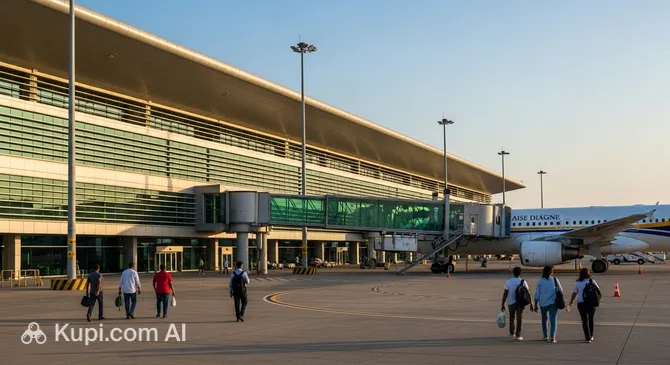
Blaise Diagne International Airport. Source: Kupi.com Binoculars

Welcome to Blaise Diagne International Airport — the main air gateway of Senegal and one of the most modern aviation hubs in West Africa. Opened in 2017, it replaced the capital's old airport and became a symbol of a new era of travel in the region. The airport proudly bears the name of Blaise Diagne, the first African elected to the French Parliament, highlighting its national significance. Located away from the city bustle, it is designed to ensure maximum comfort and efficiency, serving flights from across the globe.

IATA Code DSS
ICAO Code GOBD
City Dakar
Distance to center 43 km
Status International
Passengers per year Almost 3 million (2.94 million in 2023)
Popular Airlines Air Senegal, Air France, Turkish Airlines
Schedule Online Schedule "Blaise Diagne International Airport"

Blaise Diagne Airport is designed as a vital transport hub connecting Africa with Europe, the Middle East, and the Americas. For the convenience of passengers, modern infrastructure is provided here: spacious waiting lounges, free Wi-Fi, currency exchange points, ATMs, duty-free shops, and diverse restaurants. Thanks to its novelty and well-thought-out logistics, the airport offers a high level of service and serves as an excellent starting point for exploring hospitable Senegal.

Contact Information

For your convenience, we have compiled the essential contact information for Blaise Diagne International Airport (DSS).

  • Official Website: www.dakaraeroport.com. Here you will find the most up-to-date information on flights, services, and airport regulations.
  • Information Desk Phone: +221 33 939 69 00. You can clarify general information by calling this number.
  • Address: Route de Popenguine, Diass, Senegal.
  • Email: To contact the administration or specific services, it is recommended to use the contact form available on the airport's official website.
  • Social Media: The airport has official pages on social networks (e.g., Facebook) where news and important updates are published.
  • Lost Luggage Information: If your luggage was lost during the flight, first contact the Lost & Found service of your airline. If you lost an item within the terminal itself, please contact the airport's lost property service.
  • Passenger Support Contacts: Information counters are located within the terminal. You can also use the main information desk phone number for consultation.

How to Get to the Airport

Blaise Diagne International Airport (DSS) is located approximately 50 kilometers east of the center of Dakar, the capital of Senegal. This distance requires planning your trip in advance. Fortunately for travelers, there are several convenient ways to get to the airport or from the airport to the city.

Public Transport: Dakar Dem Dikk Shuttle Buses

The most economical and popular way to reach the airport is to use the state-run shuttle bus services of Dakar Dem Dikk (DDD). These modern air-conditioned buses operate on several routes, connecting the airport with key points in Dakar and neighboring cities such as Thiès and Mbour. The journey from the city center takes from 1.5 to 2 hours depending on traffic conditions. This is a reliable option, the cost of which is significantly lower than a taxi.

Taxi and Private Transfer

For greater comfort, especially if you have a lot of luggage, you can use a taxi. Official taxi services with fixed rates to various districts of the city operate at the airport, which helps avoid lengthy bargaining. The cost of a trip to the center of Dakar will be significantly higher than the bus and may amount to 20,000–25,000 CFA Francs (XOF) or more. You can also pre-book a private transfer through your hotel or an online service — this guarantees you a meeting with the driver and a fixed price.

Car Rental and Parking

If you plan to actively travel around the country, renting a car can be an excellent solution. Desks of international and local rental companies are located in the arrival hall of Blaise Diagne Airport. The road to the city center runs along a toll highway, which allows for reduced travel time. However, please note that traffic within Dakar itself can be very intense. For those arriving at the airport in their own or rented vehicle, both short-term and long-term parking facilities are provided.

Recommendations for Travelers

Always allocate extra time for the journey to the airport, especially during peak hours. Traffic leaving Dakar can be unpredictable. If you are traveling light and wish to save money, the Dakar Dem Dikk bus is your best choice. For maximum convenience and predictable expenses, choose an official taxi with a fixed rate or a pre-booked transfer.

Terminals and Map

Blaise Diagne International Airport (DSS) is distinguished by a modern and well-thought-out structure, making navigation through it simple and intuitive. The airport consists of one main passenger terminal, which serves all domestic and international flights. This eliminates the need for complex transfers and searching for the right building — all processes are concentrated in one place.

The terminal building has two main levels, standard for most modern airports:

  • Upper Level — this is the departure zone. Located here are the check-in counters, baggage drop-off points, and passport and customs control zones. After completing all formalities, passengers enter a spacious waiting area with boarding gates, Duty Free shops, cafes, and restaurants.
  • Lower Level is intended for arriving passengers. You arrive here after disembarking from the aircraft. Located on this level are passport control zones for arrivals, baggage claim belts, and customs inspection. Friends, relatives, or hotel representatives can meet you in the arrival hall.

The terminal layout is logical, and navigation is simplified thanks to clear signs in French and English. You will not have to worry about how to get from one terminal to another, which significantly saves time and reduces stress. The check-in and screening process generally proceeds quite efficiently, however, queues are possible during peak hours and the tourist season. It is recommended to arrive at the airport at least 2.5–3 hours before the departure of an international flight to complete all necessary procedures without haste.

Airport History

The history of Blaise Diagne International Airport (DSS) is a story of ambition and the modern development of Senegal. Although the airport is one of the newest in West Africa, its path to opening was long and significant. It was built to replace the old and congested Léopold Sédar Senghor Airport, which was located within the city limits of Dakar and had no room for expansion. The official opening of the new airport took place on December 7, 2017.

The project was launched back in 2007, but construction faced numerous delays, stretching over a whole decade. These years were filled with financial and organizational difficulties, turning the construction into a major national project. However, the opening of the airport became a landmark event for the entire country. It was named in honor of Blaise Diagne — the first Black African elected to the French Parliament in 1914, underlining his national importance.

Since its opening, Blaise Diagne Airport has become a key element of the "Plan Sénégal Émergent" economic development plan. It was designed as a modern hub capable of serving up to 3 million passengers per year with the possibility of further expansion to 10 million. One of the most interesting facts of its history is the relocation itself: on the night of December 7, 2017, absolutely all flights were simultaneously transferred from the old airport to the new one without stopping air traffic. This was a highly complex logistical operation that marked the beginning of a new era for civil aviation in the region.

Services and Amenities

Blaise Diagne International Airport (DSS) offers passengers a wide range of services to make waiting for a flight as comfortable and productive as possible. In the terminal, you will find diverse dining options: from restaurants offering dishes of local and international cuisine to cozy coffee shops where you can enjoy a cup of coffee with fresh pastries. For shopping enthusiasts, Duty Free shops are open with perfumes, beverages, and souvenirs, as well as boutiques with goods from Senegalese artisans.

For a comfortable rest before departure, passengers can utilize several business lounges, such as Salon Teranga or Salon Prestige. They provide snacks, drinks, press, and conditions created for quiet work or relaxation. Free Wi-Fi is available throughout the airport, and numerous charging stations for gadgets allow you to always stay connected.

It is easy to solve financial matters at Blaise Diagne Airport. At your service are bank branches, currency exchange points, and ATMs available around the clock. In case of necessity, passengers can turn to the medical center, where first aid and consultation will be provided. A pharmacy also operates within the terminal territory.

The airport is fully equipped to serve passengers with reduced mobility: ramps, elevators, and specially equipped restrooms are provided. Airport staff are ready to provide assistance and wheelchairs upon prior request. Families with children will appreciate the availability of mother and child rooms, where one can take care of a baby in a quiet environment.

For those who need to rest between flights, several hotels offering transfers to the terminal are located in the immediate vicinity of the airport. Business travelers can take advantage of business services provided in the VIP lounges: there are work zones with computers, access to printers, and meeting rooms for conducting negotiations.

Where to Eat

At Blaise Diagne International Airport (DSS), travelers will find diverse dining options capable of satisfying any taste and budget. Regardless of whether you are looking for a quick snack before departure or want to enjoy a full lunch in a quiet atmosphere, there is plenty to choose from here.

Most establishments are located in the departure zone (airside), after passing passport control and security screening. Here you will find several restaurants with à la carte service, cafes, and lounges. In the public zone (landside), before check-in, the selection is usually more modest and represented mainly by coffee shops and snack points, which is convenient for those seeing off or meeting passengers.

Be sure to take the opportunity to try local cuisine. Some restaurants offer Senegalese specialties, such as Chicken Yassa (chicken in onion-lemon sauce) or Thieboudienne (rice with fish and vegetables). This is an excellent chance to enjoy the flavors of Senegal one last time before departure. Of course, familiar international dishes are also available: pizza, sandwiches, salads, and pastries.

For those in a hurry, cafes offering fresh coffee, croissants, sandwiches, and soft drinks will be the ideal solution. If time permits, you can settle into one of the restaurants serving hot dishes and offering a wider selection of drinks. Prices at the airport are generally higher than the city average, ranging from budget options in fast-food outlets to higher prices in full-service restaurants.

Most establishments in the departure zone operate around the clock or adjust their schedule to flights, so you will be able to have a snack even at night. Regarding dietary preferences, Halal dishes are easy to find, given the local traditions. Options are also available for vegetarians, mainly in the form of vegetable side dishes, salads, or special meals. It is recommended to check the ingredients with the establishment's staff.

Travel Tips

To ensure your journey through Blaise Diagne International Airport goes as smoothly as possible, follow these tips. Planning in advance will help avoid unnecessary stress and make the beginning or end of your trip to Senegal more comfortable.

Arrival Time at the Airport: For international flights, it is recommended to arrive at the airport at least 3 hours before departure. For domestic flights, 1.5-2 hours is usually sufficient. This will give you enough time to complete check-in, baggage drop, and security control without haste, even if queues arise.

Check-in and Security: Many airlines offer online check-in, which can save time. However, if you are traveling with luggage, you will still need to go to the baggage drop counter. Have your passport and boarding pass ready. During security screening, be prepared to remove laptops and other large electronic devices from your carry-on, as well as liquids in a transparent bag.

Seat Selection on the Plane: Classic choice: a window seat for beautiful views during takeoff and landing, or an aisle seat for greater convenience if you need to move around during the flight. If you are flying to Dakar, try to find out which side offers the best views of the coast — this may depend on your flight route.

Carry-on Rules: Standard international rules usually apply here as well. Liquids can be carried in containers up to 100 ml, packed in a single transparent bag. Sharp objects, flammable substances, and other dangerous items are prohibited. Always check your airline's rules, as there may be additional restrictions on weight and size.

Transit Passengers: Blaise Diagne Airport is a modern transit hub. If you have a connecting flight, follow the "Transit" or "Flight Connections" signs. Clarify with the airline at your initial check-in whether you need to collect and re-check your luggage. The transit zone has shops, cafes, and comfortable places to wait for the next flight.

Customs Control: When entering Senegal, have your passport, visa (if required), and completed migration card, which is often distributed on the plane, ready. Be prepared to answer standard questions about the purpose of your trip. If you are carrying large sums of money or expensive goods subject to declaration, familiarize yourself with the country's customs regulations in advance.

Saving Time and Money: To save on taxis, consider booking a transfer in advance or use official taxi services at the airport. Inside the terminal, there are ATMs and official currency exchange points — this is safer and often more favorable than private money changers. Bring an empty reusable water bottle to fill after passing security control.

If the Flight is Delayed: In case of a flight delay, follow the information on the departure boards and in your airline's app. For long delays, airlines are obliged to provide drinks and meals. Do not hesitate to contact the airline representative's counter for information. Having travel insurance can also help compensate for unforeseen expenses.
Reached the end of the page?

That means the route is fully explored