Support

Kismayu

About the Airport

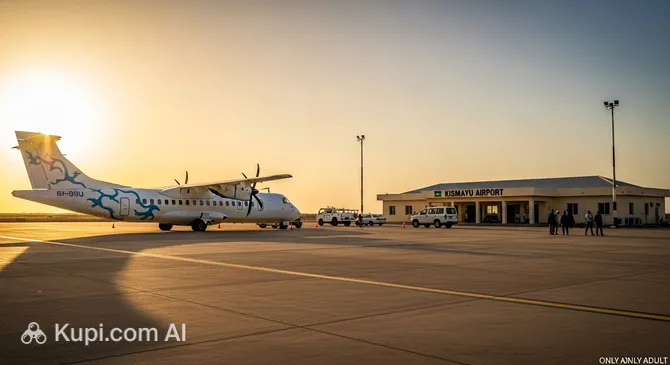
Kismayu. Source: Kupi.com Binoculars

Kismayu Airport is not just a regional transport hub, but a true aerial gateway to the southern part of Somalia and the vibrant Jubaland region. Located just a few kilometres from the turquoise waters of the Indian Ocean, it welcomes travellers with a warm sea breeze and an atmosphere of authenticity. For many tourists, this is where their acquaintance with the ancient port city, which has served as a crossroads for East African trade routes for centuries, begins. Despite its modest size, the airport plays a key role in the life of the region, connecting it with the capital and neighbouring countries.

IATA Code KMU
ICAO Code HCMK
City Kismayo
Distance to city centre ~10 km
Status International / Domestic
Annual Passengers No official data
Schedule Check with the airline

Airport Features and Advantages:

  • Strategic Location: The airport is located in close proximity to the city, allowing you to reach the centre and major hotels in just 15–20 minutes by car.
  • Clear Navigation: Thanks to the compact terminal, all procedures — from check-in to boarding — take place in a single building, eliminating the risk of getting lost.
  • Updated Infrastructure: In recent years, the runway and terminal have undergone reconstruction, improving the level of comfort and safety for passengers.
  • Regional Air Link: It serves as a vital link for business trips and humanitarian missions in the Jubaland region, and also handles flights from neighbouring Kenya.

Contact Information

Finding precise and up-to-date contact information for Kismayu Airport (KMU) can be challenging. Most flight-related issues are resolved directly through the airlines. Below is general information that may be useful for travellers.

  • Official Airport Website: Currently, Kismayu Airport does not have an official website. For information regarding flights, schedules, and regulations, it is recommended to contact your airline's website directly.
  • Inquiry Service Phone: There is no single public phone number for inquiries. For urgent questions or to clarify details regarding your flight, please contact the customer service department of the airline you are flying with.
  • Airport Address: The airport is located in the immediate vicinity of the city of Kismayo, Somalia. A precise postal address is generally not used; for navigation and taxis, stating "Kismayo Airport" is sufficient.
  • Email: There is no public email address for general inquiries. All communications are recommended to be conducted through the official channels of the air carriers.
  • Airport Social Media: Official social media pages for the airport are currently unavailable. We recommend following updates on your airline's pages.
  • Lost Luggage Information: If your luggage has been lost or damaged, you should immediately contact your airline's representative at the arrival airport. The air carrier is responsible for tracing and delivering luggage.
  • Passenger Support Contacts: Passenger support regarding booking, ticket changes, special services, and other topics is provided by the airlines. Their contact details can be found on their official website or on your ticket.

How to Get to the Airport

There are several ways to get from the city centre of Kismayo to the airport (KMU), but the options for tourists have their own specificities. The airport is located near the city, and the journey usually takes from 20 to 40 minutes depending on road conditions and the chosen transport.

Taxis and Private Transfers are the most reliable and recommended method for travellers. You can find a taxi in the city or ask hotel staff to arrange a car for you. Key point: always agree on the cost of the trip with the driver in advance, as taximeters are practically not used. A taxi ride is relatively inexpensive, but the price depends on your negotiation skills. Booking a transfer through a hotel may be slightly more expensive, but it guarantees safety and a fixed price.

Public Transport in the conventional sense (regular buses with a clear schedule) is poorly developed in Somalia. Movement around the city and its surroundings is mainly carried out by route taxis (minibuses) or shared taxis. This option can be significantly cheaper, but it is less comfortable and predictable. Routes do not have strict stops, and vehicles can be overcrowded. It is not recommended for tourists without knowledge of local customs and language to use such transport.

Car Rental is possible, but is most often provided with a driver. Self-driving for foreigners is not a common practice due to road conditions and safety considerations. Renting a car with a driver is a good option for those who value comfort and flexibility. As for parking at the airport, it exists, but typically consists of a simple lot and is more suitable for quick drop-offs and pick-ups than for long-term vehicle storage.

If you are considering other flight options within the region, there are several airports nearby. In neighbouring Kenya, there is Lamu Airport (LAU), Wajir Airport (WJR), and Malindi Airport (MYD). The largest aviation hub in the country is Mogadishu International Airport (MGQ), located at a distance of about 412 km.

Terminals and Map

Kismayo Airport (KMU) is a small regional aviation hub serving the southern part of Somalia. Its infrastructure is quite simple and consists of one main terminal, which is used for all passenger flights, both domestic and the few international ones.

The terminal building is a compact and functional structure. The departure and arrival zones are under one roof, making navigation intuitively clear. You won't have to worry about transfers between terminals or long walks to the boarding gate — everything is located within walking distance. The airport layout is very simple: after entering, you find yourself in a general hall where the check-in counters are located, followed by the security screening area and a small waiting lounge.

Check-in procedures and security screening typically do not take much time due to the low passenger flow. Nevertheless, it is recommended to arrive at the airport well in advance, at least 2 hours before departure. This will allow you to complete all formalities without rushing, especially considering that some processes may be performed manually, which sometimes slows down service.

The main advice for navigating Kismayo Airport is its simplicity. It is practically impossible to get lost here. The main zones — check-in counters, security area, and waiting lounge — are arranged sequentially and logically. Signage may be minimal, but in case of questions, airport staff are always ready to assist and point out the direction.

Airport History

The history of Kismayo Airport (KMU), also known as Kismayo National Airport, reflects the complex history of the entire region. The airport was built in the mid-20th century and initially served as an important transport hub for the southern part of Somalia, providing links to Mogadishu and other parts of the country. Its creation was a strategic step for the development of the Jubaland region, of which Kismayo is the centre.

Throughout its history, the airport has played a key role not only in civil transport but also in humanitarian missions. During periods of instability, it became a vital facility for the delivery of food, medicine, and other aid to the population. Its runway has hosted aircraft from international organisations, highlighting its strategic importance for all of Somalia.

In the 21st century, significant stages of reconstruction and modernisation of the airport began. Efforts were directed towards restoring and improving the runway, building a new terminal, and updating navigation equipment. These works have improved safety levels and prepared the airport for the resumption of regular commercial flights, including international ones. The modernisation has become a symbol of revival and the region's aspiration for stability and economic growth.

One interesting fact in the airport's history is its multifunctionality. It has repeatedly transitioned from performing exclusively civil functions to the role of a key base for peacekeeping and humanitarian operations and back again. Today, Kismayo Airport serves as the gateway to southern Somalia, striving to regain its status as an important regional aviation hub connecting Kismayo with the world.

Services and Facilities

Kismayu Airport (KMU) is a key transport hub for the region, providing passengers with a basic set of services for a comfortable wait before their flight. It is important to note that the airport's infrastructure corresponds to its regional status, and the range of amenities may be limited compared to large international hubs.

In the terminal, you will find several small cafes and kiosks where you can have a snack, drink coffee, or purchase essential items and local souvenirs. The selection of establishments and shops is modest but sufficient to pass the time before departure.

General waiting lounges are equipped for passengers awaiting flights. For those preferring more comfort, a VIP lounge may be available, offering a quieter environment. Access to Wi-Fi and charging points for mobile devices may be limited, so it is recommended to carry a portable power bank.

Currency exchange points can be found within the airport grounds. Basic medical services are also available in case first aid is needed. For passengers with children and travellers with reduced mobility, it is recommended to contact the airline in advance to arrange special services, such as assistance or the provision of a wheelchair.

There are no hotels within the airport building itself, however, various accommodation options can be found in the city of Kismayo, located nearby. There are no specialised conference rooms or business centres provided at the airport.

Dining

When planning a flight through Kismayo Airport (KMU), it is important to consider that this is a small regional aviation hub, and dining options here are quite modest. Do not expect a wide variety of restaurants and cafes as found in major international airports. Nevertheless, finding a simple snack or drinks before departure is quite possible.

Typically, small kiosks or cafeterias operate in the main and only terminal of the airport. They are located in the general area, accessible to both departing passengers and those seeing them off. Here you can purchase basic snacks, pastries, and drinks. This is a good option for a quick bite if you are short on time.

If you are lucky, you might be able to try some local dishes. Look out for sambusa (similar to samosa) — triangular pastries with meat or vegetable filling, which are a popular snack in Somalia. You will also almost certainly be able to order traditional Somali tea (shaah) — strong black tea with spices and milk. regarding a full meal, the choice will be extremely limited, so it is better to eat before arriving at the airport.

Most dishes offered at the airport will be halal by default. However, finding specialised vegetarian, vegan, or gluten-free options may be difficult. If you have strict dietary restrictions, it is strongly recommended to bring food with you. Prices in local establishments are usually low, but it is recommended to carry cash, as card payments may not be available. The opening hours of cafes are generally tied to the flight schedule.

Travel Tips

To ensure your journey through the airport of Kismayo goes as smoothly as possible, make use of these practical tips. Given that this is a small regional airport, advance planning will help avoid unforeseen situations and make your experience more comfortable.

Arrival and Check-in. It is recommended to arrive at the airport at least 2–3 hours before departure. Check-in and security procedures here may be conducted manually and take longer than in major hubs. Online check-in is generally unavailable, so you will need to obtain a boarding pass at the airline counter. Keep your passport, tickets, and other documents close at hand.

Cash and Transport. Definitely carry a sufficient amount of cash (US Dollars or Somali Shillings). Bank cards are practically not accepted at the airport or for taxi payments. It is strongly recommended to arrange a transfer in advance from the airport with your hotel or a trusted local contact, as finding reliable transport upon arrival can be difficult.

Security and Hand Luggage. It is forbidden to carry liquids in containers larger than 100 ml and sharp objects in hand luggage. Most importantly: always keep all valuables, documents, necessary medication, portable chargers, and cash with you in your hand luggage. Be prepared for a simple but thorough security check.

Passport and Customs Control. Upon entering Somalia, be prepared to present your passport, visa (if required), return ticket, and proof of accommodation booking. The border control officer may ask questions about the purpose of your visit. If you are carrying goods subject to declaration, declare them to avoid problems.

For Transfer Passengers and in Case of Delays. If you have a connecting flight, clarify at check-in whether you will need to collect and re-check your luggage. In the event of a flight delay, remain calm and contact an airline representative. Information support may be limited, so patience is your best helper. Having travel insurance will be a big plus.

General Tips. If the airline allows, choose a seat during check-in: by the window (A, F) for views or by the aisle (C, D) for convenience. Services at the airport are minimal, so bring a book or download movies to your device. It is also helpful to have a bottle of water (purchased after security) and a light snack with you.

Airports in nearby cities

Reached the end of the page?

That means the route is fully explored