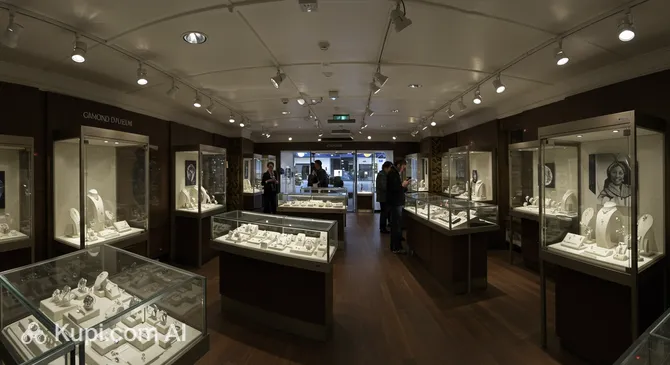
A visit to the Cape Town Diamond Museum is an immersion into the glittering world of the planet's most precious stones. Located in the heart of the vibrant Victoria & Alfred Waterfront in Cape Town, this museum tells the fascinating story of diamond mining in South Africa. Here, guests can trace the journey of a stone from its birth in the Earth's depths billions of years ago to its transformation into an exquisite piece of jewelry.
Cape Town Diamond Museum. Illustration.
Source: Kupi.com AI
Traveler photos:
The museum's exhibition is unique in that it offers an immersive experience. Visitors can see exact replicas of the most famous diamonds in history, such as the "Cullinan," "Hope," and "Taylor-Burton," and appreciate their impressive size and clarity. The museum uses authentic artifacts, historical photographs, and interactive installations to bring the era of the Kimberley diamond rush to life.
A special atmosphere is created by a realistic mine model with appropriate sound effects and lighting, allowing you to feel what it was like for the first miners. The introduction to the world of luxury concludes in the modern Shimansky showroom, where masterpieces of jewelry art are displayed. This site is recognized as an important cultural landmark and is a must-visit for those who want to understand why South Africa is called the country of diamonds.
Contacts
For those planning a visit and wishing to clarify tour details, the museum provides several ways to get in touch. You can book a tour in advance or ask staff questions by phone or through the official website. Detailed contact information is provided below for your convenience.
The main reason to visit the museum is the professional guided tour, which takes guests through all stages of a stone's "life." You will be able to study the displays dedicated to geology and the formation of kimberlite pipes in detail. A particular highlight for visitors is the collection of world replicas of famous diamonds, where you can visually compare the legendary "Cullinan" with other historical finds.
The interactive part of the museum allows you to step into a replica mine, where sound effects recreate the atmosphere of working underground. For those interested in history, there is a visual timeline covering the period from 3.3 billion years BC to the key discoveries of the 19th century. You will see authentic tools used by miners of past centuries: sieves, lamps, and personal items preserved from the time of the rush.
After immersing yourself in history, guests are invited to the Shimansky showroom. Here you can witness the diamond cutting and polishing process firsthand and admire finished pieces. This is an excellent opportunity to learn the secrets of choosing a high-quality diamond and to see rare tanzanite, which is found only in Africa. The museum's intimate and cozy setting makes this experience very personal and educational.
Getting There
The museum is located in one of the city's most popular and safest areas—the Victoria & Alfred Waterfront, on the first level of the Clock Tower building. Thanks to this location, it is easy to reach on foot if you are already in the waterfront area or have arrived here for a tour to Robben Island.
From the city center, it is most convenient to take a taxi or use popular services like Uber and Bolt. Cape Town also has an excellent network of MyCiTi buses, which run regularly to the Waterfront stop. If you are coming from the airport, the car journey will take approximately 20–30 minutes depending on traffic.
For those who prefer to travel by their own or a rented vehicle, there are many multi-level parking lots in the V&A Waterfront area. The historical Clock Tower, a bright red building visible from afar, can serve as a landmark for navigation.
Nearest city: Cape Town
History & Facts
The history presented in the museum begins incredibly long ago—more than 3 billion years ago, when the first diamonds began to form under colossal pressure in the Earth's mantle. The exhibition describes this geological process in detail before transporting visitors to the beginning of the human "diamond era," which started in India as far back as 2500 BC.
Particular attention is paid to a life-changing event for South Africa: in 1867, a 15-year-old boy named Erasmus Stephanus Jacobs found a transparent pebble on the banks of the Orange River. This discovery, which became the famous "Eureka" diamond, marked the start of the great diamond rush. Shortly thereafter, incredibly rich deposits were discovered in Kimberley, and by the 1880s, the country was providing 95% of the world's production of these precious stones.
The museum also highlights the activities of key industry figures, such as Cecil Rhodes and the founders of De Beers. Visitors can see how mining methods transformed: from simple washing of river sand to the creation of giant open-cast pits, such as the legendary "Big Hole". This is not just a history of stones, but a chronicle of how diamonds shaped the modern face of South Africa.
Time Needed
For a standard tour of all exhibits, including viewing the historical dioramas and the collection of famous diamond replicas, 45 to 60 minutes is sufficient for most visitors. This time is enough to slowly study the information stands and appreciate the skill of the diamond cutters.
If you plan to join a professional guided tour or linger in the showroom to take a closer look at jewelry made from diamonds and rare tanzanite, you should allow for about an hour and a half. The museum is quite compact, so a visit can easily be combined with other activities at the waterfront.
Working Hours
The museum hospitably opens its doors to visitors daily, offering a convenient schedule for tourists. From Monday to Sunday, the exhibitions are available for viewing from 9:00 AM to 8:00 PM, making it easy to include a visit in your plans for a walk along the waterfront, even in the evening.
9:00 – 20:00
Nearby
The museum's location in the Victoria & Alfred Waterfront makes it an ideal starting point for further exploration of the city. Exploring the surroundings will allow you to immerse yourself in the region's maritime history, enjoy modern architecture, and feel the dynamic rhythm of Cape Town life.
The area around the museum is home to many interesting locations, from historical monuments to modern entertainment centers. Be sure to set aside time to stroll along the piers and visit neighboring cultural sites.