Support

Avila (Railway Station)

About the Station

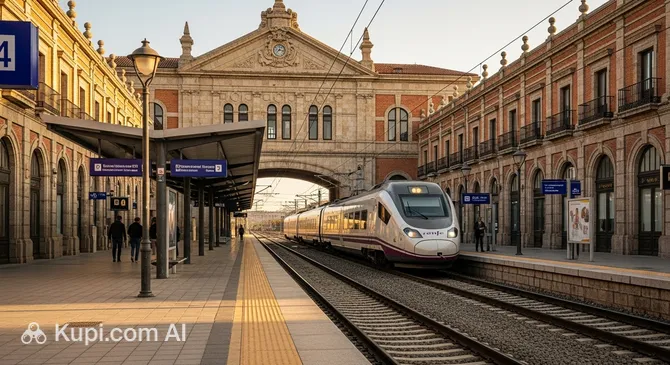
Ávila Railway Station is a key transport hub providing tourists access to one of the most picturesque medieval cities in Spain.

Ávila Railway Station. Source: Kupi.com Binoculars
The station is located in the modern part of the city but is within walking distance of the famous fortress walls and the historic centre. Trains arrive here daily from Madrid, Salamanca, and other major cities in the region, making the station a convenient starting point for your travels.

CityÁvila
CountrySpain
TypeRailway Station

The station building is compact with simple navigation, so it is difficult to get lost here. Inside, passengers will find ticket counters, an information board, and a waiting area; exits to the platforms are clearly marked with signs. Ramps and crossings are provided for the convenience of travellers with heavy suitcases.

You can reach the main attractions from the station on foot in approximately 15–20 minutes, walking along a straight street. If you prefer transport, there is a taxi stand and a stop for city buses located right at the exit of the building, which run to the old town. This makes transferring from the train to local transport quick and comfortable.

Contact Information

To check the schedule, request special services, or plan your route, the following contacts and technical details of the station will be useful:

  • Official website: adif.es (information portal of the management company Adif).
  • Inquiry phone: +34 912 320 320 (general information line of the operator Renfe).
  • Address: Paseo de la Estación, s/n, 05001, Ávila (Spain).
  • Opening hours: The station building is open daily from 06:00 to 23:30 (ticket counter hours may vary).
  • Luggage storage note: Please note that there are no automatic lockers for luggage storage at the station. It is recommended to find private storage points in the city in advance through specialised apps.
  • Accessibility information: The station is fully adapted for passengers with reduced mobility (barrier-free access, ramps); a free boarding assistance service Atendo is available (booking in advance is recommended).

How to Get There

Thanks to the city's compact size, getting to Ávila Railway Station is quite simple, regardless of the mode of transport you choose. The station is conveniently located at the end of the avenue Paseo de la Estación, connecting the modern district with the historical core.

The most scenic and popular option is to go on foot. From the main tourist gates of the city and Santa Teresa Square (Plaza de Santa Teresa), the journey will take just 10–15 minutes. The route runs straight along the street Paseo de Don Carmelo or the parallel Calle Duque de Alba. The pavements here are wide and convenient, so a walk even with a small suitcase will not cause any trouble.

If you prefer public transport, use the city buses. The route network in Ávila connects the station with the hospital, university, and the old town. The stop is located in the immediate vicinity of the terminal entrance. Tickets are purchased from the driver, and the journey time from the centre will be about 5–10 minutes depending on traffic.

For travellers with bulky luggage or in case of early departure, a taxi is the best option. A trip from hotels inside the fortress walls to the station will take no more than 5–7 minutes. Official tariffs apply in Ávila, and the cost of a transfer within the city usually varies between 6–8 Euros. You can order a car through the hotel reception or find one at stands near the main attractions.

Services and Amenities

Despite its compact size, Ávila Railway Station offers passengers the necessary set of services for a comfortable start or end to their journey. The building is designed so that all functional zones are within sight, making navigation intuitive even for first-time visitors.

To purchase travel documents, traditional ticket counters operate in the lobby with staff ready to help with route selection. If you are in a hurry or prefer independence, you can use self-service terminals to buy and print tickets for Renfe trains. It is recommended to arrive at the station in advance, as small queues may form at the machines during peak hours.

While waiting for a trip, passengers can sit in the general waiting hall. This is a clean and bright space equipped with seats. Free Wi-Fi (Adif operator network) is usually available on the station premises, although signal quality may vary. Regarding charging gadgets, the number of available power outlets in the hall is limited, so travellers are advised to carry a fully charged power bank.

The infrastructure also includes clean toilets and vending machines with drinks and light snacks where you can have a bite before the road. An important nuance for tourists with large luggage: there is no luggage storage (automatic lockers) at the station. Leaving things at the station is not possible, so it is better to resolve the luggage issue in advance at your hotel or through city services.

Special attention is paid to the accessible environment. The station is fully adapted for passengers with reduced mobility: entrances are equipped with ramps, and there are specially equipped washrooms. In addition, the Atendo assistance service operates here, where staff accompany passengers in wheelchairs from the building entrance to boarding the carriage (it is advisable to request this service when buying a ticket).

Where to Eat

The gastronomic infrastructure of the station itself is quite modest, which is typical for small stations. Inside the terminal, there is usually a classic cafeteria where you can drink a cup of strong café con leche (coffee with milk) and have a snack with fresh pastries or a tortilla. This is a convenient option for a quick breakfast before departure; the average bill here will be just 3–5 Euros. If the café is closed, vending machines with water, chocolate bars, and crisps are available to help passengers.

For a more varied and substantial meal, it is better to exit the building onto the avenue Paseo de la Estación. Literally two steps from the entrance, there are several local cafés and lounges. Here you will be offered famous Spanish bocadillos (baguette sandwiches) with cheese, calamari, or local cured meats. Such a snack is convenient to take with you on the train, and it will be much tastier than shop-bought alternatives.

If time allows you to stay for lunch, look for signs saying Menú del día ("Menu of the Day") in nearby establishments. A set lunch, including a starter, main course, drink, and dessert, will cost approximately 12–15 Euros. This is an excellent opportunity to try local dishes at a reasonable price without straying far from the platform.

It is important to consider that there are no 24-hour dining establishments directly at the station. Most cafés close around 22:00–23:00, and the kitchen may stop working even earlier. If your train arrives late at night, it is recommended to take care of food in advance, as the only available option will be snack machines inside the station.

Station History

The history of railway communication in Ávila dates back to the second half of the 19th century, when Spain was actively developing its transport network. The grand opening of the station took place in 1863. This event was a real breakthrough for the city, which had been isolated for centuries by fortress walls and mountainous terrain. The arrival of the train connected Ávila with Madrid and the French border, giving a powerful boost to trade and the first tourist visits.

Initially, construction and management were carried out by the famous "Northern Railway Company" (Compañía de los Caminos de Hierro del Norte de España). The passenger terminal building, preserved to this day, is a fine example of classic railway architecture of that time. It is made of stone and brick, combining functionality with strict elegance, harmonising with the austere appearance of the city itself.

An important stage in the station's history was 1941, when, as a result of the nationalisation of railways, the station came under the management of the state company Renfe. In subsequent decades, the station was modernised repeatedly: track electrification, security system updates, and platform reconstruction were carried out. However, despite technical improvements, the external historical appearance of the building was carefully preserved.

Today, the role of the station in Ávila's transport system is difficult to overestimate. It has turned into a key hub for regional Media Distancia transport. Thanks to convenient and fast connections with Madrid (travel time is about one and a half hours), the station ensures a constant flow of tourists wishing to see the famous fortress walls and allows local residents to comfortably work or study in the capital.

Passenger Tips

To ensure your journey through Ávila Railway Station goes as smoothly as possible, we have prepared several practical recommendations. Although the station is small and intuitive, knowing local features will help avoid unnecessary stress before departure.

Arrival time and security check. For regional (Media Distancia) and long-distance trains, it is recommended to arrive at the station no later than 20–30 minutes before departure. This time is enough to get your bearings and pass security control. Please note: before proceeding to the tracks, your luggage may be scanned through an X-ray belt. The procedure is quick but requires a small queue.

Tickets and boarding. Boarding usually ends 2 minutes before the train departs. Keep your tickets handy: inspectors may check them both at the entrance to the platform and directly in the carriage. If you are using an electronic ticket on a smartphone, increase the screen brightness in advance for scanning the QR code. For paper tickets without a specified seat (if purchased), do not forget to validate them in the special orange validators before going out to the platform.

Luggage. According to Renfe rules, each passenger can transport up to 3 pieces of luggage free of charge, the total weight of which does not exceed 25 kg. It is important to remember that suitcase racks in carriages are located at the beginning and end of the cabin, so it is better not to delay boarding to occupy a convenient place for your belongings. And once again, a reminder: there are no luggage lockers at the station, so plan your logistics so that you do not have to carry heavy bags with you if you have time for a walk around the city.

Navigation and transfers. Transition between platforms is carried out via a convenient underground passage. The station is equipped with lifts, making transfers with heavy luggage or a pushchair comfortable. Information boards on the platforms clearly indicate the train number and direction, and voice announcements are duplicated, so it is difficult to miss your trip.

Night waits. This is one of the most important points: Ávila station does not operate 24 hours a day. The building closes for the night after the arrival of the last train (around 23:30) and opens early in the morning (around 06:00). You cannot plan to sleep in the waiting hall. Also, consider the climate: Ávila is the highest provincial capital in Spain, so nights here can be very cold even in summer. If you have a night transfer or early departure, be sure to book a hotel nearby in advance.
Reached the end of the page?

That means the route is fully explored