Support

Burgos

About the Airport

Burgos Airport (RGS) is not a bustling international giant, but rather a cosy and modern gateway to the very heart of historic Castile. It serves as an ideal starting point for those who value comfort and dislike the hustle and bustle of large terminals. Located just a few kilometres from the city, this compact airport allows you to begin exploring the treasures of northern Spain almost immediately after landing.
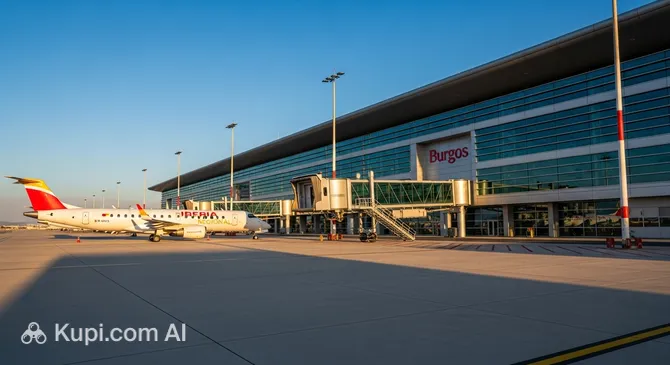
Burgos. Illustration.
Source: Kupi.com AI
PropertyValue
IATA CodeRGS
ICAO CodeLEBG
CityBurgos
CountrySpain
TimezoneEurope/Madrid
ScheduleOnline Timetable

The main advantage of Burgos Airport is its compactness and efficiency. Thanks to the low passenger flow, all pre-flight formalities, from check-in to security screening, take minimal time. The terminal is modern and intuitive, making your stay there as comfortable as possible. The airport primarily focuses on domestic and seasonal flights, connecting the region with the country's major tourist hubs.

Despite its modest size, the airport offers all necessary services: car rental desks, a taxi rank, and a café. Its strategic location makes it an excellent choice for travellers planning to explore not only Burgos itself, with its majestic Gothic cathedral, but also other cities in the Castile and León region. From here, it is convenient to reach the vineyards of Ribera del Duero or the Atapuerca archaeological complex, a UNESCO World Heritage site.

Contact Information

  • Official Website: www.aena.es/es/aeropuerto-burgos
  • Information Desk Phone: (+34) 947 28 30 00
  • Airport Address: Carretera N-120, km 103, 09199 Cardeñajimeno, Burgos, Spain
  • Email: Communication with the airport administration is conducted via the contact form on the official Aena operator website.
  • Social Media: News and important information are published on the centralised pages of the Aena airport network (e.g., on Twitter: @aena).
  • Lost Luggage Information: For questions regarding lost or damaged luggage (Lost & Found), please contact your airline's representative office directly.
  • Customer Support Contacts: For general information and support, you can also use the central Aena service phone number: (+34) 913 21 10 00.

How to Get to the Airport

Burgos Airport (RGS) is located just 4 kilometres east of the city centre, making it easily accessible for travellers. There are several ways to get from Burgos to the terminal, each convenient in its own way.

Public Transport is the most economical option. Special bus route No. 25 connects the city centre (departing from Plaza de España) with the airport. It is important to remember that the schedule of this bus depends directly on flight arrival and departure times, so be sure to check the current timetable before your trip. The journey takes about 20–30 minutes, and the ticket price is comparable to a regular city bus fare.

Taxi or Private Transfer is the fastest and most comfortable way to reach the airport. The trip from the centre of Burgos will take just 10–15 minutes. The estimated cost of a taxi ride is €10–€15, but this may vary slightly depending on the time of day and luggage. For greater convenience and a fixed price, you can book a private transfer in advance.

If you plan to explore the surroundings of Burgos and the Castile and León region, renting a car is a good solution. You can pick up a car in the city and easily drive to the airport via the N-120 highway. For those arriving in their own vehicle, the airport provides official AENA parking, located directly opposite the terminal. It is suitable for both short-term and long-term parking.

Since Burgos Airport mainly serves domestic and seasonal flights, it is worth considering other gateways to northern Spain. Major international airports are within a 1-2 hour drive: Bilbao Airport (BIO), Santander Airport (SDR), Vitoria Airport (VIT), and Valladolid Airport (VLL). From these, you can easily reach Burgos by bus or rental car.

Terminals and Map

Burgos Airport (RGS) is a compact and modern regional airport distinguished by its simplicity and convenience for passengers. Its main feature is that it consists of a single passenger terminal that handles all flights — both departures and arrivals.

Due to its small area, the airport's layout is intuitively understandable. All key zones are located in one building on a single level, eliminating the need for long walks or shuttles. Immediately after entering the terminal, you find yourself in the general hall where the check-in counters are located. After checking in and dropping off luggage, passengers proceed to security screening, followed by a small but cosy departure lounge with boarding gates. The arrival zone is equally simple: after disembarking, passengers go straight to the baggage claim hall with one belt and then into the general hall.

Completing all formalities at Burgos Airport usually takes very little time. Due to the low passenger traffic, queues for check-in and security control are minimal or non-existent. The entire process from entering the building to arriving at the boarding gate rarely takes more than 20–30 minutes. Nevertheless, it is recommended to arrive at the airport in advance, in accordance with your airline's rules, especially during peak summer months.

No special advice is needed for navigating the terminal — getting lost here is practically impossible. All signs are clearly visible and easy to understand. This airport is perfect for those who value their time and prefer to avoid the hustle of large aviation hubs, starting their journey through northern Spain in a calm and comfortable environment.

Airport History

The history of Burgos Airport (RGS), also known as Villafría, goes back to the early 20th century. Its predecessor, the Gamonal airfield, was established in the 1920s and was initially used for military purposes. During the Civil War in Spain, it became one of the most important airbases, permanently inscribing it into the country's history. After the war, the airfield was opened for civil flights, but its role in commercial aviation remained insignificant, and over time it practically ceased to accept regular passenger transport.

A new era for air travel in Burgos began in the 21st century. The authorities of the Castile and León region decided to build a modern airport capable of meeting the needs of the growing city and becoming a catalyst for economic development. The large-scale project included the construction of a new passenger terminal covering more than 2,300 square metres, a new runway 2,100 metres long, and a modern control tower. The old airfield was completely reconstructed to meet international standards.

The official opening of the renovated Burgos Airport took place on July 3, 2008. This event was a real achievement for the city, which had waited decades for direct air connections. Although the airport does not break passenger traffic records, its existence plays an important role in the logistics and business development of the region. An interesting fact: more than half a century passed between the peak of its military activity and its modern civil revival, making its history a unique example of transport infrastructure transformation in Spain.

Services and Amenities

Burgos Airport (RGS) is a compact regional hub offering passengers all necessary services for a comfortable wait. Despite its small size, the terminal infrastructure is designed to ensure convenience before departure or after arriving in this picturesque corner of Spain.

Dining and Shops. There is a cafeteria in the airport building where you can have a snack, drink coffee, or buy soft drinks. It is a great place to pass the time while waiting for boarding. The selection of shops is limited, but you can find newspapers and essential items here.

Terminal Amenities. For passenger convenience, free Wi-Fi is available throughout the terminal. There are also zones for charging electronic devices. The airport has ATMs, but for currency exchange, it is better to visit banks in the city itself. There are no dedicated VIP lounges in the airport; the general passenger hall serves as the main waiting area.

Special Services. The airport is fully equipped to serve passengers with reduced mobility. Assistance during boarding and disembarking (PRM service) is provided, which is recommended to be booked in advance through the airline. For travellers with small children, a mother and child room is available. In case of necessity, one can visit the first aid station.

Business Services and Hotels. There are no hotels or conference rooms within the airport itself. The nearest hotels and business centres are located in the city of Burgos, which can be quickly reached by taxi or rental car. This is a convenient option for those arriving late in the evening or planning business meetings.

Where to Eat

Burgos Airport (RGS) is a small regional airport, so the choice of dining establishments here is limited. Nevertheless, passengers can have a snack or a coffee before their flight, but it is important to understand that options are few.

The main and, typically, the only place for food at the airport is the cafeteria-restaurant. It is located in the public zone of the terminal, before security control (landside), making it accessible to both departing passengers and those seeing them off. Here you can order coffee, soft drinks, pastries, as well as more substantial options such as Spanish baguette sandwiches (bocadillos) with various fillings and simple hot dishes.

Regarding local cuisine, the café may offer snacks characteristic of the Castile and León region, but one should not expect a full restaurant menu. If you are lucky, you might try a sandwich with local cheeses or sausages. For a quick snack, a croissant and coffee are perfect, and for something more substantial — a bocadillo or a ready-made salad.

Passengers with special dietary needs should be prepared for a limited selection. Vegetarian options are usually reduced to a cheese sandwich or vegetable salad. Finding specialized vegan, gluten-free, or halal dishes in such a small airport will likely not be possible. It is recommended to bring suitable food with you.

The cafeteria's opening hours are directly linked to the flight schedule — it opens a few hours before departure and closes after the last plane leaves. Prices here are typical for airports in Spain: somewhat higher than in city establishments. Given the limited choice, if you have time, the best solution would be to have a full meal in one of the numerous restaurants in Burgos before travelling to the airport.

Travel Tips

Planning a trip through Burgos Airport (IATA: RGS) will be easier if you consider a few tips. This is a small regional airport, so large crowds are rare here. For domestic flights within Spain or within the Schengen area, arriving 1.5–2 hours before departure is usually sufficient. If your flight is international (outside Schengen), it is better to allow 2.5 hours. This time will be enough to complete all formalities without rushing.

To save time, use online check-in if your airline provides this option. This will allow you to go straight to baggage drop or, if you are travelling light, to the security checkpoint. Security control here is usually quick, but the rules are standard: liquids in hand luggage must be in containers of no more than 100 ml and packed in a transparent bag. All electronic devices, including laptops and tablets, must be removed from bags for scanning.

When choosing a seat on the plane, consider your preferences. Window seats will offer you beautiful views of Castile and León during takeoff and landing. If quick access to the aisle is important to you or you want the ability to stretch your legs, choose an aisle seat. You can save money at the airport by bringing an empty water bottle and filling it after passing security, as well as taking care of light snacks in advance to avoid spending money on expensive food.

Burgos Airport is not a major transfer hub, so flights with short connections are rare here. If you are planning a transfer yourself, allow sufficient time between flights. In case of flight delay, remember your rights: for flights departing from the EU, regulation EU261 applies, which provides for compensation and assistance from the airline. Since amenities in a small airport may be few, download movies or take a book in advance to pass the waiting time.

Customs control for most passengers goes unnoticed, as the majority of flights are operated within the Schengen zone. If you are arriving from a country outside the EU, you will need to pass through customs. Follow the green channel if you have nothing to declare, or the red channel if you have goods subject to declaration. Customs officers may conduct random checks, so be prepared to answer questions about the purpose of your trip and the contents of your luggage.

Reached the end of the page?

That means the route is fully explored