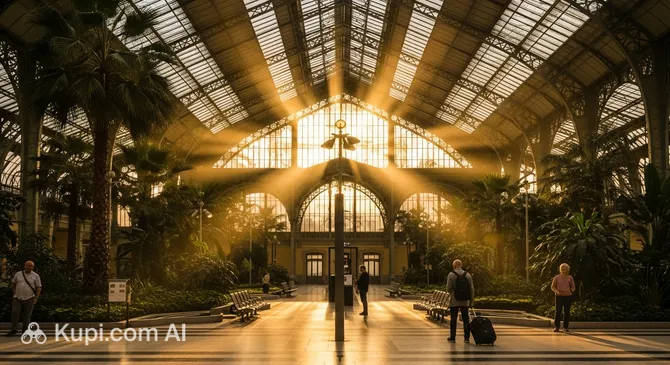
Atocha Station (Estación de Atocha) is the largest railway hub in Madrid and one of the most recognizable stations in Spain. It is famous for its unique architectural design: the historic terminal building was transformed into a magnificent tropical garden, where passengers can relax while waiting for their trip amidst palms and exotic plants. Both commuter trains and high-speed AVE trains depart from here, connecting the capital with Barcelona, Seville, and Valencia.
It is important for passengers to know that the station is a complex facility divided into two main zones: the historic part with the garden and the modern terminal. Long-distance trains usually depart from the Puerta de Atocha station, while commuter trains leave from the underground Atocha-Cercanías station. Watch the navigation signs carefully to find the correct entrance.
Contact Information
Official website: adif.es / renfe.com
Address: Plaza del Emperador Carlos V, 28045 Madrid, Spain
Opening hours: daily from 05:00 to 01:00
Information desk: available at Renfe and Adif kiosks inside the terminals
Luggage storage: the "Consigna" zone is located at the end of the historic garden (fee applies)
Accessibility: the free assistance service for passengers with reduced mobility Atendo operates here (booking in advance is recommended)
How to Get There
Getting to Atocha station is very simple, as it is the main transport hub of central Madrid.
Metro: Station Atocha Renfe (Line 1, blue) has a direct exit into the station building.
Bus: Many city routes stop at Plaza del Emperador Carlos V. The airport express also arrives here (yellow bus, operates 24 hours).
Commuter Trains (Cercanías): Lines C-1 and C-10 connect the station with Barajas Airport (Terminal T4); travel time is about 30 minutes.
On foot: The station is within walking distance of the "Golden Triangle of Art". From the Prado Museum — about 10 minutes, from Retiro Park — 5–7 minutes.
Taxi: Official stands are located at the exits of the Llegadas (Arrivals) terminals.
Services and Amenities
Atocha Station offers a full range of services for comfortable travel and waiting.
The terminals house ticket offices and numerous self-service machines (accepting cards and cash). Free Wi-Fi is available throughout the area (registration required). For passengers with premium tickets, the Sala Club is available — a high-comfort lounge with beverages and press.
Also available to travelers: automatic luggage lockers of various sizes, paid restrooms (clean and modern), a pharmacy, ATMs, and currency exchange points. For citizens with reduced mobility, elevators, ramps, and special restrooms are provided.
Where to Eat
Inside the historic building, around the tropical garden, there is an extensive food court area.
For a quick snack, popular chain establishments like Burger King or Rodilla (famous Spanish sandwiches) are suitable. If you wish to enjoy coffee with dessert, visit one of the coffee shops overlooking the palms. The average bill for a light breakfast or lunch will be 5–12 euros.
If you have time, on the adjacent streets (for example, Paseo de las Delicias), you can find traditional eateries where they serve tapas, local delicacies, and set lunches (menú del día) at more affordable prices than inside the station.
Station History
The history of the station began in 1851, when the first station, named the Noon Station, was opened. After a severe fire in the late 19th century, the building was completely rebuilt under the direction of architect Alberto de Palacio, who collaborated with Gustave Eiffel. It was then that the famous glass and steel structure appeared, becoming the hallmark of Atocha.
A large-scale reconstruction took place in 1992 for the launch of the first high-speed AVE line. Under the direction of architect Rafael Moneo, the old terminal stopped receiving trains and was turned into a unique greenhouse, while a new modern complex was built for trains. Today, Atocha is a harmonious combination of industrial history and modern technology.
Passenger Tips
Arrive early: To board high-speed trains (AVE, Avlo, Iryo, Ouigo), security control (luggage scanning) is required. It is recommended to be at the station at least 30–40 minutes before departure.
Safety: Atocha is a very crowded place. Watch your belongings carefully, as pickpockets may operate here. Do not leave bags unattended for even a second.
Navigation: The station has a complex structure. Remember that the Salidas (Departures) zone is often located on the upper levels, and Llegadas (Arrivals) on the lower ones. If you are transferring from a commuter train to a high-speed train, allow at least 20 minutes for the transfer between terminals.