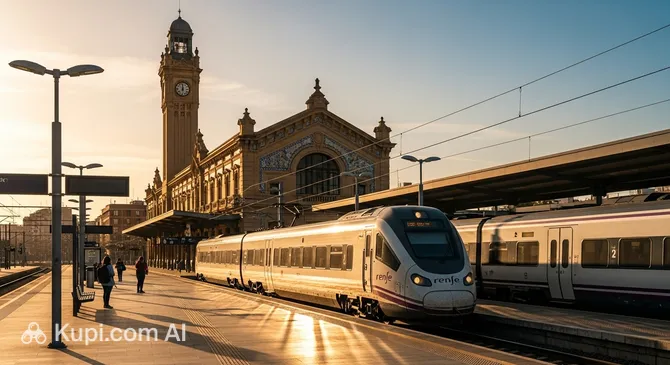
Reus Railway Station is a significant transport hub in the province of Tarragona and the gateway to the Baix Camp region. The station connects the city with Barcelona, Zaragoza, and Lleida, making it a convenient starting point for both locals and tourists heading to PortAventura or the beaches of the Costa Daurada. The station building is notable for its functionality and compactness, ensuring simple navigation for passengers.
It is important for passengers to know that the station has one main entrance leading to the ticket hall. Access to the platforms is via turnstiles, so please keep your ticket until the end of your journey. An underground passage equipped with elevators is provided for moving between tracks, which is convenient when travelling with heavy luggage.
Contact Information
Official website: www.adif.es (station information) / www.renfe.com (schedules and tickets)
Information phone: +34 912 32 03 20 (Renfe general enquiries)
Address: Plaça de l'Estació, s/n, 43201 Reus, Tarragona, Spain
Opening hours: The station building is open daily from 05:30 to 23:30 (times may vary on public holidays)
Luggage storage info: Currently, there are no automatic lockers at the station; it is recommended to verify information on-site
Accessibility information: The station is equipped with ramps and elevators, and the Atendo assistance service is available for passengers with reduced mobility
How to Get There
Getting to Reus station is quite simple, as it is located within walking distance of the historic centre. From the main square, Plaça del Mercadal, the walk takes about 10–15 minutes along a straight street. This is an excellent option for those travelling light who wish to see the city.
For those who prefer public transport, city buses (such as line L10) stop near the station exit, connecting the station with other districts. There is also a taxi rank at the main entrance; a trip to the centre will take no more than 5–7 minutes. If you are travelling from Reus Airport, it is best to use a taxi or shuttle bus, as there is no direct railway connection to the airport.
Services and Amenities
The station provides a basic set of services for a comfortable wait. In the main lobby, there are staffed ticket counters, as well as several self-service machines that accept bank cards. There is a small waiting area with seats where you can rest before your journey.
Other amenities include restrooms and vending machines with water and snacks. Free Wi-Fi may be available in the waiting area, though signal quality varies. Special attention is paid to accessibility: the station is adapted for citizens with reduced mobility, and elevators are in operation for access to the underground passage leading to the platforms.
Where to Eat
Inside the station building, there is usually a small café where you can have coffee, order soft drinks, or have a snack such as a sandwich (bocadillo). This is a convenient option for a quick breakfast or while waiting for a train; the average cost here is reasonable — around 5–8 euros.
If you have time before departure, it is recommended to go out to the station square or walk a couple of blocks towards the centre. Within a radius of 200–300 metres, you will find local bakeries and dining venues where the choice of dishes is much wider and the atmosphere is cosier. Please note that there are practically no 24-hour establishments nearby; most close by midnight.
Station History
The history of railway communication in Reus began in the second half of the 19th century, when the city was experiencing an economic boom due to the trade in textiles and other goods. The first train arrived here in 1856, which gave a powerful impetus to industrial development. The station became a key link connecting Tarragona with the inland areas of Catalonia.
The current station building, although modernized over time, retains features of classic railway architecture from the last century. In recent decades, the station has undergone a number of renovations aimed at track electrification and safety improvements, remaining an important hub on the Barcelona — Zaragoza line.
Passenger Tips
Plan to arrive at the station at least 15–20 minutes before your train departs. Although the station is small, queues can sometimes form at the turnstiles or ticket counters, especially during morning peak hours and the holiday season. Watch the electronic display board carefully, as the platform number may be announced shortly before the train arrives.
If you are travelling on regional trains (Regional or Rodalies) and purchased a ticket at the counter without a reserved seat, do not forget to validate it. The station closes for the night after the last train, so staying overnight at the station is not possible. Always keep your luggage with you, as storage facilities may not be available.