Support

La Gomera Airport

About the Airport

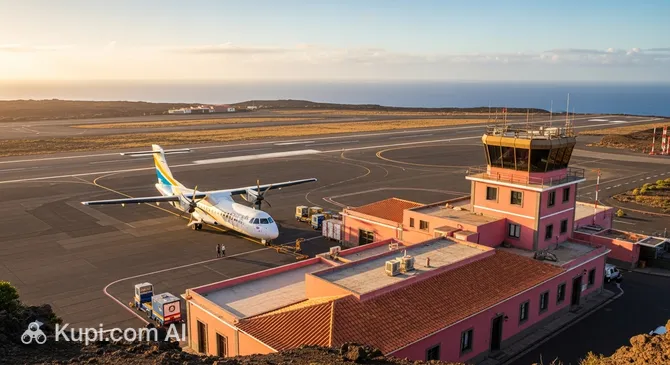
La Gomera Airport. Source: Kupi.com Binoculars

La Gomera Airport is not merely a transit hub, but a true aerial gateway to a world of relict forests and misty ravines. Located atop a picturesque cliff, seemingly hovering over the ocean, this air terminal resembles a cosy Canarian estate with a tiled roof and stonework rather than a typical high-tech terminal. Here, far from the hustle and bustle of giant hubs, the journey begins with a sense of tranquillity and harmony with nature, while the approach for landing offers some of the most breathtaking views in the entire archipelago.

IATA Code GMZ
ICAO Code GCGM
City Alajeró (serves San Sebastián de La Gomera)
Distance to Centre ~34 km
Status Regional (Domestic)
Annual Passengers ~120,700 (2024 data)
Schedule Regular flights (please check with operator)

Features and Advantages of the Airport:

  • Unique Architecture: The terminal building is designed in the traditional Canarian style, blending harmoniously with the surrounding landscape. The interiors are decorated with wood and stone, creating a warm and welcoming atmosphere immediately upon arrival.
  • Exceptional Views: Thanks to its location on a plateau above a cliff, take-off and landing turn into a genuine excursion. Passengers can admire the boundless ocean, the coast of Playa de Santiago, and the silhouette of the Teide volcano on neighbouring Tenerife.
  • Intimacy and Speed: The airport handles a small number of flights, which guarantees the absence of queues. Completing all pre-flight formalities and baggage reclaim takes mere minutes.
  • Personal Approach: The staff here are known for their friendliness and readiness to assist, which is rarely encountered in overloaded international airports.

Contact Information

To contact representatives of La Gomera Airport (GMZ), you may use the following contact details. Please note that the airport is managed by the company Aena, so many contacts lead to the operator's general services.

  • Official Website: Up-to-date information on flights, services, and airport regulations can always be found on the official Aena operator website: www.aena.es/es/la-gomera.html
  • Information Service Phone: For information, you can call the unified information service of Spanish airports (Aena) at: (+34) 91 321 10 00.
  • Airport Address: The airport is located in the municipality of Alajeró. Full address: Carretera de los Apartaderos, s/n, 38812 Alajeró, Santa Cruz de Tenerife, Spain.
  • Email: A direct email address for general enquiries is not published. It is recommended to use the feedback form on the official Aena website.
  • Social Media: You can follow news via the official Aena accounts on social networks such as X (formerly Twitter) @aena or Facebook.
  • Lost Luggage Information: Issues regarding lost or damaged luggage are handled by the airline with which you flew. You should contact the Lost and Found service of your carrier. Airline contacts are available at counters in the airport or on their official websites.
  • Passenger Support Service Contacts: For assistance to persons with reduced mobility and other passengers requiring support, a special service exists. Assistance must be requested in advance (at least 48 hours before departure) via the Aena website or by phone at (+34) 91 321 10 00.

How to Get to the Airport

La Gomera Airport (GMZ) is located in the municipality of Alajeró, approximately 34 kilometres from the island's capital, the city of San Sebastián de La Gomera. It primarily serves inter-island flights, connecting La Gomera with Tenerife and Gran Canaria. Many travellers arrive in Spain via large international hubs, such as Tenerife South Airport (TFS), and then reach La Gomera by ferry. You can get from the island's capital or other resorts to the airport in several ways.

Public Transport: The most budget-friendly method is local buses, which are called guaguas in the Canary Islands. Route No. 7 of the transport company GuaguaGomera connects the airport with the capital San Sebastián de La Gomera and the popular resort of Valle Gran Rey. The bus schedule is usually coordinated with flight arrival and departure times, but it is always worth checking in advance. The journey from the capital takes about 50-60 minutes. The ticket cost is just a few euros.

Taxi and Transfer: For greater comfort, especially if you are travelling with luggage or family, you can use a taxi. The rank is located directly at the terminal exit. A trip from San Sebastián de La Gomera to the airport will take about 40-45 minutes, and the cost will be approximately 40–50 euros. You can also book a private transfer in advance, which guarantees a car upon your arrival.

Car Rental: This is the most convenient and popular way to move around the island, giving complete freedom to explore its unique landscapes. You can rent a car at one of the rental agencies, whose offices are located both at the airport and in the port of San Sebastián. The road to the airport from the capital follows the main GM-2 highway and is well signposted. This option is ideal for those planning to travel actively around La Gomera.

Parking at the Airport: If you are travelling to the airport in your own or a rented vehicle, public parking is at your disposal. It is located directly in front of the terminal building and offers spaces for short-term and long-term parking. This is a convenient option if you need to leave the car while flying to another island of the archipelago.

Terminals and Map

La Gomera Airport (GMZ) is a small and modern regional airport distinguished by its compactness and convenience. Its structure is maximally simple, making navigation intuitively clear even for those visiting for the first time.

The airport has only one passenger terminal, which serves both arriving and departing flights. Thanks to this, you will not have to worry about transfers between buildings or complex logistics. All key zones—check-in counters, security screening, the waiting lounge, and the baggage reclaim area—are located in one building on a single level.

The terminal layout is very simple:

  • Departure Zone: After entering the terminal, you immediately find yourself in a small hall where check-in counters and airline offices are located. After checking in and dropping off luggage, passengers proceed to pre-flight security screening, beyond which lies a comfortable waiting lounge with several boarding gates.
  • Arrival Zone: Arriving passengers enter the baggage reclaim hall, where one baggage belt is installed. Immediately after collecting suitcases, you exit into the general hall, where car rental desks and the airport exit are located.

Completing all formalities typically takes a minimum amount of time. On a normal day, check-in and security take no more than 20-30 minutes. Nevertheless, it is recommended to arrive at the airport approximately 1.5 hours before departure to go through all procedures without haste. Getting lost in La Gomera Airport is practically impossible, making travel through it maximally comfortable and calm.

Airport History

La Gomera Airport (GMZ), located near the city of San Sebastián de La Gomera, is one of the youngest in the airport network of Spain. Its history does not span many decades, but its opening was a turning point for the entire island. Officially, the airport was opened in June 1999, ending the island's long isolation from convenient and rapid air connections. Until that moment, La Gomera could be reached mainly by sea, which significantly limited tourist flow and created inconveniences for local residents.

The idea of building a proper airport on La Gomera had been in the air for decades. A small private airfield called "El Revolcadero" existed on the island, but its short runway and difficult weather conditions made it unsuitable for regular commercial flights. In the 1980s, the Government of the Canary Islands began active research to find a suitable location, and in 1987 a plateau above the cliffs south of the island's capital was chosen. Construction began in 1995 and became a true engineering challenge due to the complex mountainous terrain.

Since its opening, La Gomera Airport has focused on serving domestic flights, primarily connecting the island with Tenerife and Gran Canaria. This has significantly reduced travel time for tourists and residents who previously had to use ferries. The airport is designed to accommodate turboprop aircraft, such as the ATR-72, which are ideally suited for short inter-island flights. Although it is not a major international hub, its role in the development of the economy and tourist appeal of La Gomera is difficult to overestimate.

One interesting fact is that La Gomera Airport is an example of a modern approach to infrastructure construction. The terminal building was designed to blend harmoniously into the surrounding landscape, and its architecture reflects traditional Canarian motifs. Throughout its short history, the airport has not undergone massive renovations, as it was originally built taking into account modern safety and comfort requirements. Its main record is not millions of passengers, but the very fact of its existence, which opened this unique and picturesque corner of the Canary Islands to the world.

Services and Facilities

La Gomera Airport (GMZ) is a small regional airport oriented towards serving flights between the Canary Islands. The infrastructure here is compact and functional, offering passengers all the essentials before departure. A cafeteria operates in the terminal building, where one can have a snack, coffee, or soft drinks. There is also a shop selling press, souvenirs, local products, and travel necessities.

For those who need to stay connected, free Wi-Fi from the Aena network is provided throughout the airport. Power outlets for charging electronic devices can be found in the waiting lounge, although their number may be limited. An ATM is installed in the airport for cash withdrawals; however, currency exchange points and full-service bank branches are absent, as the airport predominantly serves domestic flights.

The airport is fully equipped to serve passengers with reduced mobility. A free support service (Sin Barreras) is provided, which is recommended to be requested in advance. For travellers with small children, mother and child rooms with changing tables are provided. In case of necessity, there is a first aid point at the airport.

There are no VIP lounges, on-site hotels, conference halls, or business centres at La Gomera Airport. The nearest accommodation options and a wider range of services can be found in nearby settlements, such as Playa de Santiago or the island's capital — San Sebastián de La Gomera. This is a wonderful opportunity to get acquainted with the charming towns of Spain even before or immediately after your flight.

Where to Eat

La Gomera Airport (GMZ) is a compact regional air terminal, so the choice of dining establishments here is limited. One should not expect a large variety of restaurants as found in major international hubs. In fact, all opportunities for a snack are concentrated in one main establishment located in the single terminal building.

The main and only café-restaurant is located in the general departure zone, before passing security control (landside). Here, passengers and those seeing them off can order coffee, soft drinks, pastries, as well as sandwiches (bocadillos) and simple snacks. This place is suitable both for a quick bite and for a more relaxed wait for a flight. After passing control (airside), the choice is generally limited to vending machines with drinks and snacks.

Although the menu is mostly standard, one can sometimes find something with local flair. Pay attention to pastries or desserts using palm honey (miel de palma) — a gastronomic symbol of La Gomera. Regarding special dietary needs, the choice will be extremely limited. Vegetarians will likely be able to find a cheese sandwich or a simple salad, but vegan, gluten-free, or Halal options are unlikely to be available here. If you have strict dietary restrictions, it is more reliable to bring food with you.

The price range in the airport café, as in most air terminals, is somewhat higher than in city establishments. Opening hours depend directly on the flight schedule — the café is open during airport operating hours and flight service times but may close during quiet periods. Therefore, if you are looking for a full lunch or dinner with a wide selection of dishes, the best solution would be to eat beforehand in the island's capital, San Sebastián de La Gomera, or in another settlement on the way to the airport.

Travel Tips

Planning a trip through the airport on the island of La Gomera? This is a small and very convenient regional airport located near the city of San Sebastián de La Gomera. To ensure your trip goes smoothly, make use of our tips.

Arrival Time and Check-in. Despite the airport's compactness, arrive approximately 1.5-2 hours before departure. This will allow you to drop off luggage and pass control without haste. To save time, it is best to complete online check-in on your airline's website (e.g., Binter or Canaryfly). The security procedure is standard, but queues here are a rarity.

Seat Selection on the Plane. Flights between the Canary Islands are a scenic adventure in themselves. Be sure to book a window seat! When departing from La Gomera or arriving on the island, breathtaking views of the ocean and the majestic Teide volcano on neighbouring Tenerife open up. This is a spectacle not to be missed.

Hand Luggage. Hand luggage rules comply with general European standards: liquids up to 100 ml in a transparent bag, no sharp objects. If you are carrying local delicacies as souvenirs, for example, the famous palm honey (miel de palma) or almogrote cheese paste, remember that they are classified as liquids. It is better to pack them in checked luggage.

Connections and Customs. La Gomera Airport mainly serves flights to other Canary Islands, most often to Tenerife (TFN airport). If you have a connection planned, allow at least two hours for it. Since Spain is part of the Schengen Area, there is no customs control on domestic flights, which significantly simplifies travel.

Saving Time and Money. Tickets for inter-island flights are cheaper to buy in advance. Travelling only with hand luggage will also save you both time and money. You can get from the airport to the island's capital by bus (guagua) — this is the most budget-friendly method compared to a taxi.

In Case of Flight Delay. Bear in mind that La Gomera Airport has a limited selection of cafés and shops. In case of a flight delay (sometimes they happen due to weather conditions, for example, strong wind), it is better to have a book or downloaded films with you. In the event of a long delay, contact an airline representative — according to EU rules, you may be provided with drinks or meals.

Reached the end of the page?

That means the route is fully explored