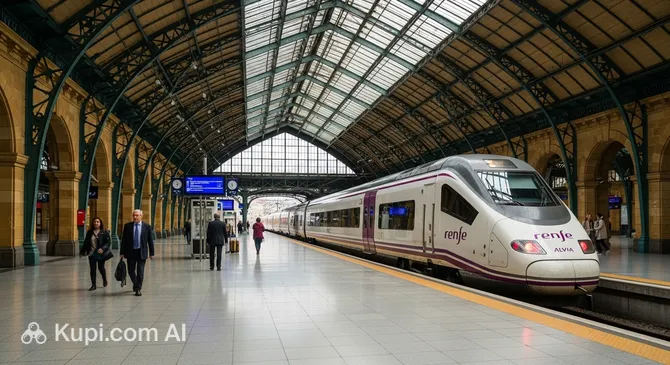
San Sebastian Railway Station, also known as Estación del Norte (North Station) or Atocha station, serves as the main rail gateway to this picturesque Basque city. Located on the right bank of the Urumea River, the station immediately impresses travellers with its historic architecture, particularly the magnificent metal canopy covering the tracks. It is not merely a transport hub, but a vital departure point for journeys across Spain (including Madrid and Barcelona) and into neighbouring France.
It is important for passengers to know that the station is quite compact, which makes navigation simple. The main building houses the ticket counter area and a waiting hall, from where you can access the tracks through turnstiles. Platforms are located at ground level, though moving between them may require using the underpass, which is equipped with elevators. The station serves both long-distance Renfe trains and the Cercanías commuter lines connecting the city with the surrounding Gipuzkoa region.
Address: Paseo de Francia (Frantzia Pasealekua), 22, 20012 Donostia-San Sebastián, Gipuzkoa
Opening hours: Daily, approximately from 05:30 to 23:30 (depending on the schedule of the first and last train)
Luggage storage: The availability of automatic lockers (consigna) should be confirmed on-site as regulations may change; they are often available at the neighbouring bus station.
Accessibility: The Atendo service is available to assist passengers with reduced mobility (advance booking is recommended).
How to Get There
Getting to San Sebastian Railway Station is very straightforward, as it is located in close proximity to the city centre. If you are in the historic centre (Parte Vieja) or near the Good Shepherd of San Sebastián Cathedral, you can reach the station on foot in 10–15 minutes by crossing the beautiful Maria Cristina Bridge.
For those who prefer public transport, city buses run by Dbus (lines 17, 24, 37, 45) stop near the station. The stop is usually named "Estación del Norte" or "Renfe". Additionally, a taxi stand is located right at the exit of the station building; a trip from La Concha beach will take about 5–7 minutes. It is worth noting that the city's main bus station is located literally next door (underground), making transfers from train to bus extremely convenient.
Services and Amenities
Despite its modest size, the station in San Sebastian offers the necessary range of services for a comfortable wait. The main hall features staffed ticket counters as well as automatic terminals for self-service ticket purchases. A small waiting area with seating is available for passengers.
The station premises include restrooms (usually paid or accessed via ticket), as well as an area with vending machines. An important service is the availability of free Wi-Fi (Adif network), allowing you to stay connected. The station is adapted for people with disabilities: there are ramps, elevators in the passageways, and dedicated accessible restrooms.
Where to Eat
Dining options within the station itself are limited. Typically, there is a small cafeteria operating here, where you can grab a coffee, a sandwich, or a pastry before your journey. This is a convenient option for a quick snack, but not for a full meal. Prices here are reasonable—a coffee and croissant will cost a couple of Euros.
If you have at least 30–40 minutes to spare, it is better to step outside the station building. Directly across the road is the Tabakalera cultural centre, which houses excellent cafes and restaurants serving higher quality food. Also, by crossing the bridge towards the centre, you will find yourself in an area with a multitude of dining spots where you can try the famous Basque pintxos.
Station History
The history of San Sebastian Railway Station dates back to the mid-19th century. It was inaugurated in 1864 by the "Northern Railway Company" (Caminos de Hierro del Norte), becoming a key link on the Madrid–Paris line. This event played a huge role in transforming San Sebastian into a fashionable European resort frequented by the aristocracy.
The most recognisable feature of the station is its metal canopy over the platform, built in 1881. The structure was designed in the workshops of the famous Gustave Eiffel, lending the station a distinct engineering charm of that era. In recent years, the station has been undergoing major reconstruction and modernisation to accommodate high-speed trains (AVE), whilst preserving its historic façade.
Traveller Tips
The main advice for tourists in San Sebastian: do not confuse the stations. This station (Renfe/Estación del Norte) serves long-distance trains and Cercanías commuter lines. Local narrow-gauge trains (Euskotren) travelling to Bilbao or Hendaye depart from the Amara station, located in a different area.
Arrive at the station at least 20–30 minutes before departure, especially if you are travelling on an Alvia train to Madrid or Barcelona, as luggage screening via scanner is conducted before boarding. It is best to keep your tickets until you exit the arrival station, as turnstiles may be installed at the exit. The station closes at night, so staying overnight here is not possible.