Support

China Bay

About the Airport

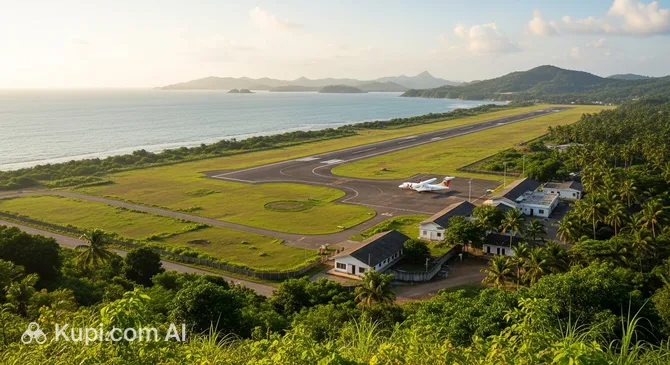
China Bay. Source: Kupi.com Binoculars

Landing at China Bay Airport is not just an arrival at a destination; it is an exciting start to a journey along the eastern coast of Sri Lanka. The air harbour welcomes guests with stunning views of one of the deepest natural harbours in the world, where the azure waters of the Indian Ocean meet emerald tropical greenery. This compact airport allows you to bypass long hours of overland travel and instantly immerse yourself in an atmosphere of relaxed leisure, being just a few minutes' drive from famous beaches.

IATA Code TRR
ICAO Code VCCT
City Trincomalee
Distance to Centre approx. 7 km
Status Domestic
Annual Passengers Statistics not published
Schedule

China Bay Airport possesses a number of unique features that favourably distinguish it from major international hubs:

  • Scenic Approach. The flight to Trincomalee is often called an excursion in itself. Descending over the bay, passengers can enjoy an incredible panorama of the rugged coastline, islands, and ships anchored in the roadstead.
  • Speed of Service. Thanks to the low passenger flow and the compactness of the terminal, all formalities here take mere minutes. You can step off the plane and be in a taxi within 15–20 minutes after landing.
  • Strategic Location. The airport is located in immediate proximity to the city and the popular resort areas of Nilaveli and Uppuveli. This is an ideal option for those wishing to save the 6–7 hours of travel time from Colombo.
  • Unique Atmosphere. As an active Air Force base, the airport combines military organisation with civilian hospitality. Order and tranquillity reign here, uncharacteristic of noisy transport hubs.

Contact Information

China Bay Airport (TRR) is primarily a Sri Lanka Air Force base that also serves domestic civilian flights. Because of this, it does not have as extensive a contact network as major international airports. Here is the main information that may be useful for travellers:

  • Official Website: China Bay Airport does not have a separate official website. General information about civil aviation in the country can be found on the Airport and Aviation Services (Sri Lanka) (AASL) portal: www.airport.lk.
  • Inquiry Service Phone: The airport does not have a direct public inquiry service. General questions can be directed to Airport and Aviation Services (Sri Lanka) (AASL) at +94 11 226 4444.
  • Airport Address: St. Mary's College Road, China Bay, Trincomalee, Sri Lanka.
  • Email: For official inquiries, you can use the general email of Airport and Aviation Services (Sri Lanka): info@airport.lk.
  • Airport Social Media: Official social media accounts for the airport do not exist. It is recommended to follow the pages of airlines operating flights to Trincomalee.
  • Lost Luggage Information: For all issues related to lost or damaged luggage, you must contact your airline directly. Airport services do not handle luggage tracing.
  • Passenger Support Contacts: Support regarding booking, flight changes, and carriage rules is provided by the carrier airline.

How to Get to the Airport

China Bay Airport (TRR) is located quite close to the centre of Trincomalee, so getting there is not difficult. The most popular and convenient method is a taxi or a local three-wheeled motorcycle, known as a tuk-tuk. A ride in a tuk-tuk is not only a budget-friendly option but also part of the authentic experience of travelling around Sri Lanka. The journey from the city centre to the airport will take approximately 20–30 minutes depending on traffic. A taxi will cost slightly more but ensures greater comfort, especially if you have a lot of luggage.

For the most budget-conscious travellers, there is the option to use local buses. This is the cheapest way to travel, however, it requires a certain flexibility and readiness for adventure. Buses run along the main roads, and you will likely have to walk some distance from the stop to the terminal or take a short tuk-tuk ride from there. This option is best suited for tourists with a light backpack and time to spare.

If you value independence and plan to actively explore the surroundings, car rental is an excellent choice. By renting a car, you can easily reach the airport at a time convenient for you. Parking for private vehicles is provided at China Bay Airport. Additionally, many hotels offer an organised transfer service, which is a reliable and worry-free option. It is worth booking this in advance to avoid unnecessary hassle on the day of departure.

To summarise, the choice of transport depends on your budget and preferences. For maximum convenience, choose a taxi or a pre-booked transfer. If you want to save money and experience the local flair, feel free to hop into a tuk-tuk. The bus is suitable for those for whom budget comes first. Important tip: always agree on the cost of the trip with the taxi or tuk-tuk driver in advance to avoid misunderstandings upon arrival.

Terminals and Map

China Bay Airport (TRR) is a compact and convenient aviation hub that primarily serves domestic flights. Its key feature is one passenger terminal, which makes navigating it extremely simple and fast. You will not have to deal with the complex structure of multi-storey complexes, which is a big plus for a peaceful journey.

The terminal building is functionally divided into two main zones: the departure zone and the arrival zone. Thanks to the small size of the airport, all key points—check-in counters, the security checkpoint, the waiting hall, and the boarding gate—are within walking distance of each other. The airport layout is intuitive, and getting lost here is practically impossible, even if you are visiting for the first time.

Completing all pre-flight formalities at China Bay Airport usually takes minimal time. Queues for check-in and security are typically short. It is recommended to arrive at the airport approximately 1-1.5 hours before your flight's departure. This time will be more than sufficient to check in luggage without rushing, pass through security control, and reach the boarding gate.

Since there is only one terminal at the airport, you do not have to worry about long transfers or searching for the right building. All infrastructure is concentrated in one building. Signs will help you orient yourself, and the small number of flights eliminates the bustle characteristic of major aviation hubs. For travellers, this means a calmer and more predictable start or end to their trip.

Airport History

The history of China Bay Airport (TRR) is closely linked to the military history of Sri Lanka and the entire region. It was founded by the British Royal Air Force (RAF) in the 1930s as the airfield RAF China Bay. Its strategic location on the island's eastern coast, near one of the world's largest natural harbours in Trincomalee, made it a key military facility during the colonial period.

The most dramatic pages of the airport's history were written during the Second World War. In April 1942, during the famous Indian Ocean Raid, Japanese aviation attacked the harbour of Trincomalee. The China Bay airfield played a central role in the defence, although it sustained significant damage. This event forever inscribed the airport into the annals of military history and highlighted its exceptional importance for the Allies in the Asia-Pacific theatre of operations.

After Ceylon (now Sri Lanka) gained independence in 1948, the base was handed over to the Royal Ceylon Air Force, which later became the Sri Lanka Air Force. For decades, it remained one of the country's main airbases under the name SLAF Base China Bay, playing an important role in ensuring security and logistics in the east of the island.

In recent years, with the growth of tourist flow, China Bay Airport has begun a new chapter in its history, opening up to civil aviation. Domestic flights were launched, connecting Trincomalee with Colombo and other key points in the country. This has significantly simplified access for travellers to the magnificent beaches and historical sights of the eastern coast. Although the airport is still an active military base, its infrastructure has been modernised to service commercial passenger aircraft.

Interesting fact: the name "China Bay" comes from the bay of the same name on the shores of which it is located. There are various theories regarding the origin of this toponym, one of which links it to ancient maritime trade routes and the possible presence of Chinese merchants here. Today, the airport is a unique example of a facility with a rich military past that has successfully adapted to peaceful life, becoming the aerial gateway to one of the most picturesque regions of Sri Lanka.

Services and Facilities

China Bay Airport (TRR) is a small domestic aviation hub serving as the gateway to the picturesque city of Trincomalee and the eastern coast of Sri Lanka. Given its size and primarily regional significance, the range of services here is basic but sufficient for a comfortable wait for your flight.

Dining and Shopping. In the terminal, you will find a few small kiosks or cafes where you can buy light snacks, sandwiches, pastries, and drinks. There are no full-service restaurants or large Duty Free shops here, so a substantial lunch or shopping is best planned in the city.

Waiting Halls and Amenities. A general waiting hall is available for all passengers. There are no specialised VIP lounges at the airport. In some zones, you can find sockets for charging electronic devices. Access to Wi-Fi may be limited or unavailable, so it is better to have mobile data with you.

Financial and Medical Services. Currency exchange points and banks are absent at China Bay Airport. It is recommended to exchange money in advance in major cities. In case of need, there is a first aid point at the airport.

Services for Passengers with Special Needs. Basic amenities are provided for passengers with disabilities; however, to receive special assistance (for example, a wheelchair), it is strongly recommended to contact your airline in advance. There are no special play areas for families with children, but you can comfortably settle in the waiting hall while awaiting departure.

Accommodation and Business Services. There are no hotels within the airport territory itself. The nearest accommodation options are located in the city of Trincomalee and its surroundings. Conference halls and business centres are also absent at China Bay Airport, as it is not oriented towards business travellers.

Where to Eat

China Bay Airport (TRR) is a small regional airport serving primarily domestic flights. Consequently, the infrastructure for passengers, including dining outlets, is quite modest and not comparable to major international hubs.

In the airport's single passenger terminal, there is usually a small cafe or kiosk operating. As a rule, it is located in the general area before security control (landside). This is the main and often the only option for a snack on the airport premises. Its operating hours are usually tied to the schedule of arriving and departing flights.

The assortment here is basic and oriented towards a quick bite. Travellers can expect:

  • Hot drinks: tea and instant coffee.
  • Soft drinks: bottled water, carbonated drinks.
  • Simple snacks: packaged biscuits, crisps, as well as popular Sri Lankan "short eats" (small savoury pastries with fillings, samosas).

Specialised restaurants offering full hot meals are absent here. There are also no establishments with specific vegetarian, vegan, Halal, or gluten-free menus. If you have strict dietary requirements, it is strongly recommended to bring food with you. For a proper lunch or dinner, it is better to choose one of the numerous cafes in the city of Trincomalee before travelling to the airport.

Travel Tips

To ensure your journey through China Bay Airport is as comfortable and hassle-free as possible, make use of these proven tips. The airport serves primarily domestic flights, making it quite convenient, but preparation is never wasted.

Arrival Time and Check-in. Despite China Bay being a small airport, it is recommended to arrive here at least 1.5–2 hours before the departure of a domestic flight. This will give you enough time to calmly check in at the counter and drop off luggage. Security procedures here usually go faster than in major international hubs, but it is better to have a buffer of time. Keep your passport and boarding pass close to hand for quick verification.

Seat Selection and Hand Luggage. If possible, choose a window seat—scenic views of the Trincomalee coastline may open up during takeoff and landing. Standard rules for hand luggage apply here too: liquids up to 100ml must be packed in a transparent bag, and sharp objects are prohibited. Always check baggage and hand luggage allowances with your airline to avoid extra charges at the airport.

Customs Control and Transfers. If you are flying on an international itinerary with a transfer in Colombo, verify whether you will need to collect and re-check your luggage. When passing through customs control in Sri Lanka, be prepared to declare expensive electronics or large amounts of cash. Standard restrictions apply to the import of tobacco and alcoholic products.

Saving Time and Unforeseen Situations. To save time, complete online check-in if your airline provides such an option. In case of a flight delay, contact your airline representative for information about the new departure time and possible compensation (meals, drinks). In small airports like China Bay, the choice of establishments may be limited, so it is useful to have a book or a charged power bank with you to while away the wait.

Reached the end of the page?

That means the route is fully explored