Support

Khartoum International Airport

About the Airport

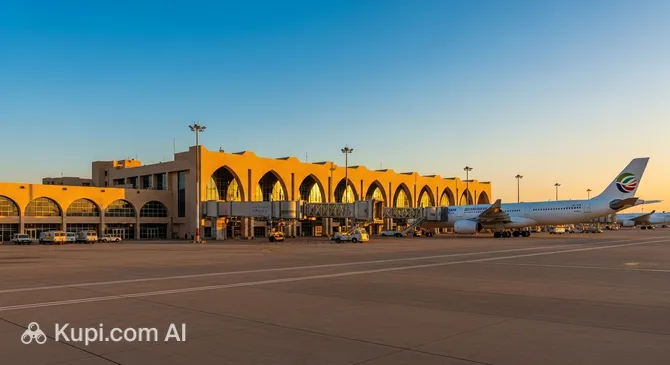
Khartoum International Airport. Source: Kupi.com Binoculars

Khartoum International Airport is not merely a transport hub, but the key aerial gateway to Sudan, situated at the confluence of the legendary White and Blue Nile rivers. The airport's unique location allows airliners to approach for landing directly over the city districts, offering passengers an impressive bird's-eye panorama of the capital. This aviation hub connects the country with the outside world, combining the flair of African hospitality with the rhythm of a modern metropolis.

IATA Code KRT
ICAO Code HSSK
City Khartoum
Distance to Centre 4 km
Status International
Passengers per Year ~3.5 million
Schedule Online board

Airport Features and Advantages:

The main advantage of this air harbour is its exceptional proximity to the city centre. The airport is literally integrated into the urban environment, which distinguishes it favourably from many global counterparts located dozens of kilometres away from capital cities. Thanks to this, travellers can reach hotels, administrative institutions, or key attractions in just 15–20 minutes, significantly saving time and money on transfers.

The terminal is characterised by its compactness and clear logistics. It is difficult to get lost here: intuitively designed routes allow for a quick passage through all necessary pre-flight formalities, from check-in to the boarding gate. Airport staff generally speak English and are ready to assist, making navigation comfortable even for those visiting the region for the first time.

For passengers preferring privacy and a high level of service, VIP and CIP lounges are available. These zones ensure a calm atmosphere away from the bustle of general waiting halls, providing an opportunity to work productively or relax before a flight. Such amenities are especially appreciated by business people and transit tourists using this aviation hub as a connecting point for travels across Africa.

Contact Information

Please note that due to the current situation in the region, the operations of Khartoum Airport (KRT) may be suspended, and contact details may be outdated. It is recommended to verify all information with your airline.

  • Official Website: The official airport website may be unavailable or contain outdated information.
  • Information Desk Phone: Direct telephone communication with the airport is likely not functioning. For up-to-date information, please contact your air carrier directly.
  • Airport Address: Africa Street, Khartoum, Sudan
  • Email: Public airport email addresses are currently unavailable or not monitored.
  • Social Media: Official social media pages of the airport may exist but are likely not updated.
  • Lost Luggage Information: For all issues related to lost or damaged luggage, you should appeal exclusively to your airline's support service. Airport services will not be able to assist.
  • Passenger Support Contacts: The primary source of support and information for passengers is the airline operating the flight.

How to Get to the Airport

Khartoum International Airport is located very close to the central part of the city of Khartoum, making the journey there quite quick and simple. The most convenient and popular way to reach the terminal is by taxi or private transfer. You can hail a car on the street, however, for greater reliability and a predictable price, it is recommended to use official taxi services or pre-book a transfer through your hotel or an online service. This is especially convenient if you are travelling with large luggage or arriving late at night.

For budget-conscious travellers, there is public transport. Although the capital of Sudan does not have a metro or trams, you can reach the airport on local buses or more manoeuvrable minibuses. This option is the cheapest but may not be the most comfortable: transport is often overcrowded, and routes can be confusing for a tourist. If you decide to choose a bus, verify its number and direction in advance, and be prepared for potential inconveniences.

If you value independence in movement, you might consider car rental. Both local and international rental agencies operate in the city. Having your own transport will give you the freedom to explore not only the city but also its surroundings. For those arriving at the airport in their own or a rented vehicle, parking is provided. There are zones for both short-term and long-term parking.

On average, the trip from the city centre to the airport takes from 15 to 40 minutes depending on traffic conditions and the time of day. In terms of cost, a taxi will be the most expensive option, while a bus ride will cost a nominal amount. Our advice: if comfort and speed are your priority, choose a taxi. If you wish to save money and immerse yourself in local colour, use public transport, but be sure to allocate extra time for the journey.

Terminals and Map

Khartoum International Airport (KRT) possesses a compact and logical structure, which simplifies orientation for travellers. The airport complex consists of one main passenger terminal, which serves both international and domestic flights. For ease of navigation, the building is functionally divided into two key zones.

The International Zone is the larger and more modern part of the terminal. It is here that the check-in counters of most global airlines, as well as passport and customs control points, are located. The arrivals area with baggage claim belts is situated on the ground floor, while the departures area is on the first floor. In the "airside" zone after security screening, passengers have access to waiting lounges, several cafes, and duty-free shops.

The Domestic Flights Zone is used for travel within Sudan. It represents an older and more compact section of the terminal. The setting here is simpler, and the range of services is more limited, yet everything necessary for waiting for a flight is present. Since both zones are part of the same building, transferring between them does not require going outside and takes just a few minutes on foot.

Navigation inside the terminal is intuitive, aided by signs that are duplicated in English. Despite this, check-in and security control procedures can take a considerable amount of time, especially during peak hours. It is recommended to arrive at the airport well in advance: at least 3 hours before an international flight and 1.5-2 hours before a domestic one. This time will be sufficient to complete all formalities without rushing.

Airport History

The history of Khartoum International Airport (IATA: KRT, ICAO: HSSK) is inextricably linked with the development of the capital of Sudan. The airport was built after World War II and officially opened in 1947. Initially, it was created to serve the country's growing needs for air transport and quickly established itself as the state's main international aviation hub.

From its very foundation, the airport occupied a unique location — practically in the centre of the city of Khartoum. In the mid-20th century, this was an advantage, providing easy access for passengers. However, with the rapid growth of the capital, the airport found itself densely surrounded by residential and commercial districts, which seriously limited opportunities for its further expansion and modernisation.

Throughout its history, the airport has played a vital role in regional logistics. It has repeatedly become a key centre for organising and receiving humanitarian flights directed to various parts of Africa. During its prime periods, it served as an important transit point connecting Europe, the Middle East, and the African continent, receiving flights from many leading global airlines.

Due to physical limitations for growth and increasing requirements for safety and capacity, plans for the construction of a new airport outside Khartoum have been discussed and developed for many years. Although the existing airport has undergone various stages of terminal and equipment modernisation, its central location remained the main issue that a new project was intended to solve.

Interesting fact: the airport's unique location has made it one of the most recognisable in the world in satellite imagery and for pilots approaching for landing. The view of the runways, lying amidst busy city streets, has become a distinctive calling card of Khartoum, symbolising both its historical heritage and the challenges of modern urban planning.

Services and Amenities

At Khartoum International Airport (KRT), passengers can utilise a set of standard services to spend time comfortably while waiting for their flight. If you are hungry, several cafes and small restaurants are at your service, where you can try local cuisine or order something more familiar. In the departure zone, Duty Free shops operate, offering a classic assortment: perfumes, cosmetics, confectionery, and souvenirs that will serve as a pleasant reminder of your trip to Sudan.

For those who value privacy and extra comfort, VIP lounges function within the airport. This is an excellent opportunity to rest from the pre-flight bustle in a calm environment, enjoying complimentary beverages and snacks. To stay in touch with loved ones or handle work matters, passengers can use wireless internet (Wi-Fi), as well as special charging stations for electronic devices located in various parts of the terminal.

The terminal building provides all necessary financial services: there are currency exchange points and ATMs, which is especially convenient for arriving tourists. In case of feeling unwell or needing first aid, a medical point operates within the terminal. For travellers with children, mother and child rooms are equipped, and for passengers with reduced mobility, a basic barrier-free environment has been created, including ramps and specially equipped restrooms. For more comprehensive assistance, it is recommended to notify your airline in advance.

There are no hotels directly inside the terminal, however, several hotels of various price ranges are located near the airport, which is convenient for transit passengers and those departing early in the morning. Travellers who need to work may find basic business services available, but the presence of full-scale conference rooms is better verified in advance, as their capabilities may be limited.

Where to Eat

When planning a departure from Khartoum International Airport (KRT), it is worth considering the matter of food in advance. The choice of establishments here is quite modest and oriented primarily towards the basic needs of passengers rather than gastronomic delights. Nevertheless, finding a snack or drinks before a flight is entirely possible.

The main dining points are presented in the form of small cafes and snack bars. They are located both in the general area before security control (landside) and in the departure hall (airside). The assortment in the departure zone may be more limited, so if you have time, it is better to explore options before check-in and screening. Here you can purchase sandwiches, pastries, coffee, tea, and soft drinks — a standard set for a quick bite.

Although the airport is not renowned for a variety of restaurants, sometimes simple Sudanese dishes can be found on the menus of local cafes. If you are lucky, this could be a great opportunity to try something authentic at the last moment before flying out of Sudan. For a full lunch or dinner, the choice will be extremely small, so the best strategy would be to eat in the city before travelling to the airport.

Regarding special dietary needs, practically all food served is Halal, complying with local traditions. However, vegetarians, vegans, or people with gluten intolerance will find it difficult to find suitable options. In this case, it is strongly recommended to bring food with you to avoid inconvenience. Prices at the airport, as elsewhere, are noticeably higher than in the city.

Opening hours of establishments are usually tied to the flight schedule, especially international ones. However, do not count on all points being open around the clock. If you have a night or early morning departure, be prepared that most cafes may be closed. In general, Khartoum Airport provides basic opportunities for a snack, but without frills.

Travel Tips

To ensure your journey through Khartoum International Airport goes smoothly and without unnecessary stress, make use of these helpful tips. A thoughtful approach to details will help you save time and nerves.

Arrival Time: We recommend arriving at the airport at least 3 hours before the departure of international flights. This will provide a sufficient margin of time to pass through all formalities, especially during peak hours when queues are possible.

Check-in and Security: Keep all necessary documents — passport, tickets, visa (if required) — close at hand. The screening process can be thorough, so prepare in advance: pack liquids up to 100ml in a separate transparent bag and be ready to remove laptops and other large electronics from your hand luggage.

Seat Selection: If you want to enjoy views of the capital of Sudan during takeoff or landing, choose a window seat. For those who value the ability to stretch their legs freely or get up often during the flight, an aisle seat is more suitable.

Hand Luggage: Standardly, sharp objects, flammable substances, and liquids in containers exceeding 100ml are prohibited in hand luggage. Always check the exact baggage allowance rules on your airline's website, as they may differ slightly.

Transfer Passengers: If you have a connecting flight, verify in advance whether your luggage will be transferred automatically or if you need to collect and re-check it. In the transit zone, follow signs to your next boarding gate, leaving time for potential additional security checks.

Customs Control: Upon entering the country, be prepared to fill out a customs declaration. Declare cash and valuable items in accordance with local regulations to avoid delays and fines. Be polite and patient when interacting with customs officers.

Saving Time and Money: If possible, complete online check-in for your flight — this will save you time at the airport. Prices for food and drinks in the departure zone can be inflated, so you can bring an empty water bottle and fill it at a drinking fountain after passing security.

In Case of Flight Delay: If your flight is delayed or cancelled, immediately contact your airline representative. Inquire about the flight status and your rights to beverages, meals, or hotel accommodation. Remain calm and monitor information on the departure boards.

Reached the end of the page?

That means the route is fully explored