Support

Chiang Mai International Airport

About the Airport

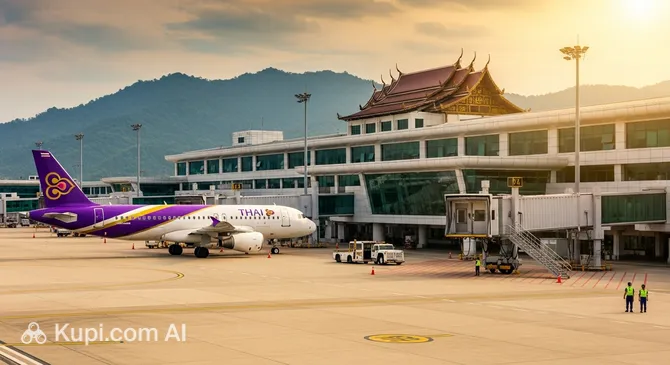
Chiang Mai International Airport. Source: Kupi.com Binoculars

Chiang Mai International Airport (CNX) is not merely a transit point, but a true gateway to the heart of the ancient Lanna culture. Even during descent, passengers are greeted with a breathtaking view of lush green hills and the golden spire of the Doi Suthep temple, setting the mood for the entire journey. This airport is renowned for its cosy atmosphere, which contrasts sharply with the hustle and bustle of capital hubs, allowing you to experience the famous northern hospitality from the very first minutes after landing.

IATA Code CNX
ICAO Code VTCC
City Chiang Mai
Distance to Centre 3–5 km
Status International
Annual Passengers Over 9.1 million (2024)

Airport Features and Advantages:

The primary advantage of Chiang Mai's aviation hub is its phenomenal proximity to the city. A taxi ride to the historical centre (the "Square") takes only 10–15 minutes, which is a rarity for major international airports. This allows tourists to begin sightseeing almost immediately after collecting their luggage.

The airport consists of two terminals (Domestic and International) located within a single building, making navigation intuitively clear and simple. It is impossible to get lost here, and transfers are quick and stress-free.

The local flair deserves special attention: in the waiting halls, you can find excellent souvenir shops featuring crafts by northern artisans, as well as dining outlets serving the famous Khao Soi soup. For those wishing to relax before their flight, high-quality Thai massage salons operate right inside the terminal.

Contact Information

For the most up-to-date information on flights, services, and airport regulations, we recommend consulting official channels. Below are the main contact details for Chiang Mai International Airport.

  • Official Website: chiangmai.airportthai.co.th
  • Information Service Phone: +66 53 922 100
  • Address: 60 Mahidol Rd, Suthep, Mueang Chiang Mai District, Chiang Mai 50200, Thailand
  • Email: For communication, it is recommended to use the contact form on the official website or the general email of the managing company, Airports of Thailand (AOT): aotpr@airportthai.co.th
  • Social Media: Official Facebook page – ChiangmaiInternationalAirport
  • Lost Luggage Information: In case of lost luggage, you must first contact your airline's representative office. You may also contact the airport's Lost and Found service.
  • Passenger Support Service: For general enquiries, you can contact the airport information service via phone.

How to Get to the Airport

Chiang Mai International Airport (CNX) is located very close to the city centre, making getting to or from it a simple and quick task. A trip from the Old City usually takes just 10-20 minutes depending on traffic. Travellers have access to several convenient transport options.

Public Transport is the most budget-friendly method. The official RTC Chiang Mai City Bus (route R3, red and yellow lines) runs between the airport and key points in the city, including the Old City. The fare is only about 20-30 Baht. Another popular local option is the songthaew (red pick-up trucks), operating as shared taxis. You can hail one on the street, but it is best to agree on the price with the driver in advance.

Taxis and Transfers are the most comfortable and popular choice. Right inside the airport building, there is an official taxi counter where you can book a car at a fixed rate (around 150-200 Baht to most hotels in the centre). This is an excellent way to avoid bargaining and overpaying. Additionally, ride-hailing apps like Grab operate actively in Chiang Mai, serving as a convenient alternative. For maximum comfort, especially if travelling with family or large luggage, you can book a private transfer in advance.

Car Rental is suitable for those planning to explore not only the city but also the picturesque surroundings of Northern Thailand. Offices of both international and local rental companies are present at the airport. Having a rental car provides freedom of movement and allows you to easily reach places like Pai or Chiang Rai. For those arriving at the airport in their own or rented vehicle, convenient parking with hourly and daily rates is provided.

Terminals and Map

Chiang Mai International Airport (CNX) is distinguished by its compactness and clear organisation, making it convenient for travellers. In fact, the airport consists of a single two-storey terminal, which is divided into two main zones: for domestic and international flights. This significantly simplifies navigation and movement within the building.

The terminal structure is logical and intuitive. The Ground Floor is entirely dedicated to the Arrivals area. Located here are baggage claim belts, customs control counters, as well as taxi offices, car rentals, and currency exchange bureaus. The First Floor is the Departures area. You come here to check in for your flight and drop off luggage, followed by passport control (for international destinations) and security screening.

Moving between sectors—Domestic (North Wing) and International (South Wing)—presents no difficulties. Since it is a single building, you can simply walk from one part to the other. No shuttles or complex crossings are required, which is particularly convenient for connecting flights. All navigation is duplicated in English, and signs are clear and visible.

The time required to complete formalities depends on the destination. For domestic flights, check-in and screening usually proceed quickly, and arriving at the airport 1-1.5 hours before departure will be quite sufficient. For international flights, it is recommended to allow more time—about 2-3 hours. The passport control procedure may take some time, especially during the high tourist season. To avoid rushing, simply check which wing—Domestic or International—your flight departs from, and follow the signs.

Airport History

The history of Chiang Mai International Airport (CNX) dates back to 1921, when it was founded as Suthep Airfield. Initially, the facility was intended for the needs of the Royal Air Force of Thailand and consisted of a modest airstrip with minimal infrastructure, focused on military tasks and rare domestic flights.

After World War II, during which the airfield played an important strategic role, its gradual transition to civil use began. This process was dictated by the growing transport needs of the country's northern region, which was becoming increasingly attractive to domestic travellers and businesses.

A key stage that defined the modern appearance and status of the airport was the major reconstruction of 1996. The modernisation was timed to coincide with the hosting of the Southeast Asian Games in Chiang Mai and the celebration of the 50th anniversary of the accession to the throne of King Bhumibol Adulyadej. As part of this project, a new international terminal was constructed, which radically increased capacity.

Obtaining international status opened direct air routes from other countries and served as a powerful catalyst for tourism development. Today, CNX is one of the busiest airports in Thailand after the Bangkok hubs, serving millions of passengers annually and remaining a vital transport node for many Asian airlines.

Services and Facilities

Chiang Mai International Airport (CNX) offers passengers a wide range of services and amenities to make waiting for a flight as comfortable as possible. In the terminal, you will find numerous restaurants and cafes where you can grab a quick bite at well-known international chain establishments or enjoy authentic Thai cuisine. Numerous shops, including Duty Free, offer a standard range of goods, as well as unique souvenirs from Northern Thailand: silk products, wood carvings, and local delicacies.

For a comfortable wait, passengers can utilise several lounges. In addition to lounges for business class passengers, such as the Thai Royal Silk Lounge, there are also lounges where access can be paid for separately, regardless of ticket class. These offer snacks, beverages, newspapers, and a quieter atmosphere. Free Wi-Fi is available throughout the terminal, and the departure halls are equipped with numerous charging stations for mobile devices.

Financial matters are easily resolved at the airport: travellers have access to banking branches, ATMs, and currency exchange points located in both the arrivals and departures zones. In case of unforeseen health situations, a medical centre operates within the terminal to provide first aid.

The airport cares for passengers with special needs. For families with small children, there are mother and baby rooms where you can feed and change a baby in a quiet environment. A barrier-free environment has been created for passengers with reduced mobility: there are ramps, lifts, and specially equipped restrooms. If necessary, an escort service can be booked in advance through your airline.

Although there is no hotel directly within the airport building, numerous accommodation options to suit every taste and budget—from guest houses to comfortable hotels—are located in the immediate vicinity, many of which provide transfers. For business travellers, basic business services such as workspaces and meeting rooms are often available in the VIP lounges.

Where to Eat

Chiang Mai International Airport (CNX) offers a decent selection of establishments where you can have a meal before departure or upon arrival. Although the airport is not as large as the capital's hubs, there is food here to suit every taste and budget, from authentic Thai cuisine to familiar international chains.

In the public zone (before security control), the selection is generally wider. The ground floor features food courts and small cafes offering local dishes at relatively affordable prices. This is a great place to enjoy the famous Khao Soi soup or Pad Thai one last time. Here you can also find coffee shops and bakeries for a quick snack. In the international and domestic departure halls (after security control), there are also several cafes and restaurants. Among them are popular coffee shops like Starbucks, and places where you can order sandwiches, salads, and hot meals. Prices in the secure area are traditionally slightly higher.

For those looking for something specific, the airport has options:

  • Quick Snack: Look out for chain coffee shops and bakeries scattered across both terminals. Here you can grab coffee, pastries, or a ready-made sandwich.
  • Full Lunch: In the public zone and the domestic departures area, there are restaurants where you can sit comfortably and order full meals of Thai or European cuisine.
  • Dietary Options: Finding vegetarian dishes will not be difficult, especially in establishments serving the cuisine of Thailand (for example, vegetable curry or fried rice with vegetables). Specific requests, such as gluten-free or Halal dishes, can be satisfied in some restaurants, though the selection may be limited.

Most establishments open early in the morning and operate until the last evening flight. However, there are practically no 24-hour restaurants at the airport, so for late-night flights, it is better to eat in advance. Overall, you certainly won't go hungry at Chiang Mai Airport—it has everything necessary for a comfortable wait for your flight.

Travel Tips

To ensure your journey through Chiang Mai International Airport (CNX) goes smoothly, it is worth noting a few points. We recommend arriving at the airport 2–2.5 hours before international flights and 1.5–2 hours before domestic ones. Although the airport is not very large, there can be queues during the tourist season. To save time, check in for your flight online before arriving at the airport if possible.

Security control here is standard, but it is best to prepare in advance. Keep your passport and boarding pass ready. All liquids must be in containers of no more than 100 ml and packed in a single transparent bag. Laptops, tablets, and power banks must be removed from hand luggage for scanning. Important nuance: power banks can only be carried in hand luggage; checking them into hold luggage is prohibited.

When choosing a seat on the plane, remember that the windows offer picturesque views of the mountains surrounding Chiang Mai. For passengers with connections, navigation in the airport is simple, but if you are transferring from an international flight to a domestic one within Thailand, you will need to pass through passport and customs control. Take this into account when planning your connection time.

Upon entering the country, "green" and "red" channels operate at customs. If you have no goods to declare, feel free to go through the green channel. To save money, bring an empty water bottle with you—after the security zone, it can be filled at drinking fountains. Food prices at the airport are higher than in the city, so it is better to have a meal beforehand.

If your flight is delayed, remain calm. All up-to-date information is displayed on the departure boards. Find your airline's counter to clarify details and ask about possible compensation, such as food vouchers during long waits. The terminal has free Wi-Fi, cafes, and shops to help pass the time.

Reached the end of the page?

That means the route is fully explored