Support

Hua Hin Airport

About the Airport

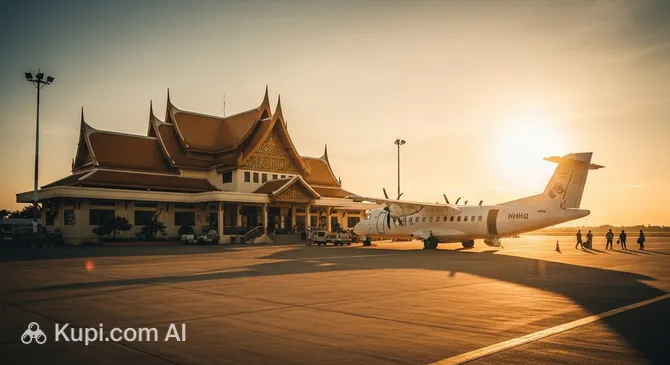
Hua Hin Airport. Source: Kupi.com Binoculars

Hua Hin Airport (HHQ) is not merely a transit hub, but a cosy aerial gateway to Thailand's oldest Royal resort. There are no endless queues or the exhausting noise of metropolises here; instead, travellers are welcomed by a calm, almost home-like atmosphere that sets the mood for relaxation from the very first minutes after landing. Located practically within the city limits, this compact aviation hub allows you to swap an aeroplane seat for a sun lounger by the sea in barely half an hour, making the start of your holiday as comfortable as possible.

IATA Code HHQ
ICAO Code VTPH
City Hua Hin
Distance to Centre ~7 km
Status International
Annual Passengers About 40,000 people
Schedule See official website

The main feature of this air harbour is its phenomenal accessibility. The airport is located directly on the main Phet Kasem Road, allowing you to reach the city centre or key hotels in just 10–15 minutes by taxi. This is a rare advantage that spares tourists from the long and expensive transfers common in major capital cities.

Another undeniable merit is its compactness and speed of service. Thanks to the terminal's small size, all pre-flight formalities are completed very quickly. It is practically impossible to get lost here, and the path from the check-in counter to the boarding gate takes mere minutes. This makes the airport an ideal choice for families with children and elderly travellers who appreciate the absence of unnecessary bustle.

Despite its modest scale, the airport holds the necessary status to receive foreign flights. The presence of customs and passport control zones opens opportunities for direct flights from neighbouring countries, although the majority of traffic consists of convenient domestic flights connecting the resort with the northern and north-eastern provinces of Thailand.

Contact Information

  • Official Website: huahin.airports.go.th
  • Inquiry Service Phone: +66 32 521 210
  • Airport Address: Phet Kasem Rd, Hua Hin, Hua Hin District, Prachuap Khiri Khan 77110, Thailand
  • Email: saraban_hhq@airports.go.th
  • Social Media: Official airport page on Facebook.
  • Lost Luggage Information: For issues related to lost or damaged luggage, it is recommended to first contact your airline's representative at the airport.
  • Passenger Support Service: For general information and assistance, you can contact the inquiry service by phone at +66 32 521 210.

How to Get to the Airport

Getting to Hua Hin Airport (HHQ) from the city centre of Hua Hin is quite simple, as it is located just a 10–15 minute drive to the north. The choice of transport depends on your budget, time, and comfort preferences.

The fastest and most convenient method is a taxi or booking a car via mobile apps (such as Grab). A trip from the central district will take no more than 15 minutes and will cost approximately 200–300 Thai Baht. This is an ideal option if you are travelling with luggage or value comfort. You can also pre-book a private transfer to meet you directly at your hotel at a designated time.

For budget-conscious travellers, local public transport — songthaew (pickup trucks equipped with benches for passengers) — is suitable. There is no direct route into the terminal, but you can travel along the main Phet Kasem Road, which passes by the airport, and walk a short distance. The cost of the trip will be minimal, around 20–40 Baht. This option suits those travelling light and in no rush.

If you prefer independence, car rental is an excellent solution. Many rental agencies in Thailand offer a car return service at the airport, which is very convenient. Next to the Hua Hin Airport terminal, there is a car park where you can easily leave your vehicle before departure.

It should be noted that Hua Hin Airport primarily serves domestic flights. For most international journeys, travellers use the country's larger aviation hubs, such as Suvarnabhumi and Don Mueang airports in Bangkok or U-Tapao Airport in the Pattaya region, which can be reached from Hua Hin by bus or minivan.

Terminals and Layout

Hua Hin Airport (HHQ) is a small and very compact airport consisting of one passenger terminal. This building serves both domestic and limited international flights, so you do not need to worry about searching for the right building or long transfers.

The terminal layout is extremely simple. Essentially, it is a single-storey building where all functional zones are located sequentially and within walking distance of each other. Immediately at the entrance are the airline check-in counters, followed by the security checkpoint. After passing through, passengers enter a small and cosy waiting hall with boarding gates. Navigation is intuitive, and getting lost here is practically impossible.

Departure and arrival zones are in the same building but separated. The arrival hall is equally compact: after disembarking the aircraft, passengers immediately enter the baggage claim area, and from there proceed to the exit where taxis and transfers await. Thanks to the airport's small size, all pre-flight and post-flight procedures are completed very quickly. Flight check-in and security screening usually take no more than 20-30 minutes, which is a huge advantage compared to major airports.

The main recommendation for navigation at Hua Hin Airport is not to arrive too early. There are no long queues or confusing corridors here. Everything necessary is literally a few steps away, making travel through this airport as comfortable and carefree as possible.

Airport History

The history of Hua Hin Airport (HHQ) is closely intertwined with the development of the resort of the same name as a Royal residence and a tourism centre of Thailand. Initially, in the mid-20th century, a small airfield named "Sanam Bin Bor Fai" appeared here, used primarily for military purposes and the needs of the Royal Family, whose summer residence is located in Hua Hin. It was a modest facility with an unpaved runway, far from the modern concept of an airport.

A key stage in the development of the air harbour occurred in the early 2000s. To stimulate tourism and make the resort more accessible, the government initiated a large-scale reconstruction. In 2003-2004, the airport was effectively rebuilt: the runway was extended to 2,100 metres, allowing it to accommodate medium-haul aircraft such as the Airbus A320 and Boeing 737. A new, more spacious passenger terminal was also constructed.

Following modernisation, the airport began accepting commercial flights, including those from budget airlines. In various years, flights to Bangkok were operated from here, and attempts were made to establish international connections, for example, with Kuala Lumpur. However, the history of commercial operation at the airport has been unstable — flights were opened and cancelled depending on tourist demand and economic viability.

In recent years, ambitious plans for the further development of the airport have emerged. Projects are being discussed for another extension of the runway and expansion of the terminal to attract a greater number of international flights, especially from Asian countries. One of the most significant recent projects is the creation of an aircraft Maintenance, Repair, and Overhaul (MRO) centre at the airport, which aims to transform it into an important aviation hub for the region.

An interesting fact: despite its modern status, Hua Hin Airport still retains its historical connection with the Royal Family. Its proximity to the Klai Kangwon Palace ("Far from Worries") and its role in serving the "Royal Resort" give it special prestige and significance beyond that of a typical regional airport.

Services and Facilities

Hua Hin Airport (HHQ) is a small and compact air hub serving one of Thailand's popular resorts. The infrastructure here is not as extensive as in capital airports, but a basic set of services and amenities is available to passengers for a comfortable wait.

Inside the terminal building, there is a small café where you can order beverages, light snacks, sandwiches, and pastries. The choice of establishments is limited, so one should not count on a full meal. Additionally, there are several small shops selling souvenirs, essential goods, and sweets. Duty Free shops have a very modest assortment and mainly serve passengers on the few international charter flights.

Passengers can utilise free Wi-Fi to stay connected while waiting for departure. Charging points for electronic devices exist, but their number is limited, so having a portable power bank is advisable. There are no high-comfort lounges or public VIP zones in the airport — premium service is provided only within the scope of a specific airline's service.

Regarding financial services, ATMs and a currency exchange counter are available at the airport. Please note that the exchange rate at the airport may be less favourable than at exchange points in the city. A medical point is available for emergency assistance, however, for serious ailments, one should visit one of the city hospitals.

There are no dedicated playrooms for children in the airport, but the restrooms are equipped with baby changing tables. Passengers with reduced mobility are provided with necessary assistance for moving through the terminal and boarding the flight. To receive this service, it is necessary to contact your airline in advance and inform them of your needs.

There are no hotels within the airport building itself, but thanks to its convenient location, you can reach numerous hotels and resort complexes in Hua Hin in just a few minutes by taxi. Conference rooms or business centres are also absent in the terminal; these services are available in major city hotels.

Where to Eat

When planning a departure from Hua Hin Airport (HHQ), it is important to consider that this is a small regional airport, and the choice of dining establishments here is quite limited. Unlike the major international hubs of Thailand, you will not find a wide variety of restaurants and cafés here. Typically, all available options are concentrated in the single terminal, in the general area before security control (landside).

Usually, a small café or snack bar operates at the airport. The menu offers basic options for a quick bite: sandwiches, pastries, crisps, as well as soft drinks, water, tea, and coffee. Sometimes simple local dishes are on sale, for example, packed spring rolls or light snacks. This is sufficient for a snack while waiting for a flight, but for a full lunch or dinner, it is better to eat in advance at one of the numerous restaurants in the city itself.

Prices at the airport are generally slightly higher than in the city. Opening hours of establishments are directly tied to the flight schedule and may be limited. Unfortunately, finding specialized options here, such as vegetarian, vegan, gluten-free, or Halal meals, is practically impossible. If you have strict dietary requirements, it is strongly recommended to bring food with you.

Tips for Travellers

To ensure your journey through Hua Hin Airport goes as smoothly as possible, make use of these simple tips. They will help save time, stress, and money, making the start or end of your trip to Thailand more comfortable.

Arrival time at the airport. Although Hua Hin Airport is small, arrive early. For international flights, it is recommended to be on-site 2-3 hours before departure, and for domestic flights — 1.5-2 hours. This will give you a sufficient buffer for check-in, luggage drop-off, and passing through controls without haste.

Check-in and Security Control. Procedures in a small airport usually proceed faster. To speed up the process, have your passport, visa (if required), and boarding pass ready. Complete online check-in in advance if your airline provides this option. When passing through security, be prepared to remove laptops and other large gadgets, as well as your bag of liquids, from your hand luggage.

Seat Selection. If it is possible to select a seat in advance, consider your preferences. Window seats will offer you magnificent views of the coast during take-off and landing. Aisle seats are convenient if you plan to get up during the flight and allow for a quicker exit from the aircraft upon arrival.

Hand Luggage. Standard international rules apply here too: liquids may be carried in containers with a volume of no more than 100 ml each, packed in a single transparent bag. Sharp objects, weapons, and flammable substances are prohibited. Always check the exact rules for hand luggage and checked baggage on your airline's website to avoid unpleasant surprises.

Transfer Passengers. Hua Hin Airport is not a major transit hub, so connecting flights are rare here. If you do have a transfer planned, verify in advance whether you need to collect your luggage and check in for the next flight again.

Customs Control. Upon arrival, follow the "Green Channel" signs if you have no goods to declare. If you are carrying items that require declaration, or if you are simply unsure, choose the "Red Channel". Please be mindful of regulations regarding the import of alcoholic beverages, tobacco products, and certain other goods.

Saving Time and Money. Checking in online and printing your boarding pass at home will save you time at the airport. To save on transfers, research options in advance: booking a taxi via an app may be cheaper than taking a car from the official airport zone.

In Case of Flight Delay. If your flight is delayed, first contact your airline representative for information. Depending on the length of the delay, you may be provided with drinks, meals, or even hotel accommodation. Keep a charged power bank, an interesting book, or downloaded films handy to pass the waiting time.

Reached the end of the page?

That means the route is fully explored