Support

Trang Airport

About the Airport

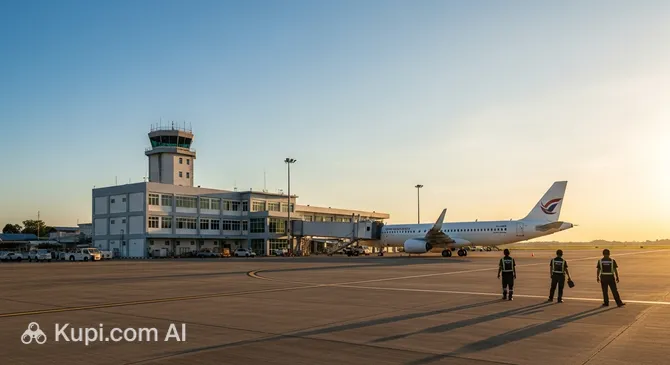
Trang Airport. Source: Kupi.com Binoculars

Trang Airport is not merely a transit point, but a cosy gateway to a world of emerald islands and authentic southern Thailand. This small air hub is devoid of the hustle and bustle of giant hubs: a relaxed atmosphere reigns here, which puts travellers in a holiday mood from the very first minute. Thanks to the terminal's compactness, the journey from the aircraft steps to the city exit takes just a few minutes, allowing you to start your adventure in Trang province much sooner.

IATA Code TST
ICAO Code VTST
City Trang
Distance to Centre 7 km
Status Domestic
Annual Passengers ~600,000 pax

Features and Advantages of the Airport:

The main advantage of Trang Airport is its strategic location. It is situated just seven kilometres from the city centre, allowing you to reach your hotel by taxi or tuk-tuk in literally 15 minutes. Furthermore, it is a key departure point for transfers to the famous islands of the Andaman Sea, such as Koh Muk, Koh Kradan, and Koh Ngai. Counters are located directly in the arrival area where you can immediately purchase a comprehensive "minivan + boat" ticket to your desired resort.

The terminal features simple and clear navigation, making it impossible to get lost. Despite its modest size, the airport has everything necessary for a comfortable wait: small cafes with local coffee, souvenir shops, and car rental counters. Passengers often note the friendliness of the staff and the absence of long queues at check-in, making the flight experience as calm and pleasant as possible.

Contact Information

Below is the essential contact information for Trang Airport (TST), which will help you plan your trip and resolve any questions that may arise.

  • Official Website: trang.airports.go.th
  • Help Desk Phone: +66 75 201 625
  • Address: 106 Moo 5, Khok Lo, Mueang Trang District, Trang 92000, Thailand
  • Email: info.tst@airports.go.th
  • Social Media: The airport has an official Facebook page where news and updates are published: facebook.com/trangairportofficial
  • Lost Luggage Information: If your luggage has been lost or damaged, you should first contact your airline's representative at the airport. Information desk staff can also provide necessary assistance.
  • Passenger Support Contacts: For general information, assistance, and enquiries, please contact the airport help desk via the main phone number.

How to Get to the Airport

Getting to Trang Airport (TST) from the centre of Trang city is very simple, as they are separated by only about 7 kilometres. The fastest and most comfortable method is by taxi or motorised rickshaw (tuk-tuk). The journey will take no more than 15–20 minutes depending on traffic conditions. The taxi fare is usually fixed and costs around 200–300 THB. With a tuk-tuk driver, the price should be negotiated in advance. For maximum convenience, especially if you have large luggage or are travelling with family, you can book a private transfer through your hotel or online.

For budget-conscious travellers, there is a more economical option — public transport. As in many cities in Thailand, the role of route taxis here is fulfilled by songthaews (pick-up trucks equipped with benches for passengers) and minivans. They run between the city and the airport. This is the cheapest way to get to the terminal, however, be prepared that the trip may take slightly longer due to stops along the way to pick up and drop off other passengers.

If you plan not just to drive to the airport but to explore the picturesque Trang province and its coast on your own, it is worth considering car rental. Counters for several rental companies operate in the city and directly at the airport. You can easily reach the airport in a rented car, where you can leave it in the guarded car park. The airport grounds provide spaces for both short-term and long-term parking.

In general, the choice of transport depends on your preferences: a taxi offers speed and comfort, whilst a songthaew offers maximum savings. It is worth noting that Trang is one of several transport hubs in the region. For travel across the south of the country, tourists also frequently use larger airports, such as Krabi Airport, Phuket International Airport, or Hat Yai Airport, which can be reached from Trang by bus or by booking a transfer.

Terminals and Map

The airport of Trang city (TST) is a small regional airport distinguished by its compactness and simplicity. It consists of one terminal which services all domestic flights. Thanks to this, navigation through the airport is intuitive and causes no difficulties even for those visiting for the first time.

The terminal layout is extremely simple. The entire building represents a single space where departure and arrival areas are combined. Immediately upon entering the terminal, you find yourself in a general hall where airline check-in counters are located. After completing check-in and dropping off luggage, passengers proceed to pre-flight security screening, behind which lies a small waiting hall with boarding gates. The arrival area with the baggage claim belt is located in the same part of the building but is separated from the departure zone.

Since there is only one terminal at the airport, the question of transfers between them is irrelevant. All procedures — from entering the building to boarding the aircraft — take place on a single floor and do not require moving over long distances. This makes Trang airport particularly convenient for families with children and elderly travellers.

The time required to complete all formalities is minimal. Flight check-in and security screening rarely take more than 20–30 minutes. Nevertheless, it is recommended to arrive at the airport 1.5–2 hours before departure to go through all procedures without haste, especially during the peak tourist season. Navigation within the terminal will not cause difficulties: signs are duplicated in English, and due to the small size of the building, it is practically impossible to get lost here.

Airport History

The history of Trang Airport (TST) is a clear example of how a small regional airfield transformed into an important transport hub contributing to the development of tourism in southern Thailand. Its foundation dates back to 1954, when the decision was made to construct a runway for government and military needs. In the first years of its existence, the airport did not service commercial flights and was used primarily for official purposes.

The transition to servicing civil aviation became a key stage in the airport's development. As Trang province and its islands began to attract the first tourists, the need for regular air connections arose. Significant modernisation took place in the late 1990s and early 2000s. During this period, the runway was extended and the terminal was reconstructed, which allowed for the reception of larger aircraft, including the popular Boeing 737, and significantly increased passenger flow.

The airport played an important humanitarian role during the tragic events associated with the Indian Ocean tsunami in 2004. It became one of the logistical centres for coordinating rescue operations, receiving humanitarian aid, and evacuating victims. In recent years, responding to the rapid growth in the region's popularity, the airport has entered a new phase of large-scale reconstruction, including the construction of a new, more spacious terminal and further extension of the runway to accommodate wide-body aircraft.

Thus, throughout its history, Trang Airport has journeyed from a small service airfield to the modern aerial gateway of the province. An interesting fact is that, having started its life as a facility for government needs, it eventually transformed into an indispensable element of the tourism infrastructure, opening access for travellers to some of the most picturesque islands of the Andaman Sea.

Services and Amenities

Trang Airport (TST) is a small regional air station offering passengers a basic set of services for a comfortable wait for their flight. Despite its compact size, everything necessary is here. In the terminal, you will find several small cafes where you can have a snack with local cuisine, drink coffee, or buy light snacks for the road. There are also several souvenir shops and stalls with essential goods where you can purchase memorable gifts from Thailand or something you forgot to pack.

General waiting halls are equipped for passengers. It is important to note that there are no specialised VIP lounges or business lounges at the airport, which is typical for small domestic terminals. Throughout the airport territory, free Wi-Fi is generally available, allowing you to stay connected. Charging stations for mobile devices can also be found in the waiting hall, although their number may be limited.

ATMs of several local banks are usually located in the terminal building, where you can withdraw cash. A currency exchange point may also be available, but its operating hours can be limited, and the rate less favourable than in the city. A medical point is provided at the airport for first aid.

For travellers with small children, there is a mother and child room where you can take care of your baby in a quiet environment. The airport is also equipped to receive passengers with reduced mobility: there are ramps and specially equipped toilets. Nevertheless, for assistance with boarding and moving around the terminal, it is recommended to notify your airline in advance.

There are no hotels directly on the territory of Trang Airport. The nearest hotels and guesthouses are located in the city itself, which can be reached by taxi or transfer in 15–20 minutes. Specialised conference halls or business centres are also absent at the airport; for business meetings, it is better to use the services of hotels in the city.

Where to Eat

Trang Airport (TST) is a small regional air station, so the choice of dining establishments here is quite modest but sufficient for a snack before departure. Most options focus on authentic Thailand cuisine, offering a chance to enjoy local flavours before flying out.

The main cafes and small eateries are located in the general hall of the single terminal, before passing security control (landside). Here you can find several establishments offering both full hot meals and light snacks. After passing control, in the departure zone (airside), the choice is usually limited to a small kiosk with drinks, sandwiches, and packaged snacks.

For a substantial lunch, you can order classic Thai dishes such as Pad Thai (stir-fried noodles) or Khao Pad (fried rice). If you are in a hurry, look out for counters with coffee, fresh pastries, and sandwiches. We recommend trying local delicacies if they are on sale, such as the famous Trang cakes. This makes for an excellent gastronomic souvenir.

Options for passengers with special dietary requirements (vegetarian, vegan, Halal, or gluten-free dishes) at the airport are very limited. It is best to verify the ingredients of dishes directly with the cafe staff. Prices in airport establishments are moderate but expectedly higher than in the city. The operating hours of most cafes and kiosks are tied to the flight schedule: they open a few hours before the first departure and close after the last one departs.

Travel Tips

Travelling through the airport of Trang city can be an easy and pleasant start to your adventure in southern Thailand. To avoid unnecessary stress, use our tips which will help you orient yourself in this small but functional airport.

Trang Airport mainly serves domestic flights, so there are rarely large queues here. Nevertheless, it is recommended to arrive at the airport at least 1.5-2 hours before departure. This will give you enough time to drop off luggage and pass security control without haste. To save time, use online check-in, which is offered by most airlines. With an electronic boarding pass and no checked luggage, you can proceed directly to screening.

Rules for carrying hand luggage in Thailand are standard. All liquids (shampoos, creams, perfumes) must be in containers with a volume of no more than 100 ml and packed in one transparent bag. It is forbidden to bring sharp objects and weapons into the cabin. Remember that portable chargers (power banks) should be carried only in hand luggage, and not in checked baggage.

When flying into or out of Trang, try to take a window seat. Depending on the route and time of day, breathtaking views of whimsical karst cliffs, emerald islands of the Andaman Sea, and the picturesque coastline may open up to you. This is a wonderful opportunity to take the first or last photos of your trip.

Trang Airport is not a major transit hub. Most passengers begin or end their journey here. If you have a self-transfer, you will likely have to collect your luggage and check in again for the next flight. Since the airport primarily serves domestic lines, you will most likely pass customs and passport control at the international airport of arrival, for example, in Bangkok. The customs control procedure in Thailand is standard: large sums of cash and goods exceeding established limits are subject to declaration.

To save on transfers from the airport, use shared minivans that run to the city and nearby piers — this is cheaper than a taxi. Prices for food and drinks at the airport may be higher than in the city. If you want to save money, have a snack in advance or bring snacks allowed for carriage with you. Always keep your passport, tickets, and other documents ready — this will significantly speed up the passage of all formalities.

In case of a flight delay, remain calm. First of all, contact your airline representative for information about the new departure time and possible compensation (for example, food vouchers). Trang Airport is small, and the choice of entertainment here is limited. In case of a long wait, it is useful to have a book, a charged power bank, and films or music downloaded to your device.

Reached the end of the page?

That means the route is fully explored