Support

Sfax El Maou Airport

About the Airport

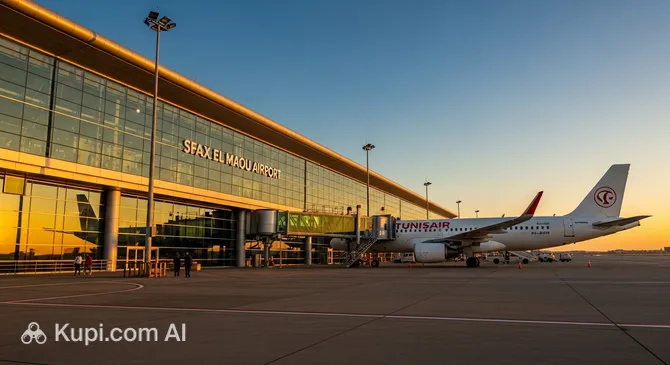
Sfax El Maou Airport. Source: Kupi.com Binoculars

Sfax El Maou International Airport acts as a compact and convenient air gateway to the second-largest city in Tunisia. Located just a few minutes' drive from the industrial centre, this aviation hub serves as an excellent alternative to the busy capital hubs for those who value their time and tranquillity. A recent large-scale modernisation has transformed it from a modest airfield into a modern transport facility, while preserving a cosy atmosphere where every passenger feels like a welcome guest. The airport is ideally suited for both business travellers heading to Sfax and tourists beginning their journey here to the unique Kerkennah Islands or the desert regions of the south.

IATA Code SFA
ICAO Code DTTX
City Sfax
Distance to centre ~6 km
Status International
Annual Passengers ~174,000 (2023 data)
Schedule Available on the online board and airport website

Features and Advantages of the Airport:

The key advantage of Sfax El Maou is its compactness and efficiency. Thanks to the small size of the single terminal, the journey from the entrance to the boarding gate takes mere minutes. Long queues at passport control or security checks are rare here, allowing passengers to arrive at the airport a little later than usual, avoiding unnecessary stress.

Following the commissioning of the new terminal in 2007, the airport received modern infrastructure capable of serving up to half a million people per year. Bright waiting halls, clear navigation, and the availability of basic services make staying here comfortable. This is particularly appreciated by business tourists, for whom Sfax is an important point of attraction.

One cannot fail to mention the exceptional transport accessibility. The airport is located literally on the edge of the city limits, so a taxi ride to the centre takes only about 15 minutes and is quite inexpensive. Such a location makes it one of the most convenient in the country in terms of "city-to-plane" logistics.

Contact Information

For your convenience, we have collected the main contact information for Sfax El Maou Airport (SFA). We recommend clarifying details (such as service operating hours) on official resources before your trip.

  • Official Website: The airport is managed by OACA (Office de l'Aviation Civile et des Aéroports). Up-to-date information can be found on their official website: www.oaca.nat.tn.
  • Inquiry Service Phone: (+216) 74 278 000
  • Airport Address: Route El-Maou, 3018 Sfax, Tunisia
  • Email: The airport usually does not provide a direct public email for general inquiries. For communication, it is recommended to use the phone or the contact form on the OACA operator's website.
  • Social Media: For the latest news and updates, you can follow the official pages of the operator OACA on social networks.
  • Lost Luggage Information: For issues related to lost or damaged luggage, you must first contact the Lost & Found service of your airline directly at the airport.
  • Passenger Support Contacts: For general information and assistance on-site, please approach the information desks in the terminal or call the main airport phone number.

How to Get to the Airport

Getting to Sfax El Maou International Airport (SFA) from the city centre of Sfax is quite simple, as it is located just 6 kilometres southwest of it. The journey usually takes no more than 15-20 minutes, depending on traffic conditions. Travellers have access to several convenient transport options, including taxis, public buses, and car rentals.

Taxi is the most popular and convenient way to get to the airport. Official city taxis in Tunisia are easily recognised by their yellow colour. The trip from the centre of Sfax to the airport will take about 15 minutes. We recommend insisting that the driver turns on the meter (in French — compteur); this guarantees a fair and, as a rule, low cost for the trip. You can also book a private transfer in advance through your hotel or online services, which is especially convenient if you are travelling with a large amount of luggage.

Public Transport in the form of city buses is the most budget-friendly option. Local bus companies operate routes passing near the airport. Although this is the cheapest method, it may not be the most comfortable, especially with heavy suitcases. Schedules may not always be precise, so it is worth allowing extra time for the journey. It is recommended to check the number of the suitable route and its schedule in advance at the nearest stop or with local residents.

Car Rental is an excellent choice for those planning to travel around the region independently. Many international and local rental companies have representation both in the city and directly at Sfax El Maou Airport. This allows you to conveniently pick up a car in the centre and return it right before departure. The airport territory has parking where you can leave a vehicle for both short and long terms.

Terminals and Map

The Sfax El Maou Airport (SFA) is a compact and functional aviation hub serving the second-largest city in Tunisia. Its structure is extremely simple and clear, making it convenient for travellers who are not used to huge international hubs.

The airport operates one passenger terminal, which serves both domestic and international flights. Thanks to this, you do not have to worry about transfers between terminals or a long journey from one part of the airport to another. Everything is located in one building, which significantly simplifies navigation.

The terminal layout is logical and intuitive. Arrival and departure zones are located in the same building but are clearly separated. Immediately after entering the terminal, you find yourself in the general hall where the check-in counters are located. After completing check-in and dropping off luggage, passengers proceed to the security and passport control zone, after which they enter the secure area with waiting lounges and boarding gates. The arrival zone includes the baggage claim hall and customs control.

Completing all formalities usually does not take much time. Due to the small size of the airport and moderate passenger flow, queues for check-in and security are usually shorter than in major capitals. Nevertheless, it is recommended to arrive at the airport according to standard times: 2-3 hours before an international flight and 1.5-2 hours before a domestic one, to go through all procedures without haste.

To navigate the terminal, simply follow the signs, which are duplicated in Arabic, French, and English. The compactness of the airport is its main advantage: it is practically impossible to get lost here, and the entire path from the entrance to the boarding gate takes minimal time.

Airport History

The history of Sfax El Maou International Airport (SFA), also known as Sfax-Thyna, is closely linked to the events of the 20th century. Its story begins during the Second World War when it was built as a military airfield. During the North African campaign, it was used by the US Air Force under the name Sfax Airfield and played an important strategic role in Allied operations. After the war ended, the military pages of its history were turned, and the airfield was converted for civil needs, marking the beginning of a new era in the region's development.

The transition to civil aviation became a key stage for the airport, turning it into an important transport hub for the city of Sfax — the economic and industrial centre of southern Tunisia. Over the decades, the airport gradually developed, serving a growing passenger flow and helping to strengthen the region's business and tourism ties. The airport is managed by the Tunisian Civil Aviation and Airports Authority (OACA), which initiated key projects for its modernisation.

The most significant event in the airport's modern history was a large-scale reconstruction completed in 2007. As part of this project, a new passenger terminal with an area of 8,000 square metres was built and put into operation. This allowed the airport's capacity to increase to 500,000 passengers per year and significantly improved the level of comfort and service quality. The modernisation also affected the runway and other airfield infrastructure, making Sfax-Thyna Airport modern and compliant with international standards.

An interesting fact: the airport name "Thyna" comes from the ancient city of Thaenae, the ruins of which are in the immediate vicinity of the air harbour. This gives the airport a special historical aura and reminds travellers of the rich past of these lands. Today, Sfax El Maou Airport continues to play a key role, connecting Tunisia's second-largest city with the world and serving both scheduled and seasonal charter flights.

Services and Facilities

Sfax El Maou Airport (SFA) offers passengers all necessary services for a comfortable wait for their flight. Although the airport is not large in size, its infrastructure is designed to satisfy the basic needs of travellers arriving in or departing from the second-largest city in Tunisia.

In the airport terminal, you will find several cafés and snack bars where you can have a bite to eat or drink coffee before your flight. For those wishing to shop, there is a Duty Free shop offering a standard range of perfumes, cosmetics, beverages, and souvenirs, as well as other small retail outlets.

General waiting lounges are equipped for passenger relaxation. Travellers preferring enhanced comfort can use the services of the VIP lounge. Free Wi-Fi is available throughout the terminal, and there are power outlets for charging electronic devices so that you can always stay connected.

To resolve financial matters, bank branches and currency exchange points operate at the airport, where you can exchange money or withdraw cash from ATMs. In case of need, there is a medical point in the terminal building to provide first aid.

The airport is equipped to receive passengers with reduced mobility: ramps and special assistance upon prior request are provided for them. Families with small children can use the mother and child room to take care of their little ones in a quiet environment.

There are no hotels directly on the airport territory, but the nearest hotels can easily be found in the city of Sfax, which is located just a few kilometres away. For business travellers, basic business services, such as work areas and internet access, are usually provided in the VIP lounge.

Where to Eat

Dining options at Sfax El Maou Airport (SFA) correspond to its status as a compact regional airport. You will not find a large variety of restaurants here as in major international hubs; however, there are a few spots for a snack and rest before departure. The main establishments are cafés and snack bars offering a standard set of snacks and beverages.

Catering establishments are located both in the public area (landside) and in the departure zone after passing passport control (airside). Usually, there is at least one café in the departure zone where you can comfortably wait for your flight. There is also a café in the public area, convenient for those seeing someone off and those who arrived at the airport early.

In the menus of local cafés, you can find both international and local offers. This is a great opportunity to enjoy the atmosphere of Tunisia one last time: order a cup of aromatic mint tea or strong coffee, try Tunisian pastries, or a sandwich with harissa. For a quick snack, croissants, sandwiches, or packaged snacks are ideal. Options for a full lunch are limited here, but you can find sufficiently filling sandwiches or small portioned dishes.

Passengers with special dietary needs (vegetarians, vegans) should be prepared for a limited selection. Most often, simple vegetable sandwiches or salads can be found. It is recommended to check the ingredients of dishes with the staff. Prices at the airport are generally higher than the city average but remain moderate. The opening hours of establishments are usually tied to the flight schedule, so they are open to serve passengers of both morning and evening flights.

Travel Tips

Travelling through Sfax El Maou Airport will be more comfortable and predictable if you familiarise yourself with a few useful tips in advance. These recommendations will help you save time, money, and avoid stress during your trip to Tunisia.

Arrival Time at the Airport. For international flights, it is recommended to arrive at the airport at least 2.5–3 hours before departure. For domestic flights, 1.5–2 hours is usually sufficient. During peak tourist season or on holidays, it is worth allowing extra time, as queues for check-in and security control may be longer than usual.

Check-in and Security Control. To save time, use online check-in if your airline provides this option. At the airport, the process is standard: check-in counters, then passport control and security screening. Prepare your passport and boarding pass in advance. During screening, be ready to remove laptops, tablets, and liquids in a transparent bag from your hand luggage.

Choosing a Seat on the Plane. If you have the opportunity to choose a seat during check-in, consider your preferences. Window seats (A, F) offer beautiful views during takeoff and landing. Aisle seats (C, D) are convenient if you plan to get up often. Seats in emergency exit rows usually offer more legroom, but they are often provided for an additional fee.

Hand Luggage. Remember international rules for carrying liquids: the volume of each container must not exceed 100 ml, and all of them must be packed in one transparent bag with a volume of no more than 1 litre. It is forbidden to take sharp objects, flammable substances, and weapons in hand luggage. Always check your airline's rules, as there may be additional restrictions on weight and size.

Transfer Passengers. If you have a connecting flight, clarify during check-in whether your luggage will be automatically checked through to the final destination. Sfax El Maou Airport is relatively small, so navigation will not cause difficulties, but still calculate the time needed to transfer between gates in advance.

Customs Control. Upon arrival in Tunisia, you will need to fill out an immigration card. Be prepared to declare large sums of cash and valuable items. There are restrictions on the import of alcohol and tobacco products. When departing from the country, the export of local currency (dinars) is prohibited, and special permits may be required for the export of antiques and art objects.

Saving Time and Money. To avoid inflated taxi prices at the airport, consider booking a transfer in advance. It is more profitable to exchange currency at banks or exchange offices in the city rather than at the airport. Take an empty water bottle with you to fill it after passing security control and avoid spending on drinks.

In Case of Flight Delay. First of all, contact your airline representative for information about the reasons for the delay and the estimated departure time. Depending on the duration of the wait, the air carrier is obliged to provide drinks, meals, and for long delays — hotel accommodation. Keep all receipts for unforeseen expenses to claim compensation later.

Reached the end of the page?

That means the route is fully explored