Support

Sabiha Gokcen International Airport

Airports in the city

About the Airport

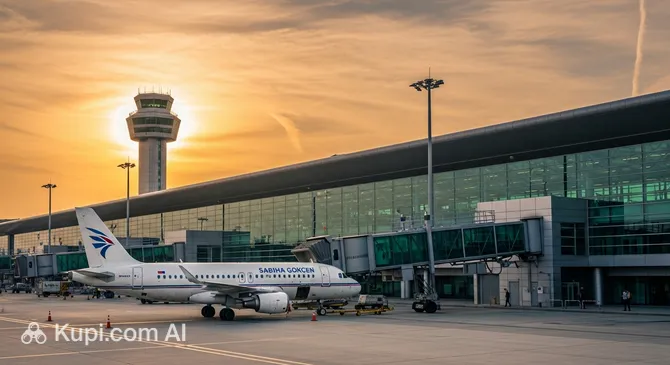
Sabiha Gokcen International Airport. Source: Kupi.com Binoculars

Sabiha Gökçen International Airport is not just the second-largest air gateway to Istanbul, but a vital transport hub located on the Asian side of the metropolis. Named after the world's first female combat pilot, it symbolizes the modern and dynamic side of Turkey. The airport opened in 2001 and has since expanded significantly, becoming a key base for many airlines, primarily low-cost carriers. Today, it welcomes tens of millions of passengers annually, offering them convenient and modern infrastructure.

IATA Code SAW
ICAO Code LTFJ
City Istanbul
Distance to Centre ~35-50 km
Status International
Annual Passengers Over 37.1 million (2023)
Popular Airlines Pegasus Airlines, Turkish Airlines, AJet
Schedule online arrival/departure board "Sabiha Gökçen International Airport"

The main advantage of Sabiha Gökçen Airport is its reputation as a major hub for low-cost carriers; in particular, it serves as the base for Pegasus Airlines. This makes it attractive for budget-conscious travellers. The airport terminal is designed as a single modern building that is easy to navigate: domestic and international flights are served under one roof, simplifying transfers. Since 2022, the airport has been directly connected to the city by the M4 metro line, allowing passengers to quickly and affordably reach the Kadıköy district and transfer to other lines, including the Marmaray line for travel to the European side. Additionally, the airport is known for utilizing advanced earthquake-resistant technologies in its construction, making it one of the safest buildings in the world.

Contact Information

There are several ways to contact representatives of Sabiha Gökçen Airport. Below are the main contact details for passengers.

  • Official Website: www.sabihagokcen.aero — here you will find the most up-to-date information on flights, services, and airport regulations.
  • Information Desk Phone: +90 216 588 88 88 (24/7 support available).
  • Address: Sanayi Mahallesi, Havaalanı İç Yolu, 34906 Pendik/İstanbul, Türkiye.
  • Email: For general inquiries and feedback, you can write to customer service: customercr@sgia.aero.
  • Social Media: The airport actively maintains pages where it publishes news and answers passenger questions on X (formerly Twitter), Facebook, and Instagram.
  • Lost Luggage Information: If your items were lost within the terminal building, contact the Lost and Found office. If luggage was lost by the airline, you must contact your carrier's baggage tracing service. Contacts are usually available on the airport's official website in the relevant section.
  • Passenger Support Contacts: The primary channel for support is the 24-hour telephone number and the customer service email.

How to Get to the Airport

Reaching Sabiha Gökçen International Airport (SAW), located on the Asian side of Istanbul, can be done in several ways, each with its own advantages depending on your budget, time, and comfort preferences. When planning your trip, it is important to account for the famous Istanbul traffic jams, which can significantly increase travel time.

Public Transport — the most reliable and economical method.

  • Metro: The most predictable option is the M4 (Kadıköy - Sabiha Gökçen Havalimanı) metro line. It directly connects the airport with the Kadıköy district, a major transport hub where you can transfer to ferries to the European side or the Marmaray commuter train. The journey from end to end takes about 50 minutes, making the metro the best choice for those wishing to avoid traffic.
  • Havabus/HAVAİST Shuttle Buses: These comfortable buses operate on several key routes, including Taksim and Kadıköy. They are an excellent compromise between price and comfort. The buses have luggage compartments. Travel time depends heavily on the traffic situation and can range from 60 to 120 minutes or more.
  • City Buses (IETT): The most budget-friendly way. Several routes connect the airport with different parts of the city (e.g., E-10 and E-11 from Kadıköy, SG-2 from Taksim Square). The journey will be longer and less comfortable, especially with luggage, but allows for maximum savings. To pay for the fare, you will need an Istanbulkart.

Taxi and Private Transfer offer maximum comfort.

  • Taxi: A convenient "door-to-door" option. The cost of a trip from central districts on the European side, such as Sultanahmet or Taksim, will be higher and heavily dependent on traffic and the time of day. The trip can take from 60 to 90 minutes without traffic and up to 2-3 hours during peak times. It is recommended to use official yellow or turquoise taxis and ensure the driver switches on the meter, or book a car via mobile apps.
  • Private Transfer: A pre-booked transfer guarantees a fixed price and no surprises. The driver will meet you at the designated location. This option is especially convenient for families with children or large groups with bulky luggage.

Car Rental and Parking — an option for those planning to travel by car outside the city. The airport itself has a large multi-level car park where you can leave your vehicle for both short and long periods. However, bear in mind that driving in Istanbul is a challenging task due to dense traffic and complex navigation. Also consider that Turkey has other air hubs, for example, the main hub on the European shore — Istanbul Airport (IST), the route to which is planned completely differently.

Regardless of the chosen method, we strongly recommend leaving for the airport with plenty of time to spare, especially if your flight falls during morning or evening peak hours. This will allow you to avoid unnecessary stress and calmly go through all pre-flight formalities.

Terminals and Map

Sabiha Gökçen International Airport (SAW) features a modern and well-thought-out structure that makes navigation for passengers as simple as possible. A key feature of the airport is its single large terminal, which serves both domestic and international flights. This saves travellers from having to move between different buildings, which is particularly convenient for transit flights.

The terminal layout is intuitive. The building is divided into two main levels:

  • Arrivals Level (Ground Floor): Here you will find baggage claim areas, customs control, and exits to the city. Taxi stands, shuttle buses, and car rental companies are also located on this level.
  • Departures Level (Upper Floor): Upon arriving here, you find yourself in a spacious check-in hall with numerous airline counters. After receiving a boarding pass, passengers proceed to security screening areas, which are separated for domestic and international flights.

Zones for domestic and international flights are located in different wings of the same building. Navigation is very simple thanks to clear signage in Turkish and English. After passing security and passport control (for international flights), passengers enter a common airside area with numerous Duty Free shops, cafes, restaurants, and boarding gates.

Completing all procedures may take varying amounts of time depending on the season and time of day. On average, it is recommended to allocate:

  • For check-in and security for domestic flights — at least 1.5–2 hours.
  • For all formalities for international flights (including passport control) — about 2.5–3 hours before departure. Queues are possible during peak hours, so it is better to arrive with time to spare.

For easy navigation, follow simple tips: determine in advance which part of the terminal your flight departs from (domestic or international), keep an eye on information on departure boards, and do not hesitate to ask airport staff for assistance. Thanks to its compact and logical structure, Sabiha Gökçen Airport leaves a positive impression on most travellers.

Airport History

The history of Sabiha Gökçen International Airport (SAW) is a story of rapid development and strategic planning aimed at relieving the main aviation hub of Istanbul at the time. The decision to build it was made in the late 1990s, and the official opening took place in January 2001. Located on the Asian side of the city, it was originally conceived as an auxiliary airport but quickly exceeded all expectations.

One of the most interesting facts is its name. The airport is named after Sabiha Gökçen — the world's first female combat pilot and one of the adopted daughters of Mustafa Kemal Atatürk, the founder of the Republic of Turkey. This choice symbolizes the progressive spirit of modern Turkey and its achievements in aviation.

A key stage in the airport's history was its massive modernization. In 2009, a new international terminal was opened, increasing capacity from 3 to 25 million passengers per year. This event turned Sabiha Gökçen into a fully-fledged international hub and the main base for many budget airlines, primarily Pegasus Airlines. The terminal building was designed with earthquake resistance in mind and became one of the largest seismically isolated structures in the world.

Since its expansion, the airport has repeatedly broken passenger traffic growth records, regularly appearing on lists of the fastest-growing airports in Europe. To further increase capacity, a second runway was built, marking another important milestone in its development. Today, Sabiha Gökçen Airport is an integral part of Istanbul's transport system, continuing its history of success and constant improvement.

Services and Amenities

Sabiha Gökçen International Airport (SAW) offers passengers modern infrastructure and a full range of services for a comfortable wait before their flight. The terminal houses numerous restaurants and cafes where you can taste both Turkish cuisine and international favourites. For shopping enthusiasts, there is a large Duty Free zone, as well as boutiques of famous brands, souvenir shops, and travel goods stores.

For those who value enhanced comfort, the airport has several business lounges, access to which can be obtained for a fee or via privilege cards. Here, guests can relax in silence, use shower facilities, and enjoy snacks. Free Wi-Fi is available throughout the terminal, usually with a time limit, and numerous charging stations for electronic devices allow you to stay connected at all times.

Financial matters can be handled at bank branches, currency exchange offices, or via ATMs located in different parts of the airport. Passenger health is looked after by 24-hour medical points and pharmacies, where you can receive first aid or purchase necessary medicines.

Sabiha Gökçen Airport is well-equipped for travellers with children. At their disposal are special baby care rooms for changing and feeding, as well as play areas to help pass the time before departure. For passengers with reduced mobility, escort assistance is provided, and ramps, elevators, and specially equipped restrooms are available.

A comfortable hotel is located directly on the airport premises, which is particularly convenient for transit passengers or those with an early flight. Business travellers have access to conference rooms and business centres equipped with everything necessary for meetings and negotiations, allowing for effective time management even while waiting for a flight.

Where to Eat

At Sabiha Gökçen International Airport (SAW), travellers will find a wide selection of establishments to suit every taste and budget. Whether you are looking for a quick snack before departure or wish to enjoy a full meal, you will easily find a suitable option. Most cafes and restaurants are concentrated in the main terminal, both in the public area (landside) and in the departure zone after passport control (airside).

The main part of the food court is located in the departure zone (airside), after security screening. Here you will find world-famous fast-food chains such as McDonald's, Burger King, and Popeyes, as well as coffee shops like Starbucks. For those wishing to experience local cuisine, a visit to the Tadında Anadolu restaurant is highly recommended. It serves authentic dishes from various regions of Turkey, allowing you to experience the country's gastronomic diversity without leaving the airport. Most establishments in this zone operate 24/7, which is especially convenient for passengers on night flights.

If you have time before check-in or are meeting arrivals, there are also excellent options in the public area (landside). In the arrivals and departures hall, you can find several cafes serving coffee, pastries, and sandwiches. For example, at Simit Sarayı, you can try the traditional Turkish sesame bagel — simit. This is a wonderful choice for a light and inexpensive snack.

For a quick bite, sandwich kiosks or international fast-food chains are ideal. For a full lunch or dinner, it is better to choose one of the table-service restaurants where you can try kebabs, meze (appetizers), or hearty soups in a relaxed atmosphere. Regarding special dietary needs, Halal dishes are the standard at most establishments. Vegetarians will easily find suitable options such as salads, vegetable dishes, and meze. Vegan and gluten-free options are less common, so it is recommended to study the menu carefully or check with the staff.

Food prices at the airport are generally higher than in Istanbul. You will pay one amount for a quick snack with a drink, while a full meal in a restaurant will cost more. We recommend allocating slightly more funds for dining at the airport than in the city. The main advantage is that most key dining spots in the departure zone are available 24/7, so you certainly won't go hungry, no matter what time your flight is.

Tips for Travellers

Planning your trip through Sabiha Gökçen International Airport in Istanbul will help make your journey more comfortable. To avoid rushing, arrive at the airport well in advance: 2-3 hours before domestic flights and at least 3-4 hours before international flights. The airport is a major hub for low-cost carriers, so it can be quite crowded during peak hours.

To save time, use online check-in, which is offered by most airlines. This will allow you to head straight to baggage drop (if you have luggage) or to the security checkpoint. Be prepared for standard security procedures: you will need to present your boarding pass and passport, as well as scan your carry-on luggage. Additional random checks may sometimes be conducted.

Seat selection on the plane depends on your preferences. Window seats offer magnificent views during takeoff and landing, especially if you are flying over Turkey in clear weather. Aisle seats are convenient if you plan to get up during the flight without disturbing your neighbours. If you need more legroom, check with the airline about the possibility of booking emergency exit seats for an additional fee.

In carry-on luggage, liquids are permitted in containers up to 100 ml, packed in a transparent bag. All electronic devices, including laptops and power banks, must be with you in the cabin. Sharp and cutting objects are strictly prohibited. To speed up screening, take all electronics and your bag of liquids out of your bag in advance.

If you have a transfer at Sabiha Gökçen, carefully follow the signs for "Transit" or "International/Domestic Transfers". Ensure you have enough time between flights, as you may need to go through security again. Information about your next flight and the gate number will be displayed on information boards throughout the terminal.

When passing through customs control after arrival, standard "Green" and "Red" channel rules apply. If you have no goods to declare, proceed confidently through the "Green" channel. Otherwise, you must fill out a declaration and pass through the "Red" channel.

To save money, use Havabus buses or public transport to get to the city — this is significantly cheaper than a taxi. Inside the airport, there is a food court where prices are usually lower than in the cafes near the boarding gates. Also, remember that drinking water after passing security can be expensive, so bring an empty bottle and fill it at the drinking fountains.

In case of a flight delay or cancellation, contact your airline representative first. They will provide up-to-date information and explain your rights regarding meals, hotel accommodation, or compensation depending on the length of the delay. Do not panic, keep all receipts and documents — they may be needed to claim compensation.

Reached the end of the page?

That means the route is fully explored