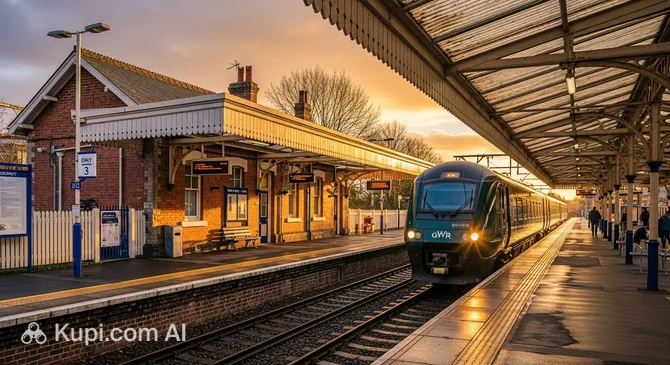
Bridgwater Railway Station is a historic station serving the town of the same name in the county of Somerset. Designed by the famous engineer Isambard Kingdom Brunel, the station is an important transport hub on the line between Bristol and Taunton. The station building, designed in a classic Victorian style, combines the atmosphere of the past with modern requirements for passenger transport.
It is important for passengers to know that the station has two platforms. Platform 1 usually serves trains towards Bristol and London, while Platform 2 serves the direction of Taunton and Exeter. A footbridge is used to cross between the platforms. The station is located relatively close to the town centre, making it convenient for tourists wishing to explore local attractions.
Contact Information
Official Website: Up-to-date timetables and tickets are available on the National Rail or GWR (Great Western Railway) websites.
Address: St John Street, Bridgwater, Somerset, TA6 5HB, United Kingdom.
Ticket Office Hours: Mon-Fri: 06:40–18:00, Sat: 07:10–13:50, Sun: 09:10–13:30 (it is recommended to verify before travelling).
Luggage Storage: Not available at the station.
Accessibility: Staff assistance is available (booking in advance is advisable), and there are induction loops for the hearing impaired.
How to Get There
You can get to Bridgwater station in several ways, depending on your location in the town.
On Foot: The station is located on St John Street. A walk from the town centre takes about 10–15 minutes at a leisurely pace.
Public Transport: Local buses stop near the station, connecting it with the Bridgwater bus station and nearby colleges. Please check the routes of local operators (e.g., First Bus).
Taxi: Taxis are usually waiting at the station exit, or they can be booked by phone. The trip from the centre will take 3–5 minutes.
Services and Amenities
Bridgwater station offers a basic range of services for a comfortable wait for your train.
For ticket purchases, there are ticket offices (operating according to schedule) and 24-hour ticket machines that accept cards. There is a waiting room on the platform where you can shelter from the weather. Passengers have access to free Wi-Fi (usually via the GWR operator network) and public toilets. Please note that there are no luggage storage lockers at the station. For passengers with reduced mobility, there is step-free access to Platform 1; however, access to Platform 2 is via a bridge, so staff assistance may be required to cross the tracks using a special crossing.
Where to Eat
The choice of dining places directly at Bridgwater station itself is limited.
On the platform, you can find vending machines with drinks and snacks for a quick bite. If you have time before your train departs (20–30 minutes), it is recommended to go out to St John Street, where small cafes, eateries, and shops offering coffee, sandwiches, and hot meals are located. The average price in such establishments is quite reasonable. For a full meal, it is better to visit the town centre before arriving at the station.
Station History
Bridgwater Railway Station has a rich history dating back to the heyday of the railways.
The station was opened on 14 June 1841 as part of the Bristol and Exeter Railway. The station building was designed by the legendary engineer Isambard Kingdom Brunel and is today a Grade II listed building. Over the years of its existence, the station has undergone several renovations but has retained its historic charm, remaining a key link connecting Somerset with the rest of the country.
Passenger Tips
To ensure your journey through Bridgwater station goes smoothly, please consider the following tips:
Arrive at the station at least 15 minutes before departure, especially if you need to buy a ticket at the office. Always check the platform number on the electronic displays: trains may change arrival tracks. Be careful when boarding: there may be a gap between the train and the platform (Mind the gap). If you are travelling late in the evening, try to wait for the train in well-lit areas or in the waiting room. It is more cost-effective to purchase tickets online in advance to avoid queues and extra costs on the day of travel.