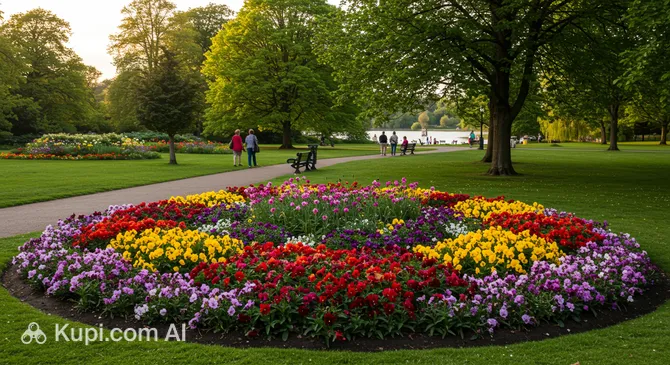
Alvaston Park in Derby, United Kingdom, has a rich history that began in August 1913. It was then that William Curzon of Breedon Hall generously donated 12 hectares of land for public use, establishing this green oasis. Interestingly, the park's landscape design was commissioned to the well-known company William Barron & Son of Borrowash. This same firm had previously designed the grounds at Elvaston Castle for Lord Harrington in 1830, reflecting the high level of craftsmanship and trust in their work.
Starting from 1925, Alvaston Park became the heart of a vibrant social life thanks to its annual carnivals. These festivities attracted huge crowds—estimated at up to 30,000 people! The carnival program was highly diverse, featuring unusual entertainment like motorcycle football alongside traditional swimming races and floral and horticultural shows. However, a serious issue arose in 1934 when the park's lake became heavily polluted. The City Council had to take urgent measures to clean the Cuttle Brook to restore the water's clarity in time for the next carnival.
The Second World War period left its mark on the park's history. It was repurposed as a prisoner-of-war camp, divided into two sections: one for German prisoners and another for Italian ones. Italian POWs worked in the fields for local farmers, while the Germans worked at an ammunition dump located on Sinfin Lane. After the war ended, the park was restored, though accounts suggest it never quite regained its former atmosphere and popularity.
Despite the City Council's efforts to maintain the park, which was primarily used for football, attendance gradually declined. Recognizing this downward trend, the local community initiated a meeting with park representatives and the City Council in 2006. This meeting resulted in a call for action, and by the end of that year, the "Friends of Alvaston Park" group was formed, aiming to revitalize this significant Derby landmark.