Support

Petroglyph National Monument

About

Petroglyph National Monument is a unique protected area in the USA, located on the western edge of Albuquerque, New Mexico. Designated as a national monument on June 27, 1990, it stretches for 17 miles (27 kilometers) along a volcanic basalt formation known as the West Mesa. This site is a true window into the past, carefully preserving thousands of ancient rock carvings left by different cultures.
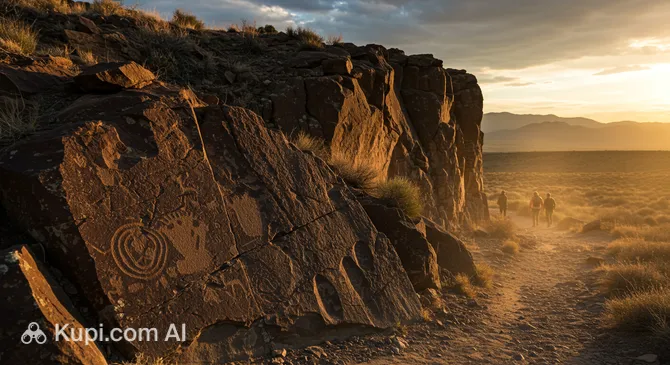
Petroglyph National Monument. Illustration.
Source: Kupi.com AI

Traveler photos:

The core value and heart of the monument are approximately 25,000 petroglyphs — images carved into the rocks. These amazing and mysterious works of art were created by both Native Americans over many centuries and early Spanish settlers. Among the drawings, one can find depictions of animals, people, symbolic signs, handprints, and more complex compositions whose meanings continue to intrigue researchers and visitors alike.

Visiting Petroglyph National Monument offers not just a walk through scenic desert terrain, but a deep immersion into the history and culture of the region. It is a rare opportunity to connect with the ancient legacy left by ancestors and attempt to decipher the messages etched in stone. Spanning nearly 30 square kilometers, the monument's territory is jointly managed by the City of Albuquerque and the U.S. National Park Service, ensuring its preservation for future generations and researchers.

Contacts

To get the most up-to-date information on operating hours, visitor requirements, and events at Petroglyph National Monument, it is recommended to visit the official website. There, you can also find detailed maps and tips for planning your visit.

How to contactContact
AddressWestern Trail NW, Albuquerque, NM 87120, USA
Phone number+1 505-899-0205
Websitewww.nps.gov

What to Do

The main activity at Petroglyph National Monument is, without a doubt, exploring the rock carvings themselves. Visitors can spend hours walking along specially designated trails, carefully observing thousands of ancient images etched into volcanic stones. These petroglyphs were created by Indigenous peoples and early European settlers over many centuries. Each such image is a priceless historical artifact that reflects the beliefs, culture, and daily life of the people who inhabited these lands in the past. It is a unique opportunity to connect with ancient heritage and attempt to unravel the messages left by ancestors.

Beyond exploring the petroglyphs, the monument's territory offers other experiences. Here, you can enjoy the region's diverse nature and its geological features. For instance, the park's western boundary features five dormant volcanoes that form a unique landscape. From certain points, including the former crater of one of the volcanoes, scenic panoramic views of Albuquerque open up. For those deeply interested in the Native American history of the American continent, this preserve is of particular interest, allowing for an immersion into ancient culture through preserved artifacts. Thus, a visit here is not only an educational journey into the past but also a chance to enjoy natural beauty.

Getting There

Petroglyph National Monument is located on the western edge of the city of Albuquerque, in the state of New Mexico. Due to its location near a major city, it can be reached in several ways. Albuquerque has a well-developed transportation infrastructure, making it easy to access its surroundings, including this unique monument.

The most convenient way for many tourists to reach Petroglyph National Monument is traveling by car. This can be either a personal or a rental vehicle. Having a car provides you with flexibility in timing and the ability to explore different parts of the vast monument area at your own pace. The roads leading to the main entrances and the visitor center are generally well-marked.

An alternative to personal transport is taxis or ridesharing services from downtown Albuquerque. This is a good option if you do not plan to rent a car. As for public transport, while Albuquerque does have a city bus system, direct routes to the park entrance itself may be limited or non-existent. It is recommended to check current routes on the official National Park Service or Albuquerque transit websites in advance to see how close public transport can get you and plan the rest of your journey.

Nearest city: Albuquerque

History & Facts

Petroglyph National Monument holds a fascinating history closely intertwined with the fates of both Native Americans and European settlers. The petroglyphs themselves are not just drawings on stones, but evidence of many eras, created over a long period. The uniqueness of this place lies in the fact that you can see rock art left by both the Indigenous tribes who inhabited these lands long before the arrival of Europeans and the Spanish colonists who began developing the region later.

Not far from the monument is the city of Albuquerque, whose history also contributes to the understanding of the cultural context of the petroglyphs. Founded in 1706 as a Spanish colonial outpost called Ranchos de Albuquerque, it was originally home to just 18 families. Spanish heritage is still felt in the region, and this is reflected even in some of the rock carvings within the monument. Albuquerque itself was built according to the traditional Spanish model: with a central plaza surrounded by administrative buildings, residences, and a church.

Recognizing the unique value of this heritage, the authorities decided to protect it: Petroglyph National Monument was officially established on June 27, 1990. Its creation aimed to preserve both the rich cultural layers and the natural environment. Since then, the territory has been managed jointly by the City of Albuquerque and the National Park Service of the USA, ensuring the preservation and accessibility of these treasures, including petroglyphs and other archaeological finds, for modern visitors and future generations.

Time Needed

When planning a visit to Petroglyph National Monument, it is worth setting aside at least a few hours to get a general sense of the place and see some of the rock carvings. For a quick look at one of the main petroglyph areas, such as the Boca Negra Canyon trail, 1-2 hours may be enough. This will allow you to walk along accessible routes and see a significant number of ancient images.

However, to more fully explore different sections of the monument, such as Rinconada or Piedras Marcadas Canyons, each of which offers its own unique petroglyphs and landscapes, significantly more time will be needed. Hiking and history enthusiasts can easily spend half a day or even a full day here, especially if they wish to visit several trails and the visitor center. The time required for a visit depends heavily on your interest in archaeology, photography, and simply your desire to enjoy a walk through the unique desert landscape.

If you have limited time, focus on one of the most accessible and petroglyph-rich areas. If you want a deeper immersion into the atmosphere of this place, allocate more time and perhaps even split the visit into several parts to explore the different zones of Petroglyph National Monument without rushing.

Working Hours

Petroglyph National Monument is generally open to visitors year-round, though operating hours may vary by season and specific areas of the park. The visitor center and various trails may have their own schedules. Typically, parks of this type are open during daylight hours, for example, from 8:00 or 9:00 AM to 5:00 PM. Entry to some trails may close earlier than the park itself.

Since exact information on hours of operation and ticket requirements can change, it is strongly recommended to check the official National Park Service (NPS) website for Petroglyph National Monument or contact the park's visitor center before your visit. This will help you get the most up-to-date information on schedules, possible restrictions, entrance fees (if any), and whether advance registration is required, especially if you plan to attend any special programs or tours.

8:30 – 16:30

Nearby

Visiting such a significant site as Petroglyph National Monument is a highlight in itself. However, to make your trip even more rewarding and complete, it is worth paying attention to its surroundings. Exploring nearby attractions will allow you to dive deeper into the atmosphere of the region, see more interesting sites, and form a complete impression of your visit to Albuquerque.

Around Petroglyph National Monument, there are many other notable places that may interest travelers. From natural wonders to cultural and historical sites, Albuquerque and its surroundings offer various options to continue your exploration. Below is a list of some of them, along with approximate distances.

NameDistance
Rio Grande Nature Center State Park6.4 km
Albuquerque Botanic Garden7.4 km
ABQ BioPark Aquarium7.5 km
El Vado Motel7.6 km
Old Town Albuquerque History and Ghost Tours8 km
Breaking Bad Store ABQ8 km
Sawmill Market8.1 km

Have you reached the end of the page?

So the route has been studied inside and out