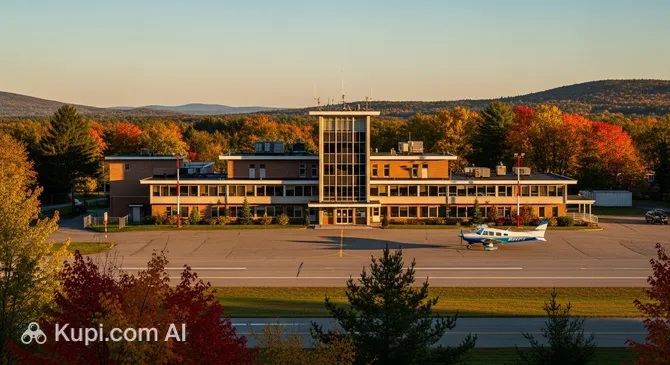
The history of Edward F Knapp State Airport mirrors the development of aviation in the state of Vermont, from the first grass strips to an important regional transport hub. Originally known as Barre-Montpelier Airport, this airport was born thanks to the enthusiasm of local residents and the desire to connect the "Granite Capital of the World," Barre, and the state's political centre, Montpelier, with the rest of the world.
Foundation and Early Years
The official starting point is considered 1929, when on 5 April, municipalities purchased land for the construction of an airfield. However, like many airports of that time, it began modestly — as a simple field with a grass surface where pilots took off and landed guided solely by the wind direction. By June 1930, the airport was ceremoniously opened by the Governor of Vermont, becoming a symbol of progress for the entire region.
Era of Development and the "Golden Age"
An important stage of modernisation occurred in the mid-1930s. Thanks to funding under the New Deal (WPA), in 1936, the first two asphalt runways appeared here, allowing the reception of heavier aircraft. On the eve of World War II, in 1941, the airport was expanded for national defence needs, receiving lengthened runways and improved lighting.
Historical Events: A Legend's Visit
The airport played a significant role in the establishment of commercial aviation in the region. Regular passenger services by Boston-Maine Airways started here as early as 1933, connecting the Vermont hinterland with major cities. However, the most vivid event of that decade was the visit of the renowned aviatrix Amelia Earhart.
The aviation legend landed in Barre-Montpelier on 7 March 1935. She arrived as part of a promotional tour, advocating for the safety and convenience of air travel. Earhart's arrival caused unprecedented excitement: hundreds of locals gathered on the airfield to see the famous pilot, forever inscribing the airport into the history of American aviation.
Change of Name and State Status
A key transformation took place on 17 March 1970. On this day, the airport officially came under the management of the State of Vermont. At a solemn ceremony, Governor Deane Davis announced the renaming of the facility to Edward F. Knapp State Airport. This was done in honour of Edward F. Knapp, who served as the state's aeronautics commissioner for over 25 years and was considered the "father" of Vermont's aviation infrastructure.
Modernisation and Present Day
The airport has not stood still in time. In 2010, a large-scale reconstruction worth over 6 million dollars was completed: taxiways, aprons, and the main runway surface were renewed. Despite the absence of scheduled commercial flights today, the airport maintains high standards of service for business jets and private aviation, remaining critically important for the region's economy.
Interesting Facts
- Unique Terminal: The terminal building, constructed in 1959, has a feature characteristic of this region. Its lobby was decorated and clad with local granite, donated by the Barre Granite Association, highlighting the city's industrial heritage.
- Capital Paradox: Edward F Knapp State Airport makes Montpelier one of the few state capitals in the USA that does not have its own scheduled commercial air service, relying on private aviation and neighbouring Burlington.
- Geography: The airport is located on a plateau, which often saves it from floods that have historically affected the low-lying areas of Barre and Montpelier, allowing it to serve as a base for emergency services during natural disasters.