Support

Chicago Riverwalk

About

The Chicago Riverwalk is a scenic pedestrian promenade stretching along the south bank of the Chicago River in the heart of Chicago. It is a true urban oasis in the USA, offering guests and residents magnificent views of famous architecture and numerous recreational opportunities. The walkway, approximately 2 kilometers long, stretches from Lake Michigan to Lake Street, connecting parks, cozy plazas, and public spaces into a single route.
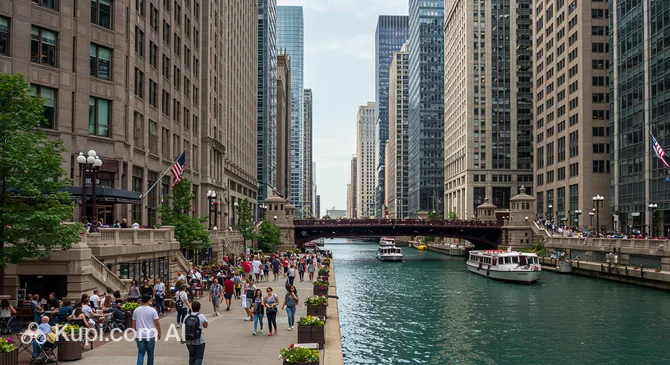
Chicago Riverwalk. Illustration.
Source: Kupi.com AI

Traveler photos:

The Riverwalk is a shining example of successful urban development. The Chicago River was once a noisy industrial and commercial artery, but thanks to a large-scale renovation project, this space has been completely transformed. Today, the promenade is a harmonious blend of history, modern culture, and comfort, where the city's past meets its present. This place clearly demonstrates how a neglected waterfront area can turn into a popular attraction.

Visitors to the Riverwalk will find plenty of entertainment. Here, you can relax in one of the many cafes, bars, or wine gardens with water views, go on a river trip by kayak, or book an architectural cruise to get a closer look at the legendary skyscrapers. Along the promenade, there are public art pieces, monuments, and museums, such as the McCormick Bridgehouse & Chicago River Museum. In the summer, musical performances are often held here, making the walk even more memorable.

Contacts

The Chicago Riverwalk is a large public space, and the best way to get up-to-date information about events, individual establishment hours, and available services is to refer to the official resources of the City of Chicago. The primary contact points are listed below.

Since the promenade is an extensive pedestrian zone, it does not have a single exact address. It is most convenient to use Wacker Drive, which runs parallel to the river, as a landmark. You can reach the Riverwalk from the CTA Red and Blue Line subway stations or by walking from major transportation hubs like Union Station.

How to contactContact
AddressChicago, IL 60601, USA
Websitewww.chicago.gov

What to Do

The main activity on the Chicago Riverwalk is, of course, a leisurely stroll. Moving along the river, you find yourself in the heart of Chicago's famous architectural "canyon," where historic skyscrapers stand alongside modern glass giants. This is a wonderful opportunity to enjoy picturesque views of the water and take impressive photos against the city skyline. The promenade offers many cozy spots to relax, where you can simply sit, watch the passing tour boats and kayaks, and feel the dynamic rhythm of one of the largest cities in the USA.

A walk along the Riverwalk is not just a vacation but a true immersion in history. The promenade allows visitors to learn about the rich past of the Chicago River, which was once a vital path for indigenous peoples and European traders. Along the route, you can find various art objects and information stands telling the story of the river's transformation from a noisy industrial artery into a modern public space. This is a unique chance to see how the city's history is reflected in its present and to appreciate the monumental work done to revitalize the waterfront.

The Riverwalk space is divided into several themed sections, each offering its own unique experience. For example, in the Marina Plaza section, you can relax by the docks, while the River Theater is a wide staircase descending to the water, resembling an amphitheater. Another interesting section is The Jetty, where you can learn more about the river's ecosystem. Throughout different parts of the promenade, there are numerous cafes, wine bars, and restaurants where you can have a snack with a view of the water, making the walk even more pleasant and fulfilling.

Getting There

Getting to the Chicago Riverwalk is very easy thanks to its central location in the heart of the city. The promenade stretches along the south bank of the Chicago River, parallel to Wacker Drive, from Lake Michigan in the east to Lake Street in the west. This makes it easily accessible from anywhere in The Loop and neighboring districts.

The most convenient way to reach the waterfront is by using Chicago Transit Authority (CTA) public transport. Numerous 'L' train lines run in close proximity. The nearest stations are State/Lake (served by the Brown, Green, Orange, Pink, and Purple lines) and Clark/Lake (served by the same lines plus the Blue line). Both stations are just a few minutes' walk from the Riverwalk. The Red Line's Lake station is also nearby. Additionally, many CTA bus routes run along the streets crossing the river, providing even more travel options.

If you prefer to travel by car, taxi, or ridesharing services, simply set your destination to the intersection of Wacker Drive and one of the central streets, such as Michigan Avenue or State Street. Keep in mind that parking downtown can be expensive and limited. For those already in downtown Chicago, a walk to the Riverwalk is an excellent choice. It is a 10–15 minute walk from iconic spots like Millennium Park or the Magnificent Mile. Access to the promenade itself is provided via stairs and ramps located at every major intersection along Wacker Drive.

Nearest city: Chicago

History & Facts

The history of the Chicago Riverwalk is inextricably linked to the river itself, which has always been the heart of the city. Long before the appearance of skyscrapers, these waters served as a vital resource for the indigenous Potawatomi people, and in the 17th century, they became a strategic trade route for European settlers. In the 19th century, during Chicago's period of rapid growth, the river transformed into a bustling commercial artery where steamboats and schooners loaded with timber and other goods flowed continuously, fueling the development of the metropolis.

The idea of turning the waterfront into a place for recreation and leisure dates back to the early 20th century. It was the famous architect and urban planner Daniel Burnham who, in his visionary 1909 "Plan of Chicago," proposed creating a continuous waterfront with parks and public spaces. The first modest section of the Riverwalk opened in 1939, but the full-scale revival of the waterfront began only in the late 1970s. With the decline of heavy industry, city authorities returned to the idea of renovation, which gave the impetus for creating the promenade we see today.

One of the most amazing facts about the Chicago River is that its flow was reversed. Originally, the river flowed into Lake Michigan, but during a massive engineering project in the early 20th century, its course was changed. This was done to improve sanitary conditions in the city and prevent the pollution of the lake, which served as the source of drinking water. Today, the river flows south from the lake, and this bold project is still considered one of the greatest urban engineering achievements in U.S. history.

Time Needed

When planning a visit to the Chicago Riverwalk, consider how much time you want to dedicate to relaxation and entertainment. For a quick stroll along the entire length of the promenade, which is about 2 kilometers (1.25 miles), you will need approximately 30-45 minutes. This is enough time to walk the route from start to finish, enjoy the main views, and take a few photos of the famous skyscrapers.

However, to truly soak in the atmosphere of this place, it is worth setting aside 1.5 to 3 hours. During this time, you can not only take a leisurely walk but also sit in one of the many cafes or wine gardens overlooking the river, watch the passing boats and kayaks, and take a closer look at the art installations. The Chicago Riverwalk is designed as a space for relaxation, so there is no need to rush.

If you want to get the most out of your experience, feel free to plan for half a day or even more. Your visit could include lunch or dinner at one of the waterfront restaurants, a visit to the McCormick Bridgehouse & Chicago River Museum, or embarking on one of the famous architectural river tours that start right here. In the summer, concerts and events are often held here, which can also extend your stay and make it even more memorable.

Working Hours

The Chicago Riverwalk is a public space, so access to the promenade itself is free and open to visitors daily from 6:00 AM to 11:00 PM. You do not need to buy tickets or book a time in advance for a walk. The promenade is accessible year-round, allowing you to enjoy views of the river and architecture in any season.

It is important to remember that commercial establishments located along the Riverwalk—cafes, restaurants, bars, kayak rentals, and companies organizing river tours—operate on their own schedules. Most of them are seasonal and are open mainly in the warmer months, roughly from May to October. If you plan to visit a specific establishment or go on an architectural cruise, it is recommended to check their operating hours and booking requirements on their official websites in advance.

6:00 – 23:00

Nearby

A stroll along the Chicago Riverwalk is a fascinating activity in itself, but exploring its surroundings will make your trip to Chicago even more rewarding. The promenade is located in the very center of the city, within walking distance of many iconic landmarks, famous museums, and architectural masterpieces. Taking a little time to explore the nearby blocks will help you better understand the cultural and historical context of this amazing area.

The central location of the Riverwalk makes it an ideal starting point for further exploration. World-famous attractions are nearby and can be reached on foot in just a few minutes. This allows you to easily combine a relaxing time by the water with visits to cultural sites, shopping, or a walk through famous parks, providing a complete picture of the multifaceted nature of downtown Chicago.

NameDistance
The Chicago Theatre0.5 km
Medieval Torture Museum0.5 km
The Art Institute of Chicago1 km
360 Chicago1.2 km
Navy Pier1.5 km
Oak Street Beach1.6 km
Aba2.1 km

Have you reached the end of the page?

So the route has been studied inside and out