Support

Delta Junction (Allen Army Airfield)

About the Airport

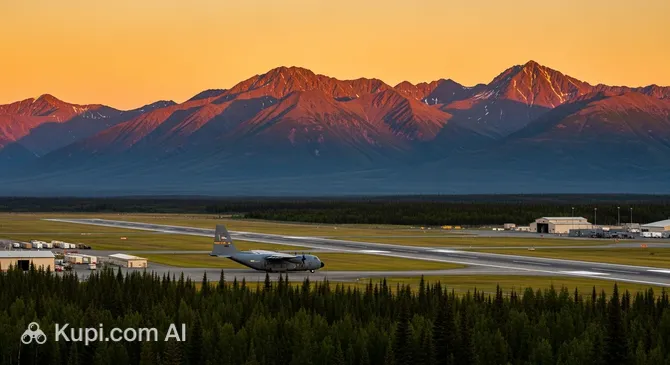
In the very heart of Alaska, where untamed nature meets strategic strength, lies Delta Junction Airport, also known as Allen Army Airfield. This is not merely an air gateway, but a vital dual-purpose facility serving both military requirements and civil aviation needs in the region. For travellers seeking to explore the rugged beauty of the interior United States, this airport serves as the starting point for an unforgettable adventure far from the beaten tourist tracks.

Delta Junction (Allen Army Airfield). Source: Kupi.com Binoculars
IATA Code BIG
ICAO Code PABI
City Delta Junction
Distance to centre About 4 km
Status Military / Public use
Annual Passengers Data on civilian passenger traffic is limited as the airport is primarily for military use
Popular Airlines Mainly used for military, charter, and private flights

The main feature of the airport is its close integration with the Fort Greely military base, making it a key logistics hub in this strategically important region of Alaska. Despite its predominantly military status, the airport is open for civilian use, primarily serving charter flights and private aviation. This provides unique opportunities for those planning hunting, fishing, or scientific expeditions to remote corners of the state. The airport is equipped to operate in harsh climatic conditions, ensuring reliable connectivity year-round, which is critical for life in this part of the world.

Contact Information

Since Allen Army Airfield is an active military facility, standard contact details for civilian passengers, typical of commercial airports, are limited here. Information mainly concerns the base's official operations.

  • Official Website: The airfield does not have a separate public website. Information about it is part of the resources dedicated to the Fort Greely military base, on whose territory it is located.
  • Information Service Phone: There is no unified enquiry service for tourists. Communication with the base is via the Fort Greely switchboard, however, it is not intended for providing tourist information.
  • Airport Address: Allen Army Airfield, Fort Greely, Delta Junction, Alaska, United States. Access to the territory may be restricted.
  • Email: There is no public email address for general or tourist enquiries.
  • Social Media: News and official announcements can be found on the Fort Greely social media pages.
  • Lost Luggage Information: This service is not publicly available. Issues related to luggage are resolved directly through the air carrier (if it was a charter flight) or via military channels.
  • Passenger Support Contacts: No specialised support service for civilian passengers is provided.

How to Get to the Airport

Allen Army Airfield, serving the city of Delta Junction in the United States, is primarily a military facility, which impacts transport accessibility. Located in the immediate vicinity of the city, the airport has a limited number of ways to reach it, which is typical for small Alaskan settlements. It is important to consider these features when planning your trip.

Taxi or car rental is your main choice. The most reliable way to get around Delta Junction and its surroundings is by car. Most travellers fly into Fairbanks International Airport (FAI), located approximately 140 km away, and rent a car there. This gives maximum freedom to explore the region. If you are already in the city, you can use local taxi services. It is recommended to book a car in advance, as the number of vehicles is limited. The drive from the centre of Delta Junction to the airfield will take just 5–10 minutes.

Public Transport. There is no regular public transport, such as buses, metro, or trains, in Delta Junction connecting the city with Allen Army Airfield. The entire city transport system is oriented towards the use of private vehicles.

Parking and Access to the Airport. Since Allen Army Airfield is an active military facility (part of Fort Greely), access to its territory for civilians may be strictly restricted. Parking and entry rules are determined by the military command. Before travelling, it is strongly recommended to check current requirements and the possibility of access to the base territory if you are not military personnel or do not have a special permit.

In summary, for most tourists, the most practical route would be flying into Fairbanks, renting a car, and travelling onwards to Delta Junction along the scenic highway. This not only solves the issue of transport to the airfield but also opens up wide opportunities to experience the unique nature of Alaska.

Terminals and Map

When planning a trip to Delta Junction, it is important to understand the specifics of the local airport. The airport with the IATA code BIG, known as Allen Army Airfield, is primarily a military facility serving the needs of the United States Army. This impacts its structure and accessibility for civilian passengers.

Unlike civilian airports, Allen Army Airfield does not have standard passenger terminals with the usual departure and arrival zones or check-in counters for commercial flights. The entire infrastructure is designed for military transport, and access to the territory for the general public is strictly restricted. Therefore, concepts such as a "terminal map" or "transfers between terminals" are not applicable here in a tourist context.

Travellers heading to the Delta Junction region are advised to consider the nearest major civilian airport — Fairbanks International Airport (FAI) — as their main point of arrival. From there, Delta Junction can be reached by rental car or other ground transport, covering a distance of about 150 kilometres. Such a route is the most convenient and standard for tourists wishing to visit this part of Alaska.

Airport History

The history of the airport in Delta Junction, known as Allen Army Airfield, is a vivid page in the military and aviation chronicle of the United States. Its creation was dictated by strategic necessity during World War II. The airfield was built in 1942 as one of the key points of the Northwest Staging Route. Its main task was to support the Lend-Lease programme — the ferrying of thousands of American military aircraft to the Soviet Union via the Alaska-Siberia (ALSIB) air bridge.

During the war years, the airfield, then named Big Delta Army Airfield, became a veritable hive of activity. About 8,000 aircraft passed through it, ferried by American and Soviet pilots to the Eastern Front. It was one of the most massive and complex logistical projects of that time, and the airfield played a critically important role in it, serving as a point for refuelling, maintenance, and rest for crews in the harsh conditions of Alaska.

After the end of World War II, the significance of the airfield did not diminish. Under the conditions of the ensuing Cold War, it became part of the strategic military complex of Fort Greely. During this period, the airfield was modernised to accommodate more modern jet aircraft. In 1962, it was renamed Allen Army Airfield in honour of Lieutenant Colonel James Allen, who died in a plane crash. It bears this name to this day, continuing to perform important defence functions.

Today, Allen Army Airfield is a vital facility for supporting US Army operations in the Arctic region. It is used for training in cold climate conditions, testing various equipment, and as a transport hub for supplying Fort Greely and other remote sites. Thus, the airfield, born in the fires of the Second World War, has journeyed from a temporary airstrip to a modern military facility, retaining its strategic importance over the decades.

Services and Amenities

Delta Junction Airport (Allen Army Airfield) (BIG) is a small dual-use airfield that primarily serves military needs and private aviation. Consequently, the range of services for passengers here is basic and significantly different from what major commercial airports offer. Travellers should plan their stay in advance and take local specifics into account.

Shopping and dining options within the airport territory are extremely limited. There are no restaurants, cafes, or shops here. Passengers are advised to bring drinks and snacks with them or have a meal in the city of Delta Junction before departure. Access to public Wi-Fi and charging stations for electronic devices is generally not provided, so it is worth ensuring you have a portable power bank.

There are no bank branches, currency exchange points, or ATMs in the terminal building. All financial transactions must be completed in the city beforehand. Services such as VIP lounges, business centres, or conference rooms are not provided at the airport. There is also no specialised medical point; only basic first aid is available.

Basic amenities are available for passengers, including a small waiting area and restrooms. Travellers with children or passengers with reduced mobility should contact their airline representative (if applicable) or the airfield administration in advance to clarify information regarding the availability of assistance and special services. There are no hotels on the airport grounds; the nearest accommodation options are located in the city of Delta Junction.

Where to Eat

When planning travel through Allen Army Airfield (BIG), it is important to understand that this is primarily a military airfield, not a major commercial airport. In this regard, the infrastructure for passengers, including dining outlets, differs significantly here from what is customary in civilian airports in the United States.

Within the territory of Allen Army Airfield itself, there are no publicly accessible restaurants, cafes, or dining lounges for civilian passengers. There is no separation into departure and arrival zones with food courts or diverse establishments. Dining services on the base are intended mainly for military personnel and staff.

Travellers are strongly advised to arrange meals in advance. The best solution is to eat at one of the establishments in the city of Delta Junction, located nearby. In the city, you can find several American-style cafes and restaurants serving hearty breakfasts, burgers, steaks, and other classic dishes. This is also your only opportunity to try some local cuisine before departure.

Thus, if you have to spend some time at the airfield waiting for a flight, the optimal option would be to bring your own drinks and snacks. The opportunity to buy anything on-site will likely not present itself.

Travel Tips

Travelling through Delta Junction Airport (Allen Army Airfield), located in the city of Delta Junction, has its own specifics as it is a dual-purpose facility — both civilian and military. To ensure your trip goes smoothly, make use of these tips.

Arrival at the airport and check-in. For domestic flights within the United States, it is usually recommended to arrive 1.5-2 hours before departure. Although the airport is small, its joint use with a military base may mean enhanced security measures. It is better to have time in reserve. To speed up the process, complete online check-in for your flight in advance and save the boarding pass on your phone.

Security control and seat selection. Be prepared for a standard but thorough security check. Always have a photo ID with you. When choosing a seat on the plane, consider that flights from small airports are often operated on compact aircraft. A window seat will offer the best views of Alaska's landscapes, while an aisle seat provides greater convenience if you need to stand up.

Luggage rules. In carry-on luggage, liquids are allowed in containers up to 100 ml, packed in a transparent bag. Sharp objects, weapons, and flammable substances are prohibited. To avoid excess charges, weigh your luggage at home and ensure it complies with the airline's standards. Save money by taking an empty water bottle with you, which can be filled after passing security, and light snacks, as the selection in a small airport may be limited.

Transfers and customs control. If you have a connecting flight, allow sufficient time between connections, especially if the next departure is from a major hub airport. Customs control is only passed when crossing international borders. For domestic flights, it is not required. If you are flying abroad with a transfer, you will pass customs at the first airport of arrival in the other country.

In case of flight delay. Delays happen, especially in regions with complex weather conditions. Check your flight status on the airline's website in advance. In case of a delay, contact the carrier's representative to find out about your rights to compensation, provision of meals, or accommodation. Keep essential items in your carry-on luggage: chargers, medication, and hygiene items.

Reached the end of the page?

That means the route is fully explored