Support

Centennial Airport

Airports in the city

About the Airport

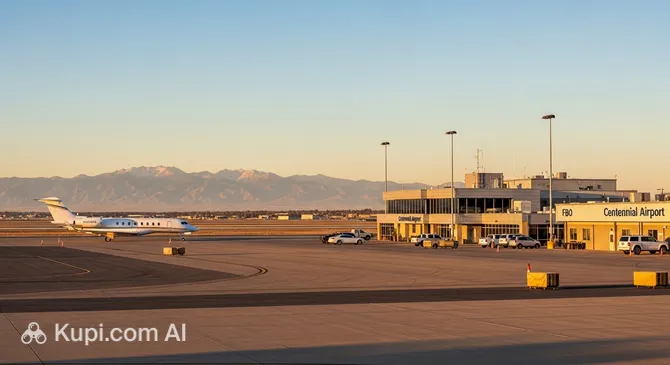
Centennial Airport. Source: Kupi.com Binoculars

Centennial Airport is not merely a transport hub, but a true aerial gateway for the business elite and private aviation, where time is valued above all else. Located in the immediate vicinity of the Denver Tech Center, this airport offers an atmosphere of exclusivity and comfort, far removed from the hustle and bustle of typical giant terminals. Here, every flight is an individual story, and the runway opens up breathtaking views of the majestic Rocky Mountains, making your arrival in Colorado unforgettable.

IATA Code APA
ICAO Code KAPA
City Denver (Englewood)
Distance to Center ~27 km
Status General Aviation (with an international customs facility)
Passengers per Year Over 300,000 takeoffs and landings (one of the leaders in US business aviation)
Schedule Specific to private flights (individual schedule)

Features and Advantages of the Airport

Centennial stands out among other air harbors for its unique specialization and strategic location. It is the ideal choice for those who wish to avoid the crowds and complex procedures of major hubs.

  • Strategic Location: The airport is located just a few minutes' drive from the Denver Tech Center — the business heart of the region, making it maximally convenient for business travelers.
  • Speed and Comfort: Thanks to a developed network of Fixed-Base Operators (FBOs), passengers complete all pre-flight formalities in a matter of minutes, enjoying VIP-level service.
  • International Capabilities: Despite its status as a general aviation airport, a 24-hour US Customs service operates here, allowing for the reception of direct international private flights.
  • Unique Atmosphere: The absence of regular commercial lines creates a tranquil environment, and the presence of a high-class restaurant overlooking the airfield turns waiting for a flight into a pleasure.

Contact Information

For your convenience, we have compiled the main contact information for Centennial Airport (APA).

  • Official Website: www.centennialairport.com
  • Inquiry Phone: +1 303-790-0598
  • Address: 7800 S Peoria St, Englewood, CO 80112, USA
  • Email: customerservice@centennialairport.com
  • Social Media: Current information and news can be found on the airport's official pages on Facebook, X (formerly Twitter), and Instagram.
  • Lost & Found: For questions regarding items lost on airport territory, please contact the main phone number or use the form on the official website. If items were lost on board an aircraft, you must contact your airline directly.
  • Passenger Support Service: To receive assistance or consultation, you may use the main telephone number or email address.

How to Get to the Airport

Centennial Airport (APA) is one of the busiest business aviation airports in the USA and is located south of downtown Denver. Its specialization in private and corporate flights determines the specifics of transport accessibility. Unlike the region's main passenger hub, Denver International Airport (DEN), direct public transport routes here are limited; however, there are several ways to reach Centennial.

Public Transport is the most budget-friendly but not the most convenient option. Denver's public transport system (RTD) does not have direct bus or rail lines to the Centennial Airport terminals. The nearest Light Rail stations, such as County Line or Dry Creek, are located several kilometers away. From there, you will have to take a taxi to the airport, which adds to the total cost. This method is suitable for travelers without bulky luggage who wish to save money and have plenty of time.

Taxis and Transfers are the most popular and convenient way to get to the airport. A ride by taxi or via Uber and Lyft apps from downtown Denver will take from 30 to 45 minutes depending on traffic conditions. During peak hours, travel time may increase. The cost of the trip usually ranges from 40 to 70 USD, but may vary depending on demand. This is a reliable option, especially if you value comfort and are traveling with luggage. You can also pre-book a private transfer at a fixed price.

Car Rental offers maximum flexibility, especially if you plan to travel around the Denver area. Many car rental companies operate both in the city itself and in the airport area. The road to Centennial runs along major highways, such as I-25, making navigation quite simple. The cost of rental depends on the company, the class of the vehicle, and the rental period.

Airport Parking is well-organized and offers options for both short-term and long-term parking. If you arrive in your own or a rented car, you will easily find a parking space in the immediate vicinity of the terminals. It is important to note that the cost of parking depends directly on the duration: rates are available for both short-term (hourly) and long-term (daily) parking. This is a convenient solution for those making short business trips or meeting arrivals.

Terminals and Map

Centennial Airport (APA) is one of the busiest civil aviation airports in the USA and specializes in private, corporate, and charter flights. Its structure differs significantly from the large commercial airports that most passengers are accustomed to.

Main Structure and Terminals

Instead of several large public terminals as found in international airports, Centennial's structure consists of one main terminal building and several Fixed-Base Operators (FBOs), which function as private terminals for their clients.

  • The Centennial Airport Main Terminal: This is the administrative heart of the airport. Located here are management offices, conference rooms, and the famous "The Perfect Landing" restaurant overlooking the runways. Charter flight passengers rarely use it for check-in, as all procedures go through the FBOs.
  • Fixed-Base Operators (FBOs): These are the key points for passengers. Each FBO is essentially a separate, small, and comfortable terminal. They provide a full range of services: from aircraft refueling and maintenance to meeting passengers, baggage handling, and organizing ground transport. Passengers on a private or charter flight head directly to their FBO building, where personalized service awaits them.

Procedures and Navigation

Navigating the airport is very simple for the passenger. The most important thing is to know which FBO is servicing your flight. All necessary information is provided when booking the flight. Upon arrival at the airport, you follow the signs to your operator.

Passing through check-in and security control at an FBO is incomparably faster than at a commercial airport. There are no long queues here. The process usually takes a few minutes, and passengers are recommended to arrive 30-45 minutes before departure, rather than 2-3 hours. Departure and arrival zones are located within the same FBO building, making the process maximally convenient and fast. After landing, you will also be met at the operator's building, where your luggage and ordered transport will already be ready.

Recommendations for Travelers

The main advice when flying from or to Centennial Airport is to verify the name of your FBO in advance. This is the only important detail for successful navigation. The road network on the airport territory is well-organized, and signs will easily lead you to the correct building. The FBO staff will take care of all other aspects of your journey, ensuring a high level of comfort and privacy.

Airport History

The history of Centennial Airport is a tale of rapid growth and strategic development that turned it into one of the key centers of business aviation in the USA. The airport was opened on May 12, 1968, under the name Arapahoe County Airport. Its primary task was to serve the growing demand for private and corporate aviation services in the Denver metropolitan area, which was experiencing an economic boom at that time.

From the very beginning, the airport developed actively. By 1970, a control tower was built, highlighting its growing importance. A significant moment in history was the renaming: in 1984, the airport received its current name — Centennial — in honor of the centennial of the state of Colorado, which was celebrated in 1976. By this time, it had already established itself as one of the busiest general aviation airports in the country, serving thousands of private and charter flights.

Unlike Denver International Airport, Centennial has always focused on non-commercial transportation. A key milestone in its modern history was a major modernization in 2015, when a federal inspection station for US Customs and Border Protection opened on its territory. This allowed the airport to accept direct international flights, significantly raising its status as an important hub for global business.

Among the airport's achievements is a stable place on the list of the busiest general aviation airports in the USA by the number of takeoffs and landings. An interesting fact: Centennial is self-sustaining and does not use taxpayer funds for its operational activities, financing development through user fees. It continues to play a vital role in the region's economy, providing jobs and supporting the activities of numerous companies based in its vicinity.

Services and Amenities

Centennial Airport (APA) is one of the busiest civil aviation airports in the USA and is primarily oriented towards serving private, corporate, and charter flights. Passenger services here are provided through Fixed-Base Operators (FBOs), which offer a high level of comfort and an individual approach.

There are several establishments on the airport territory where you can have a meal. The most famous of them is the restaurant The Perfect Landing, from the windows of which a panoramic view of the runways opens up. This is an excellent place for both a business lunch and a quiet dinner. regarding shops, the selection is limited and mainly focused on the needs of pilots and crews, rather than the duty-free shopping traditional for large airports.

Passengers of charter and private flights can utilize comfortable lounges and VIP zones provided by FBOs. These lounges are equipped with comfortable furniture, offer complimentary beverages and snacks, and ensure access to free Wi-Fi and charging stations for electronic devices. All conditions are created here for work or relaxation in a secluded setting.

Unlike large international airports, Centennial has no bank branches or currency exchange points. It is recommended to settle all financial matters in advance in Denver. Medical assistance is limited to first aid; in emergencies, city services are called. Services for passengers with children or those with limited mobility are provided upon prior request through your air carrier or FBO, who will ensure necessary support and accompaniment.

Although there are no hotels directly on the airport territory, many accommodation options are located a few minutes' drive away, particularly in the Denver Tech Center area. For business travelers, FBOs offer modern conference rooms and business services, including access to office equipment and meeting rooms, allowing for efficient use of time before or after a flight.

Where to Eat

Centennial Airport (APA), being one of the busiest business aviation airports in the USA, offers several cozy dining options located in the main terminal landside (before security control). The selection here is not as extensive as in major international hubs, but the available establishments are distinguished by their unique atmosphere.

For a full lunch or dinner: The Perfect Landing

The main restaurant of the airport is The Perfect Landing. It is not just a place to eat, but a true attraction. Its main feature is panoramic windows overlooking the runway, allowing you to watch the takeoffs and landings of private jets while dining. The restaurant offers dishes of classic American cuisine: steaks, burgers, salads, and seafood. It is excellently suited for a business meeting or a leisurely dinner.

  • Location: In the main terminal, landside (before the control zone).
  • Opening Hours: Usually open for breakfast, lunch, and dinner, but it is recommended to check the current schedule on the official website.
  • Price Range: Medium to above average.

For a quick snack: The Jet-A-Way Cafe

If you are short on time, stop by The Jet-A-Way Cafe. Here you can quickly grab a coffee, a sandwich, pastries, or a light salad. This is an ideal option for pilots, crew members, and passengers who need to refresh themselves before departure without a long wait. The atmosphere here is more informal and dynamic.

  • Location: Also located in the main terminal, landside.
  • Opening Hours: As a rule, operates during daytime hours.
  • Price Range: Affordable.

Special Dietary Preferences

At The Perfect Landing restaurant, you can usually find vegetarian dishes, such as salads or vegetable sides. However, if you have strict dietary restrictions (vegan, gluten-free, or Halal dishes), the selection may be limited. It is recommended to contact the restaurant in advance to clarify available options or be prepared that specialized dishes may not be on the menu.

Travel Tips

Traveling through Centennial Airport (APA), located in the city of Denver, USA, has its own specifics, as it mainly serves private and business aviation. These tips will help you prepare for your flight and make it as comfortable as possible.

Arrival Time and Check-in
Unlike large international airports, processes at Centennial are significantly faster. For domestic charter flights, it is usually sufficient to arrive 60-90 minutes before departure. However, always verify the recommended time with your air carrier or FBO operator. Check-in takes place in private terminals, which eliminates long queues.

Security and Seat Selection
Security screening is conducted in accordance with TSA standards, but thanks to the smaller flow of passengers, it takes minimum time. When choosing a seat in a small aircraft, consider that window seats offer the best views of the Rocky Mountains, while an aisle seat gives more freedom of movement.

Hand Luggage
Rules for carrying hand luggage comply with national requirements. Remember the 3-1-1 rule for liquids: containers up to 100 ml (3.4 oz) in a transparent bag with a volume of no more than 1 liter, one bag per passenger. All electronic devices larger than a smartphone must be removed from bags for screening. Sharp objects and flammable substances are prohibited.

Transfers and Customs Control
Direct commercial transfers at Centennial are rare. If your route includes a transfer at Denver International Airport (DIA), allow sufficient time for travel between airports (about 30-45 minutes by car). For international arrivals, US Customs service operates at Centennial. The procedure is standard but goes much faster than in major hubs due to the small number of passengers.

Saving Time and Money
The main time saving is achieved through the efficiency of the airport itself. To save money, book a taxi or transfer in advance. Clarify with your operator which services (beverages, snacks, Wi-Fi) are included in the cost of service at the FBO terminal to avoid unforeseen expenses.

In Case of Flight Delay
If your flight is delayed, first contact a representative of your airline or charter operator. FBO terminals at Centennial offer comfortable waiting lounges with Wi-Fi and beverages, where you can calmly wait for departure. Staff on-site will assist you with resolving issues and provide current information.

Reached the end of the page?

That means the route is fully explored