Support

Ontario International Airport

About the Airport

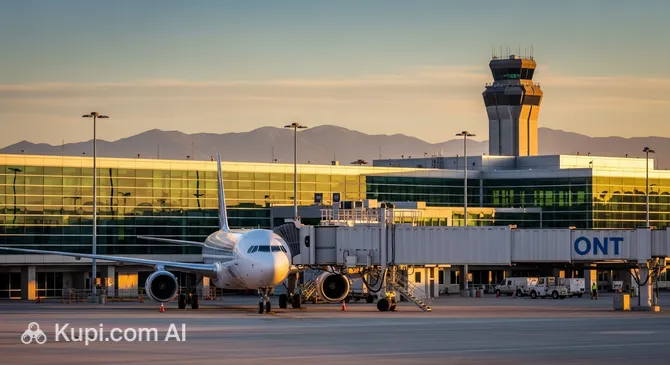
Ontario International Airport. Source: Kupi.com Binoculars

Ontario International Airport is often called the "secret weapon" for travelers heading to Southern California, thanks to its amazing ability to save you from the hustle of congested Los Angeles. Located in the heart of the Inland Empire, this aviation hub offers a calm and cozy atmosphere, where instead of endless queues, you are greeted by spacious terminals and views of mountain ranges. It is the ideal choice for those who value their time and want to start exploring California without unnecessary stress, landing just an hour's drive from the Hollywood Hills.

IATA Code ONT
ICAO Code KONT
City Ontario (Los Angeles metropolitan area)
Distance to Center 61 km (to downtown Los Angeles)
Status International
Passengers per Year Over 7 million (2024)

Features and Advantages of the Airport

The main advantage of Ontario is its compactness and efficiency. Unlike its giant neighbor LAX, procedures here — from check-in to security screening — take mere minutes. The airport consists of two main passenger terminals (Terminals 2 and 4), which are located close to each other, making navigation intuitively clear even for an inexperienced tourist.

Travelers particularly note the convenience of ground transport. Car rental here is much faster and simpler: shuttles to the rental center run frequently, and the center itself is located very close to the airfield. Additionally, the airport is known for being "photogenic" — thanks to its modern design and lack of crowds, it is often used for filming Hollywood movies and commercials, so you might recognize familiar interiors.

Despite its smaller size, the airport offers excellent service. The terminals feature rest areas, gadget charging stations, and various cafes where you can have a snack before your flight. It is a truly convenient alternative for those planning to visit the eastern part of Los Angeles, Disneyland, or head to California's national parks.

Contact Information

For your convenience, we have collected the main contact information for Ontario International Airport (ONT). We recommend verifying details on official resources before your trip.

  • Official Website: www.flyontario.com — here you will find the most up-to-date information on flights, services, and airport regulations.
  • Information Desk Phone: +1 (909) 937-2700 — for general questions about airport operations.
  • Address: 1923 E Avion St, Ontario, CA 91761, USA.
  • Social Media: Follow airport news on official pages on Facebook, X (formerly Twitter), and Instagram using the handle @flyONT.
  • Lost & Found: If you left personal items within the terminals or at security checkpoints, contact the airport Lost & Found office at +1 (909) 544-5128. For issues regarding lost or damaged luggage, you should contact your airline directly.
  • Passenger Support: For most inquiries, it is recommended to use the contact forms on the official website or call the information desk.

How to Get to the Airport

There are several ways to get to Ontario International Airport (ONT), which serves the Los Angeles metropolitan area and the Inland Empire region. The choice of the optimal option depends on your budget, time, and point of departure. The most popular method is traveling by private or rented car. The airport is conveniently located near major highways I-10 and I-15. Travel time from downtown Los Angeles depends heavily on traffic and can range from 45 minutes to 2 hours. Various parking options are available for motorists: from economical remote lots with free shuttles to terminals, to more expensive covered parking within walking distance.

For those who value comfort and direct routes, taxis or ridesharing services such as Uber and Lyft are excellent solutions. A trip from central areas of Los Angeles will cost approximately $70–$120, depending on demand and time of day. Pre-booked shared-ride vans are also popular; they offer a better price compared to taxis, especially for one or two passengers, but may make several stops along the way to pick up other clients.

The most budget-friendly way to get to the airport is public transport. The Metrolink rail system has an East Ontario station, from which the Omnitrans Route 81 bus runs to the terminals. Additionally, the Omnitrans Route 61 bus directly connects the airport with major transport hubs in Pomona and Montclair. This option requires careful planning and may take significantly more time due to necessary transfers, but the cost of the trip will be minimal.

When planning a trip to the USA, it is worth considering that there are other airports in the Greater Los Angeles region. Depending on your final destination, it might be more convenient to use John Wayne Airport in Santa Ana or Long Beach Airport. Always compare options to find the most suitable route for your journey.

Terminals and Map

Ontario International Airport (ONT) is distinguished by a well-thought-out and passenger-friendly structure, making it a popular alternative to the region's larger airports. It consists of two main passenger terminals — Terminal 2 and Terminal 4, as well as a separate building for servicing international arrivals.

The distribution of airlines between terminals is clearly defined, which simplifies navigation. Terminal 2 serves carriers such as Alaska Airlines, Delta, United, Volaris, China Airlines, and others. Terminal 4 is mainly used by giants of the American market — American Airlines and Southwest Airlines. Before traveling to the airport, be sure to check which terminal your flight departs from to avoid unnecessary hassle.

Terminals 2 and 4 are located in separate buildings but are within walking distance of each other — the walk takes about 5-7 minutes. For passenger convenience, a free shuttle runs between them, as well as to the parking lots and the car rental center. It is important to know that there is no transit zone between terminals after security. If you have a connecting flight from another terminal, you will have to exit the sterile area, walk or ride to the required terminal, and go through security screening again.

Each terminal has a standard two-level layout: the departure area with check-in counters and security checkpoints is on the upper level, while the arrival area with baggage claim belts is on the lower level. Passengers arriving on international flights pass through passport control and customs in a separate building (International Arrivals Facility), where they are transported by bus directly from the aircraft. After clearing formalities, they are returned to the main terminals to collect baggage or proceed further.

Ontario Airport is famous for relatively fast pre-flight procedures. Waiting times at check-in and security are rarely long, but it is still recommended to arrive 90 minutes before a domestic flight and 2-3 hours before an international one. Thanks to clear navigation, distinct signs, and the compact size of the terminals, orienting yourself in ONT is quite easy even for first-time visitors.

History of the Airport

The history of Ontario International Airport (ONT) begins in 1929, when the first runway was equipped on the site of a former alfalfa field. Initially, it was a private airfield, but by 1941 it received the status of Ontario Municipal Airport, laying the foundation for its future growth and development.

World War II played a significant role in the establishment of the airport. During this period, it was transferred to the jurisdiction of the USA Army Air Corps and functioned as an important training base. It was here that pilots of the famous P-38 Lightning fighters trained, forever inscribing the airport into the country's military history.

After the war, the airport returned to civil use and began actively developing as a commercial hub. In 1949, the first passenger terminal was built, and in the 1960s, the first jet liners landed here. An important stage was its acquisition by the city of Los Angeles in 1967. In 1981, the airport was officially named Los Angeles/Ontario International Airport, reflecting its new role as the region's second major aviation center.

By the end of the 20th century, it became obvious that the existing infrastructure could not cope with the growing passenger flow. In 1998, a grand reconstruction costing 270 million dollars was completed, resulting in the opening of two modern terminals — Terminal 2 and Terminal 4. This modernization defined the modern look and significantly increased the airport's capacity.

One of the most significant moments in the airport's recent history occurred in November 2016, when its management was transferred from Los Angeles back to a local body — the Ontario International Airport Authority (OIAA). This step gave a powerful impetus to development: the airport not only strengthened its position as a convenient alternative to the busy LAX but also turned into one of the largest cargo hubs on the West Coast, becoming a key base for logistics giants such as UPS and FedEx.

Services and Amenities

Ontario International Airport (ONT) offers passengers a full range of services to make your stay here as pleasant and convenient as possible. Whether you are traveling for business or leisure, you will find everything necessary for a comfortable wait in the terminals.

Dining and Shopping: The airport features a wide selection of establishments for every taste: from cafes with quick snacks and coffee to restaurants with full menus. This is a great opportunity to have a bite before departure or enjoy a full dinner. In the shops, you can find souvenirs, press, travel goods, as well as visit duty-free zones with products from famous brands.

For Work and Rest: Free Wi-Fi is available throughout the airport, and numerous stands and outlets are provided for charging gadgets. If you need to work in silence, business centers and conference rooms are at your service. For those who prefer enhanced comfort, VIP lounges are open, such as the Aspire Lounge, where you can enjoy beverages and snacks in a secluded atmosphere.

Accommodation and Comfort: For a long layover or an early departure, you can stay at one of several hotels located in the immediate vicinity of the airport. This is a convenient option to rest before your flight.

Additional Services:

  • Financial Operations: Currency exchange points and ATMs for cash withdrawal operate in the terminals.
  • For Passengers with Children: Mother and child rooms are equipped where you can take care of little ones in a calm environment.
  • Passengers with Reduced Mobility: The airport is fully adapted for comfortable movement: there are ramps, elevators, and specially equipped restrooms. If necessary, you can request an escort service in advance through your airline.
  • Medical Assistance: First aid points are available on the premises.

Where to Eat

At Ontario International Airport (ONT), passengers will find diverse dining options capable of satisfying both rushing travelers and those wishing to have a full lunch before departure. Most cafes and restaurants are located airside, meaning after passing security screening, so it is better to have a snack once you are in the secure zone.

Terminal 2 offers several excellent establishments. For those looking for a full meal with drinks, Cross Grain Brewhouse is ideal — here you can enjoy American cuisine and local beverages in a relaxed setting. If time is short, Einstein Bros. Bagels offers fresh bagels, sandwiches, and coffee — a great option for a quick breakfast or lunch. There are also coffee shops in the terminal where you can grab drinks and pastries to go.

Terminal 4 also boasts a good selection. Here you will find the famous Wolfgang Puck Pizza, serving gourmet pizza. To feel the flavor of Southern California, visit Wahoo's Fish Taco — their fish tacos have become a true classic. For those who prefer to simply relax with a drink, Jake's Bar is open. For coffee and desserts, you can head to The Coffee Bean & Tea Leaf®.

Regarding special dietary needs, many establishments offer vegetarian dishes, such as salads or sandwiches with vegetables. It is best to check directly with the café staff for the availability of gluten-free, vegan, or halal options. Prices at Ontario Airport can be characterized as average to above average, which is typical for US airports. The operating hours of most restaurants and cafes are tied to the flight schedule: they open early in the morning and work until the departure of the last evening planes.

Travel Tips

To ensure your journey through Ontario International Airport (ONT), serving the Los Angeles metropolitan area, goes as comfortably and hassle-free as possible, use our proven tips.

Arrival Time: We recommend arriving at the airport no later than 2 hours before a domestic flight and 3 hours before an international one. Although Ontario Airport is considered less busy compared to the city's main airport, an extra buffer of time is never superfluous, especially during peak hours.

Check-in and Security: The easiest way to save time is to complete online check-in on your airline's website, which usually opens 24 hours before departure. This will allow you to head straight to the baggage drop counter or, if you are traveling light, to the security checkpoint. Strict security rules apply in airports in the USA: be prepared to remove laptops and other large electronics from your carry-on luggage.

Seat Selection and Carry-on: When choosing a seat on the plane, consider your priorities: by the window for beautiful views, or by the aisle for extra legroom and freedom of movement. Regarding carry-on luggage, remember the rule for transporting liquids: all containers must be no more than 100 ml and packed in a single transparent bag. Sharp objects, such as scissors or penknives, should be placed in checked baggage.

Transfers and Customs: If you have a connecting flight in Ontario, study the airport map in advance to quickly orient yourself between terminals. Passengers arriving from other countries will have to undergo customs control. Have your passport, visa (if required), and completed customs declaration ready. Be prepared to answer the border officer's questions about the purpose of your trip clearly and calmly.

Saving Time and Money: Book parking online in advance — it is almost always more profitable than paying on-site. To avoid spending on water at the airport, bring an empty reusable bottle with you and fill it from drinking fountains after passing security. Light snacks brought from home will also help reduce expenses.

In Case of Flight Delay: First of all, contact your airline representative for current information and to clarify options (rebooking, provision of meals or hotel). Keep an eye on updates on the departure boards. If the wait drags on, find a comfortable spot in the waiting areas or consider paid access to a business lounge, where you can rest in a quieter environment.

Reached the end of the page?

That means the route is fully explored