Support

Metropolitan Oakland International Airport

About the Airport

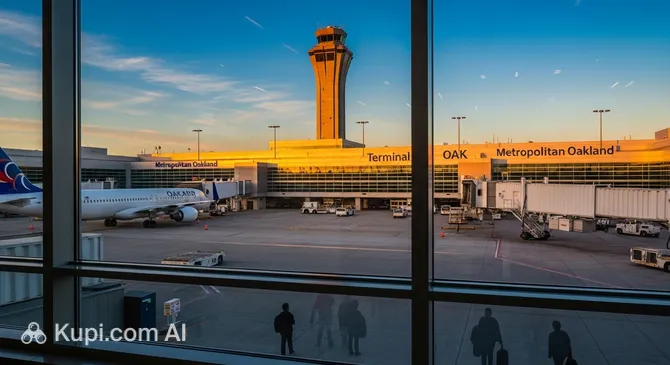
Metropolitan Oakland International Airport. Source: Kupi.com Binoculars

Metropolitan Oakland International Airport (OAK) is the "sunny gateway" to the East Bay, often chosen by seasoned travellers as a smart alternative to the busier hub in San Francisco. Located on the eastern shore of the bay, practically on the border with the cosy city of San Leandro, this airport is renowned for its punctuality and lack of thick fog that often disrupts flights in neighbouring locations. An atmosphere of calm and efficiency prevails here: compact terminals allow you to complete all formalities in a matter of minutes, making OAK the ideal start for both a business trip to Silicon Valley and a journey through California's famous scenic valleys and vineyard regions.

IATA Code OAK
ICAO Code KOAK
City Oakland (serves San Leandro and the East Bay)
Distance to Centre ~14 km to Oakland, ~5 km to San Leandro
Status International
Annual Passengers ~11.2 million (2023)
Schedule Available on the official website

Airport Features and Advantages

Oakland's main competitive advantage is weather reliability. Thanks to the unique microclimate of the bay's eastern coast, there are far more sunny days and significantly less fog here than at its "neighbours" across the bay, minimizing the risk of flight delays and cancellations. Travellers also highly appreciate the terminal logistics: intuitive navigation and rapid security screening allow for significant time savings before departure.

Transport accessibility is another strong point of OAK, especially for those planning to stay in San Leandro or Oakland. The airport is excellently integrated into the regional BART (Bay Area Rapid Transit) high-speed train system. A dedicated line connects the terminals to the Coliseum transfer hub in just 8 minutes, from where you can quickly and affordably reach most cities in the Bay Area, avoiding traffic jams.

For car travellers, the airport offers convenient access to the Interstate I-880 highway, making it a strategically advantageous arrival point. From here, it is much easier to start your journey to national parks or the Napa Valley region, bypassing the congested routes of the San Francisco Peninsula.

Contact Information

For your convenience, we have compiled the main contact information for Metropolitan Oakland International Airport (OAK). We recommend always verifying the data on official resources before your trip.

  • Official Website: www.oaklandairport.com
  • Information Desk Phone: (510) 563-3300 (general information provided)
  • Airport Address: 1 Airport Drive, Oakland, CA 94621, USA
  • Email: A direct email address for general inquiries is not published. To contact the airport administration, it is recommended to use the dedicated contact form on the official website.
  • Social Media: You can follow airport updates and news on its official pages on popular social networks such as Facebook, X (formerly Twitter), and Instagram.
  • Lost and Found Information: If you have lost an item in the general airport area, please contact the Lost and Found service at (510) 563-3982 or via the form on the website. For luggage lost on board the aircraft or during check-in, you should contact your airline directly.
  • Passenger Support Contacts: For general questions not related to your specific flight, you can call the main airport number. For information regarding tickets, schedules, and flight status, you must contact your airline's representative office.

How to Get to the Airport

Getting from the city of San Leandro to Metropolitan Oakland International Airport (OAK) is quite simple due to their close proximity. Travellers can choose the most convenient method depending on their budget, time, and amount of luggage. A car journey from the city centre to the terminals, excluding traffic, will take just 10-15 minutes.

Public Transport: BART and Buses

The most popular and efficient way to get to the airport is the BART (Bay Area Rapid Transit) high-speed train system. You need to travel to the Coliseum station and then transfer to the dedicated BART to OAK shuttle train, which will take you directly to the terminals. This is a fast and reliable option that allows you to avoid traffic congestion. Additionally, AC Transit buses operate throughout the city, offering a more budget-friendly but slower alternative.

Taxis, Transfers, and Ridesharing

For maximum comfort, especially if you have a lot of luggage, you can use taxi services or popular ride-hailing apps in the USA such as Uber and Lyft. This is the fastest "door-to-door" method. The cost of the trip will be higher than public transport and may vary depending on demand and the time of day. It is recommended to allow extra time for the journey during peak hours.

Car Rental and Airport Parking

If you are travelling in your own or a rented car, the route to Oakland Airport is via the I-880 highway. The airport offers several parking options: Hourly, Daily, and Economy Lot, which is located further from the terminals but connected to them by free shuttles. For a guaranteed spot and the best rates, it is recommended to book parking online in advance, especially during holidays and vacation periods.

Although Metropolitan Oakland International Airport is the most convenient for residents of San Leandro, it is worth remembering that there are other major airports in the region, for example, San Francisco International Airport (SFO), which offers an even wider selection of international destinations.

Terminals and Map

Metropolitan Oakland International Airport (OAK) has a simple and passenger-friendly structure consisting of two terminals — Terminal 1 and Terminal 2. They are located in the same building and are connected, which significantly facilitates navigation and movement between them.

Terminal 1 serves the majority of airlines, with the exception of Southwest. Here you will find check-in counters and boarding gates for carriers such as Alaska Airlines, Delta, Hawaiian Airlines, Spirit Airlines, and others. This terminal is used for both domestic and some international flights. Terminal 2 is almost entirely dedicated to Southwest Airlines, serving as one of its key hubs. If you are flying with Southwest, your path will lead here.

The airport layout is logical: arrival zones with baggage claim are located on the ground floor of both terminals, while departure zones with check-in counters and security checkpoints are on the first floor. The greatest advantage of Oakland Airport is that the terminals are connected not only before the security zone but also after it (airside). This means that after passing security control in one terminal, you can freely move to the other to use its shops, restaurants, or simply walk to your gate without going through screening again.

Walking between terminals takes only 5–10 minutes. Navigation is intuitive thanks to clear signage. For your convenience, information boards always indicate from which terminal and gate your flight departs. It is recommended to arrive at the airport 1.5–2 hours before the departure of a domestic flight. Although Oakland Airport is usually less busy than neighbouring SFO, queues at security checks can occur during peak hours.

Airport History

The history of Metropolitan Oakland International Airport (OAK) began in 1927, when it was built in just 63 days and grandly opened with the participation of the famous aviator Charles Lindbergh. From the very beginning, the airport became a platform for pioneering achievements in aviation. As early as 1928, the historic trans-Pacific flight of Australian Charles Kingsford Smith on the "Southern Cross" aircraft departed from here, and in 1937, Oakland became the starting point for Amelia Earhart's fateful attempt to circumnavigate the globe.

Metropolitan Oakland International Airport. Source: Kupi.com Binoculars

During World War II, the airport played a strategically important role, being transformed into a major US Naval Air Station. During this period, its infrastructure was significantly expanded and modernized for military needs, laying the foundation for post-war growth. After the war, the airport returned to civilian operations and began to develop actively, serving the growing demand for air travel in the San Francisco Bay Area.

A real breakthrough in the airport's development occurred in 1962 with the opening of a new modern passenger terminal (today's Terminal 1) and a runway over 3,000 metres long. This allowed Oakland to receive the first jetliners and compete with other major airports. In the 1980s, with the arrival of Southwest Airlines, which made Oakland one of its key hubs, Terminal 2 was built. This step firmly established the airport's reputation as a centre for budget air travel on the West Coast of the USA.

In subsequent decades, Oakland Airport has been modernized repeatedly. Work was carried out on the seismic strengthening of buildings, the expansion of passenger areas, and the improvement of transport accessibility, including the launch of the automated BART to OAK transport system in 2014. In addition to passenger transport, OAK is one of the busiest cargo airports in the country, largely thanks to the major sorting centre of FedEx. Today, Oakland Airport is not just an important transport hub but also a place with a rich aviation history that has played a significant role in the development of global air connections.

Services and Amenities

At Metropolitan Oakland International Airport (OAK), passengers are provided with a wide range of services for a comfortable wait for their flight. In both terminals, you will find numerous restaurants and cafes to suit every taste: from fast food outlets to cosy lounges and coffee shops. Shops are also at your disposal where you can purchase press, books, souvenirs, and travel essentials.

For those who need to stay connected or work, free Wi-Fi is available throughout the airport. Numerous charging stations for electronic devices, located at boarding gates and in rest areas, allow you not to worry about your gadgets' battery life. Business services are available for business travellers, and full-scale conference rooms can be found in nearby hotels.

You can take a break from the bustle of the main hall in a comfortable VIP lounge, where guests are offered snacks, beverages, and a calmer atmosphere. If you have a long layover or an early flight, there are several hotels located in the immediate vicinity of the airport, reachable by shuttle in a matter of minutes.

The airport is equipped with everything necessary to solve practical issues. Here you will find ATMs and currency exchange points. In case of necessity, passengers can seek medical assistance at special first aid points.

Particular attention at Oakland Airport is paid to the comfort of all categories of passengers. Special nursing rooms are provided for travellers with children. For people with reduced mobility, a barrier-free environment has been created, including ramps, lifts, and equipped restrooms, ensuring easy and convenient movement throughout the terminals.

Where to Eat

At Metropolitan Oakland International Airport (OAK), passengers will find diverse dining options to suit any taste and budget, from a quick coffee before departure to a leisurely meal. Most establishments are located after passing security control (airside), so it is recommended to check in for your flight and drop off luggage first.

Terminal 1

In this terminal, which serves the majority of airlines, a wide selection of establishments is presented. For a quick snack, coffee shops like the famous local chain Peet's Coffee & Tea are perfect, where you can grab freshly brewed coffee and pastries. If you have more time, visit one of the restaurants. For example, at Andalé Mexican Restaurant, you can try Mexican cuisine, and at Vino Volo, you can enjoy California flavours in a relaxed atmosphere.

Terminal 2

Terminal 2, which is mainly used by Southwest Airlines, also offers excellent options. Instead of snacking on the run, you can visit the Sierra Nevada Taproom — a great place to experience a famous California brand and enjoy classic American dishes while waiting for your flight. You can also find establishments with a more familiar menu here, for example, California Pizza Kitchen, or experience the spirit of old Oakland at the branch of the historic Heinold's First and Last Chance Saloon.

Local Cuisine and Dietary Options

Oakland Airport strives to reflect the culinary diversity of the Bay Area region. Look for dishes on the menu that are characteristic of California: avocado toast, salads with fresh vegetables, or the famous sourdough bread. Many restaurants offer vegetarian and gluten-free options — as a rule, they are marked on the menu. Finding fully vegan or certified Halal dishes might be more challenging, but you can always assemble a suitable meal from salads, vegetable sides, or fruits sold in most cafes.

Prices and Opening Hours

Prices at the airport are generally slightly higher than in the city. A cup of coffee with a pastry will cost approximately $8-12, while a full lunch in a restaurant with a drink will cost from $25 to $40 per person. Major coffee shops and eateries open very early, around 4:30–5:00 AM, while full-service restaurants begin operations later, around 6:00–7:00 AM. Most establishments close after the departure of the last evening flight.

Traveller Tips

To ensure your journey through Metropolitan Oakland International Airport goes smoothly, make use of these tips. It is recommended to arrive at the airport at least 2 hours before a domestic flight departure and 3 hours before an international one. During peak hours, for example, early in the morning or on holidays, it is better to allow extra time. To save time, complete online check-in and print or save your boarding pass to your phone in advance.

When passing through security control, be ready to present your documents and boarding pass. All carry-on luggage is screened, so prepare large electronic devices, such as laptops, for separate scanning in advance. Remember the rule for carrying liquids: containers with a volume of no more than 100 ml are permitted, packed in a single transparent bag. Sharp objects and other prohibited items should be checked in with your luggage. Participation in the TSA PreCheck programme can significantly speed up the screening process.

If you have the opportunity to choose a seat on the plane, do so in advance. Window seats will offer you beautiful views of the San Francisco Bay during takeoff or landing. Aisle seats are convenient if you plan to get up during the flight. Seats in emergency exit rows offer more legroom but also impose certain responsibilities.

For passengers with connections in Oakland, navigation is usually not difficult, as Terminals 1 and 2 are connected after the security zone. Watch the departure boards carefully so as not to miss your next flight. For international flights, keep your passport, visa (if necessary), and completed customs declaration ready for border control. Be prepared to answer questions from customs officers clearly and honestly.

There are several ways to save money at the airport. Book parking online in advance — this is often cheaper. To avoid spending money on water, bring an empty reusable bottle with you and fill it after passing security control. Food prices at airports are usually high, so you can bring light snacks from home.

In case of a flight delay or cancellation, first contact your airline representative at the information desk or at the boarding gate. It is also useful to install the mobile app of the air carrier to receive operational updates. Learn about your rights: depending on the reason and duration of the delay, you may be entitled to vouchers for meals or even hotel accommodation. Check if your travel insurance covers such cases.

Reached the end of the page?

That means the route is fully explored