Support

Fort Bragg (Pope Field)

About the Airport

Fort Bragg Airport, also known as Pope Field, is not just another point on the aviation map of the USA. Located in the immediate vicinity of the city of Spout Springs, it serves primarily as the air gateway for one of the largest military bases in the world — Fort Bragg (now Fort Liberty). This is a place where the history of military aviation is closely intertwined with logistics and strategic power, making it a unique facility, even if you do not plan to use it for a civilian flight.

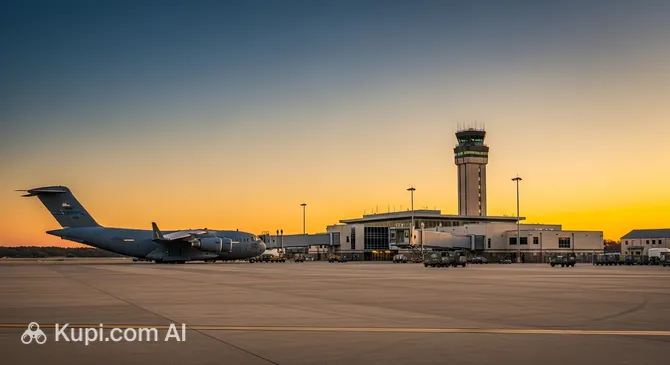
Fort Bragg (Pope Field). Source: Kupi.com Binoculars
IATA Code POB
ICAO Code KPOB
City Spout Springs
Distance to centre approx. 5 km
Status Military
Passengers per year Commercial passenger flights are not serviced
Popular Airlines Commercial flights are absent

The main feature of Pope Field lies in its status. It is an active US Air Force base that historically had a small terminal for civil flights, but is currently focused entirely on military operations. The airport plays a key role in ensuring the mobility of the 82nd Airborne Division and other units based at Fort Bragg. Its runways are capable of accommodating heavy military transport aircraft, such as the C-17 Globemaster III and C-130 Hercules.

For tourists, it is important to know that Pope Field is not an option for commercial travel. If you plan to visit this region of North Carolina, the nearest civil airport is Fayetteville Regional Airport (FAY), which is located approximately 20 kilometres away. It serves regular flights of major American airlines and is the main arrival point for travellers.

Contact Information

Since Fort Bragg (Pope Field) (POB) is primarily a military airfield (Pope Army Airfield), finding unified public contact information, as is common with civil airports, can be difficult. Always check official resources for the most up-to-date data.

  • Official Website: It is recommended to search for information on the official website of the Fort Liberty military base (formerly Fort Bragg), as the airfield is part of it.
  • Help Desk Phone: A direct public number for enquiries is generally unavailable. To contact specific services on the base, you should use the official base telephone directory if available online.
  • Airport Address: Pope Army Airfield, Fort Liberty, North Carolina, USA. The airfield is located within the military base near the city of Fayetteville.
  • Email: A public email for general questions is usually not provided. It is recommended to use contact forms on the official website if available.
  • Social Media: Try finding official pages by searching for "Pope Army Airfield" or "Fort Liberty" on major social networks for news and updates.
  • Lost Luggage Information: For questions regarding lost or damaged luggage, you must contact the airline directly. Airport services do not handle luggage processing for passengers on charter or commercial flights.
  • Passenger Support Contacts: Passenger support is also provided by the operating airline. Please use the contacts listed on your ticket or on the airline's website.

How to Get to the Airport

Fort Bragg Airport (Pope Field) is primarily a military facility serving the USA Army base of the same name, located near Spout Springs and Fayetteville. Access to the territory may be restricted, so it is important to familiarise yourself with the base visitation rules before travelling. Nevertheless, there are several ways to reach the airport.

Taxis, Transfers, and Ridesharing — this is the most convenient option for visitors. Services like Uber and Lyft operate in this region. A trip from the centre of Fayetteville to the base gates will take approximately 20–30 minutes and will cost $25–45, depending on demand and the time of day. Important to remember: drivers without a special permit will likely only be able to take you to the main checkpoint (Visitor Control Center), where you will need to undergo document checks to enter the base territory.

Public Transport in the traditional sense is virtually non-existent. There are no direct bus or rail routes to Pope Field airport due to its location within a restricted military area. You can use the Fayetteville Area System of Transit (FAST) buses to reach stops nearest to the base, but you will still need to take a taxi from there.

Car Rental provides maximum flexibility, especially if you plan to travel around the region. You can rent a car at neighbouring major airports, such as Fayetteville Airport (FAY) or the larger Raleigh-Durham International Airport (RDU), which is about a 1.5-hour drive away. To enter Fort Bragg territory by car, you will need to present a valid driving licence, vehicle registration documents, and insurance. Ensure you have all documents with you.

Airport Parking is available, but it is governed by military base rules. There are zones for short-term and long-term parking, however, they may be designated primarily for military personnel. Visitors are advised to check information regarding guest parking, locations, and potential fees in advance on the official Fort Bragg base website.

Terminals and Map

Fort Bragg Airport (Pope Field) (POB), which is inherently a military airbase (Pope Army Airfield), has its own specific features regarding passenger service. Unlike large civil airports, there is one main passenger terminal operating here. Its primary purpose is servicing military flights, transporting personnel, as well as handling charter flights related to base activities.

The terminal layout is quite simple and intuitive. The building is compact, and all main zones are within walking distance of each other, eliminating the need for complex transfers or using transport to move between different parts of the airport. Since there is only one terminal, transferring between terminals is not required. Departure and arrival zones are clearly demarcated, simplifying navigation for passengers.

The check-in and security screening process is generally organised efficiently, but times can vary significantly. This depends on the specific nature of the flight: mass military transport may require significantly more time than a standard charter. It is strongly recommended to arrive at the airport with plenty of time to spare and strictly follow instructions received from the airline or military orders.

Inside the terminal, passengers have access to basic amenities, including a waiting lounge, check-in counters, and a baggage claim area. However, it is worth noting that the selection of shops, cafes, and other services may be limited compared to major commercial airports. The main advice when navigating Pope Field is to listen carefully to announcements and follow staff instructions, as procedures may have specific requirements related to the status of the military facility.

Airport History

The history of Fort Bragg Airport (Pope Field) (POB), located in the state of North Carolina, USA, near the city of Spout Springs, is inextricably linked with the development of American military aviation. The airfield was officially established in 1919 and named in honour of First Lieutenant Harley Halbert Pope, a pilot who tragically died that same year in an aeroplane crash.

Initially, Pope Field served to support artillery exercises at the neighbouring Fort Bragg military camp, performing fire correction and communication tasks. However, its role grew rapidly. By the start of World War II, the airfield had become a crucial training centre for new US airborne troops. It was here that paratroopers and transport aviation pilots honed their skills, laying the foundation for famous airborne operations in Europe.

In the post-war period, in 1947, the airfield was designated as Pope Air Force Base and became a key element of the Tactical Air Command. Throughout the Cold War, the base was the primary departure point for rapid response units, primarily for the legendary 82nd Airborne Division. Aircraft taking off from Pope participated in operations around the world, from Southeast Asia to the Caribbean and the Middle East.

A significant milestone in the airport's recent history occurred in 2011. As a result of the Base Realignment and Closure (BRAC) process, the Air Force base was transferred to US Army control and returned to its historical name — Pope Army Airfield, becoming part of the joint Fort Bragg base. Despite the change in status, its main function remained unchanged — providing air transport and supporting airborne operations. The infrastructure is constantly being modernised to service modern heavy transport aircraft.

One interesting fact is that Pope Field is considered the "birthplace" of tactical airlift in the US Air Force. For over one hundred years, this place remains a living symbol of strategic mobility and armed forces readiness, serving as the starting point for countless missions that have gone down in history.

Services and Amenities

Fort Bragg Airport (Pope Field) (POB) is an active military airfield (Pope Army Airfield), serving primarily military personnel and their families. The passenger terminal here operates mainly for Space-A flights (flights available on a space-available basis on military aircraft). Unlike civil airports, the range of services here is strictly limited and adapted for military needs.

Restaurants, Cafes, and Shops

In the passenger terminal itself (AMC Passenger Terminal), the choice of food is minimal. Travellers are strongly advised to bring food with them, as there are no cafes or full-service restaurants inside the terminal. Vending machines with drinks and snacks may be available, but their presence is not guaranteed. For those with access to the base and time before departure, the main shops and food courts (PX/BX — Post Exchange) are located on the garrison territory, but not within walking distance of the departure zone.

Lounges and Comfort

The terminal features a basic waiting hall for passengers awaiting Roll Call and boarding. This is a functional space without the luxury VIP lounges common to commercial airlines. Amenities are modest, designed for a short stay before departure.

Wi-Fi and Communication

The availability of public Wi-Fi in the terminal is unstable and may be absent for security reasons. Passengers should not rely on high-speed internet or business services (fax, printing) inside the terminal building. It is recommended to download necessary content to your devices in advance.

Banks and Currency Exchange

There are no bank branches or currency exchange points within the terminal building. ATMs and financial institutions (such as Fort Liberty Federal Credit Union) are located on the Fort Bragg (now Fort Liberty) base territory, so it is worth arranging cash before arriving at the departure zone.

Medical Services and Accessibility

As a military facility, the airfield complies with accessibility standards for passengers with disabilities, however, specialised escort services may be fewer than in civil airports. Medical assistance on the base is provided by the military hospital (Womack Army Medical Center), but there is no 24-hour medical post for travellers within the terminal itself.

Services for Passengers with Children

There are no dedicated playrooms or entertainment zones for children in the terminal. Parents should independently arrange for their child's entertainment and nutrition during the wait for the flight.

Hotels and Accommodation

Directly on the base territory, the IHG Army Hotels chain operates (e.g., Airborne Inn), available to authorised persons. For other travellers, a wide selection of hotels is presented in the neighbouring city of Fayetteville and the town of Spring Lake, located 15–20 minutes' drive from the airfield.

Transport and Parking

Car rental services (e.g., Enterprise) may be available on the base territory (in the Mini Mall area), but not always directly at the terminal. Long-term parking for Space-A passengers may be limited, so it is recommended to check current rules with passenger services before travelling.
Where to Eat

Dining in the Terminal: What to Expect

Since Fort Bragg Airport (Pope Field) is an active military facility, passengers should adjust their expectations regarding gastronomic possibilities in advance. Unlike civil airports, there is no division into multiple terminals with food courts. In the single passenger terminal (AMC Terminal), there are no full-service restaurants, bars, or cafes. The main option for food inside the waiting area is vending machines.

Snacks and Drinks Inside the Terminal

Vending machines are located in waiting areas (both before and after security screening). This is the only available way to have a snack directly before departure without leaving the building.

  • Assortment: Standard set of snacks (crisps, chocolate bars, biscuits, crackers), as well as soft drinks (water, soda, juices). Coffee can sometimes be found in machines.
  • Prices: Budget segment; the cost of items usually varies from 1 to 3 dollars.
  • Payment: It is recommended to have small cash notes (US dollars) or coins, as not all machines accept bank cards.

Full Meals: Nearby Options

For those wishing to have a proper lunch before flight registration (Roll Call), the best options are outside the terminal, on the garrison territory (Landside). Access is only possible if you have base access and a vehicle, as it is far to walk.

  • Pope Mini Mall (Shoppette): Located near the airfield. There is often a small area with hot fast food (e.g., sandwiches, takeaway pizza) and an expanded selection of groceries.
  • Base Food Courts (PX Food Courts): Main chain establishments are located in the Post Exchange (PX) shopping centres on Fort Liberty (formerly Fort Bragg). There you can find popular American chains: Burger King, Taco Bell, Subway, Qdoba, Starbucks, and others.
  • Opening Hours: Most establishments on the base operate from 07:00–08:00 AM to 08:00–09:00 PM. There are practically no 24-hour restaurants.

Dietary Catering (Vegan, Halal, Gluten-Free)

Inside the terminal itself, the choice for people with special dietary needs is critically limited. It is extremely difficult to find healthy, vegan, or gluten-free options in vending machines.
Recommendation: Passengers observing a strict diet (such as Halal) are strongly advised to bring food with them. Bringing food through security in military terminals is usually permitted (with the exception of liquids), but it is better to clarify current rules with staff.

Tips for Travellers

Given the specifics of Space-A flights, where long delays are possible, the best strategy is autonomy. Prepare a full lunchbox or buy food in the city/on base before arriving at the terminal. Water is available at drinking fountains inside the departure zone (Airside), so an empty bottle can be refilled after passing control.

Traveller Tips

Travelling through Fort Bragg Airport (Pope Field) differs significantly from flying with civil airlines. Since this is a military airfield operating on the Space-A system (flights based on available space), preparation requires special attention to detail and flexibility.

Arrival Time and Registration Process

Unlike commercial flights, a Roll Call system operates here. You must arrive at the terminal at least 2–3 hours before the start of the Roll Call, not before the flight time. This is critically important to mark your presence in time. Watch the schedule closely: registration times can change at the last moment. Always have printed copies of all necessary documents (leave papers, ID card, passports for all family members), as electronic versions may not be accepted.

Security and Screening Features

Security procedures here are strict and comply with military standards, which are often tougher than civil ones (TSA). Be prepared for screening to take longer. Closed-toe shoes are a mandatory requirement for many types of military aircraft; you may not be allowed on board in flip-flops or sandals. Keep documents to hand at all stages of control.

Tips on Seat Selection and In-Flight Comfort

On military aircraft (e.g., C-130 or C-17), the usual choice of seats is often absent. Seating may be arranged on a first-come, first-served basis or by rank. Consider the following nuances:

  • Clothing: It can be very cold in the cargo holds of military aircraft. Dress in layers, bring warm jackets, hats, and gloves, even if flying in summer.
  • Noise: The noise level on such aircraft is significantly higher. It is recommended to bring quality earplugs or noise-cancelling headphones.
  • Amenities: Seats may be simple fold-down benches along the sides. An inflatable neck pillow and a blanket will make the flight much more comfortable.

Hand Luggage and Baggage

Rules for carrying liquids in hand luggage are similar to standard ones (containers up to 100 ml), but avoid carrying any items resembling weapons, even toys. Due to limited space in the cabin, try to take only essentials in hand luggage: medication, documents, warm clothes, and food. Luggage must be durable, as handling may be less delicate than in commercial airports.

Recommendations for Transit Passengers

Space-A flights do not guarantee connections. If you plan a transfer, allow for a maximum buffer of time (at least 24 hours). Remember that your luggage will not be automatically transferred to the next flight — you need to collect it and check it in again.

Customs Control

If you are arriving from abroad, you will pass through US customs control directly on the base. The procedure is usually faster than in major hubs, but rules on importing food and goods are strictly enforced. Declare everything you are unsure about to avoid fines.

Savings and Actions in Case of Delays

The main tip for saving money is the use of the Space-A flight option itself, which costs a nominal amount. However, always have a financial "Plan B". Military missions take priority, and your flight may be postponed for several days or cancelled altogether. Have reserve funds for a hotel in Spout Springs or Fayetteville, as well as money to purchase a commercial ticket in case of an urgent need to fly.

Reached the end of the page?

That means the route is fully explored