Support

Tulsa International Airport

About the Airport

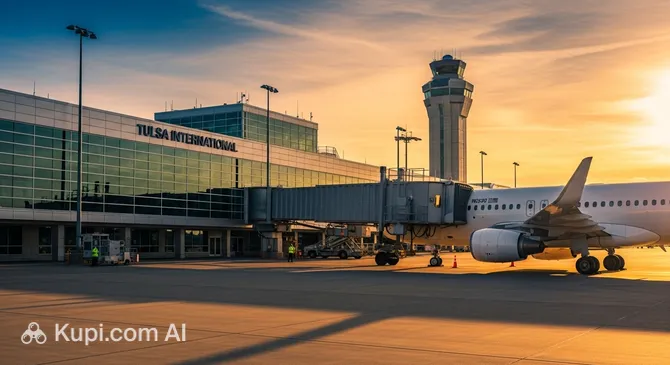
Tulsa International Airport. Source: Kupi.com Binoculars
Tulsa International Airport (TUL) is not merely a transit point, but the main aerial gateway to Oklahoma's "Green Country." The airport is renowned for its compactness and lack of the hustle and bustle typical of major hubs, allowing travelers to begin their acquaintance with the region in a relaxed atmosphere. Here, modern technologies blend harmoniously with the city's rich aviation heritage, and live music reflecting Tulsa's creative spirit can often be heard in the terminals.
IATA Code TUL
ICAO Code KTUL
City Tulsa
Distance to Center 15 km
Status International
Annual Passengers ~3.1 million (2023)
Airport Features and Advantages

Tulsa International Airport stands out among other regional airports for its attention to passenger comfort and local flair. The terminal is designed so that navigation is intuitively clear, and security screening rarely takes much time, making it one of the most convenient airports for departure in the USA.

One of the unique "highlights" of the airport is the Tunes at TUL program. Live performances by local musicians are regularly held in different parts of the terminal, turning the wait for a flight into a small concert. This is an excellent way to immerse yourself in the city's culture even before stepping out into the town.

The gastronomic section also deserves attention: instead of standard chain cafes, you can find establishments by local brands here. Travelers can taste famous burgers or beverages from local producers without leaving the airport building. Additionally, the proximity to the Tulsa Air and Space Museum makes this airport an interesting point for aviation history enthusiasts.

Contact Information

To contact representatives of Tulsa International Airport (TUL) and obtain additional information, you may use the following contacts:

  • Official Website: www.flytulsa.com. The site provides the most up-to-date information on flights, services, and airport rules.
  • Information Desk Phone: +1 (918) 838-5000.
  • Airport Address: 7777 E Apache St, Tulsa, OK 74115, USA.
  • Email: A direct email address for general inquiries is not published. It is recommended to use the special contact form on the official website for communication.
  • Social Media: The airport actively maintains pages on Facebook, X (formerly Twitter), and Instagram, where news and operational updates are published.
  • Lost & Found Information: If you have lost items within the airport terminal, please contact the Lost & Found service at +1 (918) 838-5360. For baggage lost on board an aircraft, please contact your airline directly.
  • Passenger Support Contacts: For general questions, you can call the main phone number. Contact details for specific airlines, car rental agencies, and other services can be found in the corresponding sections on the airport website.

How to Get to the Airport

You can reach Tulsa International Airport (TUL), located approximately 15 kilometers northeast of the city center, in several convenient ways. The choice of the optimal option depends on your budget, time, and comfort preferences. A trip from the central part of Tulsa usually takes from 15 to 40 minutes.

Public Transport is the most economical way to get to the airport. Tulsa Transit operates a bus route connecting the city center with the passenger terminal. This is an excellent choice for budget-conscious tourists and those traveling light. The fare is just a few dollars. Be sure to check the current schedule on the carrier's website, especially if you plan to travel on a weekend, early in the morning, or late at night.

Taxis and Ride-sharing Services, such as Uber and Lyft, offer a quick and comfortable way to reach your destination. A trip from the center of Tulsa will take about 15–20 minutes depending on traffic conditions. This is the fastest way to get to the terminal. The cost of the trip usually varies between 20–30 dollars. For added convenience, especially if you have a lot of luggage or are traveling with family, you can book a private transfer in advance.

Car Rental is an ideal option for those who value independence and plan to actively explore not only Tulsa but also the scenic surroundings of the state of Oklahoma. Counters of all leading USA rental agencies are located at the airport. You can book a car in advance online or rent it upon arrival. The road from the city center to the airport is simple and intuitive.

If you are arriving at the airport in a private vehicle, several parking options are at your disposal. There is hourly parking right at the terminal, convenient for short stops. For those leaving their car for several days, more affordable long-term parking lots are provided. Free shuttle buses run regularly from remote parking zones to the terminal.

Although TUL is the main airport for travel to Tulsa, there are other air harbors in the region. Sometimes travelers find more favorable air tickets to Will Rogers Airport in Oklahoma City or Fort Smith Airport. When choosing such a route, it is important to remember the additional costs and time required to travel to Tulsa itself.

Terminals and Map

Tulsa International Airport (TUL) is distinguished by a simple and passenger-friendly structure. It consists of one main terminal, which completely eliminates confusion when searching for the right zone and the need to move between different buildings. Such compactness makes navigation intuitive even for those visiting for the first time.

The terminal is divided into a central part and two passenger concourses — Concourse A to the north and Concourse B to the south. In the central part of the building on the upper level, check-in counters for all airlines and ticket offices are located. Immediately behind them is a single security checkpoint through which all departing passengers pass. After screening, travelers enter the common area, from where they can proceed to the boarding gates in either of the two concourses.

The arrival and baggage claim area is located on the lower level of the terminal, which is a standard layout for many airports. Passengers arriving in Tulsa simply need to go down the escalator or elevator after exiting their concourse to collect their suitcases and exit to the taxi and bus stands.

The distribution of airlines by concourses is usually as follows:

  • Concourse A serves Allegiant, American Airlines, and Delta Air Lines flights.
  • Concourse B is used by Breeze Airways, Southwest Airlines, and United Airlines.
Thanks to clear signage, finding your boarding gate is effortless.

Check-in and screening procedures at Tulsa Airport generally proceed quite quickly compared to major hubs. Nevertheless, it is recommended to arrive at the airport approximately 90 minutes before a domestic flight departure. This time will be sufficient to check luggage, pass security control, and reach the necessary gate without rushing. During peak hours, such as early morning or on holidays, it is better to allow a margin of up to two hours.

Airport History

The history of Tulsa International Airport begins in 1928, when it was founded as a Municipal Airport. From the very beginning, it played an important role in the development of aviation in the region, but its finest hour came during World War II. The airport was transferred to the jurisdiction of the US Air Force, and a huge Douglas Aircraft Company plant was built next to it. It was here that thousands of bombers were produced, including the famous B-24 Liberator, which made a colossal contribution to the country's military efforts and forever inscribed Tulsa in the history of the American aviation industry.

After the war, the airport returned to civil use and continued its development. An important milestone was 1961, when a new terminal building was opened. Its design was developed by the world-famous architect Minoru Yamasaki, who later designed the Twin Towers of the World Trade Center in New York. This elegant and functional terminal became a symbol of a new era for the airport, which received its modern name — Tulsa International Airport — in 1963 to reflect its growing importance.

Over the following decades, the airport was modernized repeatedly to meet modern requirements. Major renovations were carried out in the 1980s and early 2000s. One of the most interesting facts associated with the airport today is its status as one of the world's largest centers for aircraft maintenance and repair. The main technical base of American Airlines is located here, making the airport not just a transit hub, but a key object of aviation infrastructure in the USA.

Services and Amenities

Tulsa International Airport (TUL), located in the state of Oklahoma, USA, offers passengers a wide range of services for a comfortable wait for their flight. In the terminal, you will find various dining spots: from cafes with quick snacks and fresh pastries to restaurants where you can have a full lunch or dinner. Shops offer souvenirs, books, travel essentials, and products from local brands, allowing you to pass the time before departure and buy gifts.

Staying connected at the airport is easy — free Wi-Fi access is provided throughout the territory. Numerous stands and outlets are provided for charging electronic devices, conveniently located in waiting areas near boarding gates. Passengers preferring enhanced comfort can use the services of lounges, where drinks, snacks, and a more secluded atmosphere for rest or work are offered in a quiet setting.

ATMs are installed in the airport for financial matters. While specialized currency exchange points are not always found in regional airports, basic banking operations are available via ATMs. In case of necessity, passengers can seek medical assistance — a first aid station usually functions within the terminal.

TUL Airport is equipped for the convenience of passengers with children and people with disabilities. For families with infants, there are special nursing rooms where you can feed and change a baby in a quiet environment. For passengers requiring additional support, wheelchairs and assistance are provided; all infrastructure, including restrooms and elevators, is adapted for barrier-free movement.

Business travelers may find conference rooms and business centers offering space for meetings and a working environment useful. Although there are no hotels directly in the terminal building, several hotels of various price categories are located in the immediate vicinity of the airport, many of which offer free shuttle service for their guests.

Where to Eat

At Tulsa International Airport (TUL), travelers will find diverse dining options capable of satisfying any taste and budget. Regardless of whether you are looking for a quick coffee before departure or a full meal to pass the time while waiting for a flight, there is plenty to choose from here. Most establishments are located in the main departure zone (airside), after passing security control, in Concourses A and B, allowing passengers to have a snack in close proximity to their gates.

For those in a hurry, coffee shops and fast-food outlets are ideal. Here you can grab sandwiches, salads, pastries, and, of course, aromatic coffee to go. Both well-known national chains and local cafes are represented at the airport. If you have time, you can visit one of the full-service restaurants. Their menus usually include classic American dishes: burgers, steaks, and salads. Some establishments may also offer dishes with local flair, for example, something in the barbecue style, which is so popular in Oklahoma.

Passengers with special dietary needs should study the menu carefully. In most restaurants and cafes, you can find vegetarian dishes, such as salads or meat-free sandwiches. Gluten-free options are also becoming increasingly common, but their availability is best clarified with the staff. The price range at the airport is typically slightly higher than in the city. A quick snack will cost a moderate amount, while lunch at a restaurant will require higher expenditure.

The operating hours of catering establishments are usually tied to the flight schedule. Most of them open early in the morning to serve passengers of the first flights and close after the departure of the last planes in the evening. However, there may not be cafes or restaurants open 24/7 at the airport, so it is worth planning your visit in advance.

Travel Tips

To ensure your journey through Tulsa International Airport goes smoothly and without unnecessary worry, take advantage of our tips. These recommendations will help you save time, money, and nerves, making the start or end of your trip as comfortable as possible.

Arrival Time at the Airport: We recommend arriving at the airport at least 2 hours before the departure of domestic flights and 3 hours before international ones. This will give you a sufficient margin of time for calm check-in, baggage drop-off, and security screening, especially during morning and evening peak hours.

Check-in and Security: The fastest way to check in for a flight is to do it online on the website or in the app of your airline. At the airport, you will need to pass security screening (TSA). To speed up the process, remove laptops and other large electronic devices from your carry-on luggage in advance, and keep all liquids in a separate transparent bag according to the rules.

Seat Selection: Want to admire the clouds? Choose a window seat. Need more legroom or the ability to exit quickly? Your seat is by the aisle. Keep in mind that most airlines offer a seat selection service for an additional fee when booking a ticket.

Carry-on Luggage: Remember the rule for carrying liquids in the USA: containers with a volume of no more than 100 ml (3.4 oz) each, packed in one transparent resealable bag with a volume of no more than 1 liter. Sharp objects, weapons, and flammable substances are prohibited. Always check the weight and size allowances for carry-on luggage on your airline's website.

Connecting Passengers: If you have a connection in Tulsa, immediately after arrival, find the number of your next boarding gate on the information board. Tulsa International Airport is quite compact, making transfers convenient. If you arrived on an international flight and are flying further within the USA, you will likely need to collect your luggage and re-check it after passing customs.

Customs Control: Those arriving on international flights must pass border and customs control. Have your passport, visa, and completed declaration ready. Be prepared to answer the officer's questions about the purpose of your visit and the duration of your stay clearly and calmly.

Saving Time and Money: To save money, bring an empty reusable water bottle with you — you can fill it at drinking fountains after passing security control. It is more profitable to book airport parking online in advance. Consider using ride-sharing services or public transport to get to the city.

In Case of Flight Delay: Remain calm. Monitor updates on your flight status via the airline's mobile app or on information boards in the terminal. If the delay is significant, contact an airline representative to find out about your rights to receive meals or hotel accommodation.

Reached the end of the page?

That means the route is fully explored