Support

Alsahareej (Water Tanks)

About

Carved directly into the rugged volcanic rocks of the Wadi Tawila valley, the Al-Saharij Cisterns are one of antiquity's most impressive engineering achievements. Located in the city of Aden, this complex of cisterns served as the primary life source for the local population for centuries, collecting and storing rare rainwater in the heart of the arid land known as Yemen.
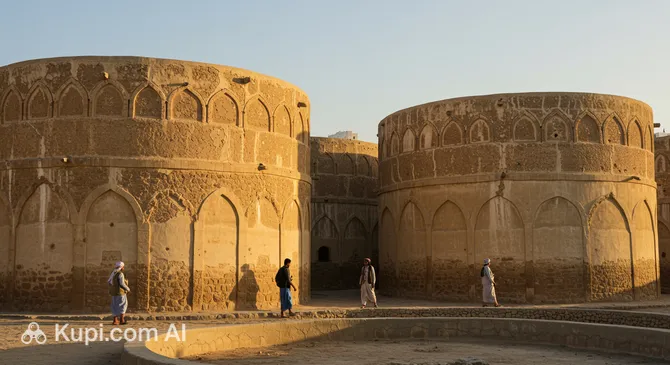
Al-Sahareej Water Tanks
Al-Sahareej Water Tanks. Иллюстрация. Источник: Kupi.com AI

This historical landmark is striking in its scale: there were once more than 50 reservoirs connected in a complex system. Today, 13 of them are open to the public, including the famous Coghlan Tank and the circular Playfair Tank. The total capacity of the surviving structures is an impressive 19 million gallons, demonstrating the profound knowledge of hydraulics and construction held by ancient master builders.

The walls of the reservoirs are coated with a special compound that has kept them impermeable for centuries. For tourists, this site is valuable not only as a historical monument but also as a magnificent observation deck: the steps of the ancient structures offer panoramic views of the surrounding hills and city quarters, providing an ideal backdrop for reflecting on the power of human genius.

Contacts

To plan your visit to this unique attraction, it is helpful to have its exact coordinates and address. The site is located in the historical part of the city and is easily accessible for tourists.

How to contactContact
AddressQ2FH+MHR, Aden, Yemen

What to Do

The main reason to visit is to walk among the giant stone basins. You can see in detail how ancient builders used the natural fissures in the rock to create a water catchment system. Be sure to climb the stone stairs to the upper levels to appreciate the scale of the structures and see how seamlessly one reservoir flows into another.

For photographers, this place is a true treasure. The play of light and shadow on the dark volcanic stone, combined with the bright sky, creates dramatic shots. The best time for photography is dawn or sunset, when the sun's rays highlight the texture of the ancient plaster. Information signs are also installed on-site to help you understand the purpose of each element in the complex.

If you want to learn more hidden facts, we recommend joining a tour with a local guide. Stories of how the city survived during times of great drought thanks to these stones make the walk truly fascinating. Don't forget to wear comfortable shoes and bring a supply of water, as walking up and down the steps can be tiring, and shade is not always easy to find under the scorching sun.

Getting There

Getting to this ancient engineering marvel is quite simple, as it is located in the popular Crater district. If you are in central Aden, the easiest way is to use a local taxi or follow GPS coordinates 12.7742337, 45.0288857. For those renting a car, parking is available near the complex.

If you are traveling from other regions, such as Lahij, the drive along the Al-Mukalla Road takes about 40–50 minutes, covering a distance of approximately 30 kilometers. From more distant cities like Raymah, the journey may take several hours via the main highway leading toward Aden.

Travelers who prefer public transport can use intercity buses or shared taxis that arrive at Aden's main station. Fares from neighboring cities range from 200 to 3,000 rials depending on the distance. From the station, the cisterns are just a few minutes away by city taxi.

Ближайший город: Aden

History & Facts

The history of the Tawila Cisterns (the official name of the Al-Saharij water reservoirs) is shrouded in legend. The most widely accepted hypothesis traces their origins back to the Himyarite Kingdom—an ancient state that flourished in these lands over two thousand years ago. The engineers of that time showed incredible ingenuity by carving the water collection system directly into the volcanic rocks of the Wadi Tawila gorge.

The construction technology is particularly noteworthy: the walls of the reservoirs were covered with a unique plaster based on volcanic ash. This composition made the stone completely waterproof, allowing precious moisture to be stored for months in the arid climate. The first written mentions of the Aden tanks appear in 10th-century Arabic manuscripts, where the geographer Al-Hamdani describes them as vital rainwater storage facilities.

During the Middle Ages, under the Rasulid dynasty, the complex was restored, saving it from complete decay. However, the reservoirs took on their modern appearance in the 19th century, when British engineers led by Sir Robert Playfair conducted a large-scale reconstruction. They connected a network of smaller basins into several large cisterns to more effectively supply fresh water to the growing port city.

Today, only 13 reservoirs remain out of the original fifty-three, but even these are impressive in scale. This site has become a symbol of resilience and an innovative approach to resource management that allowed people to survive in the harsh conditions of the Arabian deserts for many centuries.

Time Needed

To leisurely explore all the accessible cisterns, read the information boards, and take commemorative photos, 1–2 hours is sufficient for most visitors. The complex area is quite compact, but it does require some time to climb and descend the steps between the various levels.

If you choose to use the services of a professional guide or plan to wait for the "golden hour" for perfect sunset photos, you should budget about 2.5 hours for your visit. This will allow you to soak in the majesty of the ancient architecture and examine the masonry details without rushing.

Working Hours

The attraction is open to visitors daily, making it easy to include in any travel itinerary. The complex operates on a consistent schedule with no days off.

Opening hours: Daily from 08:00 to 18:30. This schedule allows you to explore the reservoirs in the morning coolness or catch the picturesque evening twilight.

8:00 – 18:30

Nearby

A visit to the ancient cisterns is just the beginning of discovering the region's rich heritage. There are many other iconic sites in the immediate vicinity that will help you better experience the atmosphere of this port city.

NameDistance
Al-Ful Tour (The Ship - Crater)0.8 km
Fun City Park1.8 km
Sira Castle2.3 km
Golden Coast3.8 km
Al Somahi Restaurant3.9 km
Al Baraka Restaurant and Grill4 km
Elephant Bay Resort4.4 km

Reached the end of the page?

That means the route is fully explored