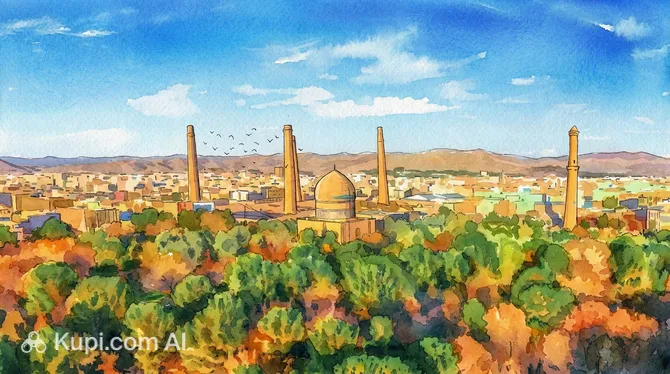
The Minarets of Herat are a majestic architectural ensemble located in the ancient city of Herat in western Afghanistan. Built during the Ghurid dynasty (12th–13th centuries), these towers are an outstanding example of medieval Islamic architecture. Originally part of a vast religious complex that included a mosque and a madrasa, they still captivate the imagination with their sheer scale.
Minarets of Herat. Illustration.
Source: Kupi.com AI
Traveler photos:
Each minaret stands over 30 meters tall, though they were even taller in antiquity. The towers' walls, made of fired brick, are decorated with intricate geometric patterns and calligraphic inscriptions. Exquisite glazed tiles, some of which remain on the facades, create a unique interplay of light and shadow, highlighting the skill of medieval artisans.
Despite the passing centuries and natural disasters, the remaining minarets stand as silent guardians of history. They are recognized as a national treasure and are considered one of the most recognizable symbols of the region, embodying the cultural flowering of the Ghurid era.
Contacts
When planning a visit to the Minarets of Herat in the city of Herat, we recommend checking for the latest information on site access in advance. As this historical area is protected, visiting conditions may change depending on ongoing restoration work or local holidays.
Be sure to check the coordinates on a map and ensure you have a way to contact a local guide or tourist office for the most up-to-date information before heading to this jewel of Afghanistan.
The main reason to visit the Minarets of Herat is the chance to touch living history and examine the unique Ghurid era decor in detail. Visitors can study the intricate brick ornaments and fragments of turquoise glaze that once completely covered these towers. The calligraphic inscriptions on the walls contain verses from the Quran and dedications to rulers, making the visit even more profound and educational.
This site is a true find for photography enthusiasts. The play of sunlight on the textured brick surfaces allows for impressive shots at different times of day. Observing these structures in Herat, you can clearly imagine the former grandeur of medieval architecture and appreciate the engineering prowess of ancient masters. A visit here offers a rare chance to see the development of Islamic architecture in Afghanistan at its most brilliant.
Getting There
Reaching the Minarets of Herat is easy, as they are located right within the city limits of Herat, along one of the main transport arteries—the AH1 highway. The exact address of the site is 95JH+RHV, AH1, Herat. As a major cultural center of Afghanistan, the city boasts a developed road network connecting it with other regions.
The most convenient way to reach the attraction from the city center is by using local taxis, which are available everywhere. You can also arrange a trip through a local travel agency that provides transportation and a guide. For more precise route planning, it is recommended to use mobile navigation apps that correctly display the location of the architectural complex.
Nearest city: Herat
History & Facts
The history of the Minarets of Herat is inextricably linked to the rise of the Ghurid dynasty, when Herat was one of the East's most important cultural and intellectual centers. These towers were part of a grand educational and religious complex—a madrasa founded by Sultan Ghiyath al-Din Muhammad. At that time, this educational institution was considered one of the largest and most prestigious in the Islamic world.
Interestingly, the architectural ensemble originally included many more structures, but only a few minarets and a mausoleum have survived to this day. In the late 19th century, much of the complex was lost, making the remaining towers even more valuable. Of the five minarets that once stood here, only two can be seen today, continuing to serve as a symbol of resilience in the face of time.
The architectural style of the Herat minarets had a colossal influence on subsequent buildings throughout the region, from Central Asia to India. Although the complex is not yet on the UNESCO World Heritage list, it remains a vital archaeological site in Afghanistan, preserving the memory of the golden age of local architecture and art.
Time Needed
For a thoughtful tour of the Minarets of Herat and to appreciate their architectural details, most travelers will need about 1–2 hours. This is plenty of time to walk around the grounds at a leisurely pace, take photos, and study the fragments of ancient ornaments at different levels of the towers.
If you are passionate about Islamic architecture or are a professional photographer, you might want to stay longer to catch the perfect lighting. It's also worth factoring in travel time from central Herat to ensure your visit is as comfortable and unhurried as possible.
Working Hours
The area where the Minarets of Herat are located is open for viewing daily, 24 hours a day. This provides an opportunity to see the towers in the morning sun or during the mysterious twilight, when they look particularly majestic against the sky.
Despite being accessible 24/7, it is recommended to plan your visit during daylight hours to fully appreciate the delicate decorative finishes and the skill of ancient Afghanistan's builders. A special schedule might only be implemented in Herat during restoration works or official events.
Open 24 hours
Nearby
A visit to the minarets can be perfectly combined with exploring other historical treasures in the city of Herat. Just a couple of kilometers away is the famous Herat Citadel, known as the ancient Alexandria Ariana, whose massive walls hold the memory of many centuries of regional history. Also nearby is the magnificent Friday Mosque of Herat—a masterpiece of Timurid architecture striking in its mosaics.
Walking between these sites will allow you to immerse yourself deeper in the atmosphere of Afghanistan and see how different eras intertwine in the modern city's appearance. After a busy day of sightseeing, you can relax at one of the local spots, for example, stopping by the Fifty Fifty restaurant to try traditional Herati cuisine.