Support

Luanda (Dr Antonio Agostinho Neto)

Airports in the city

About the Airport

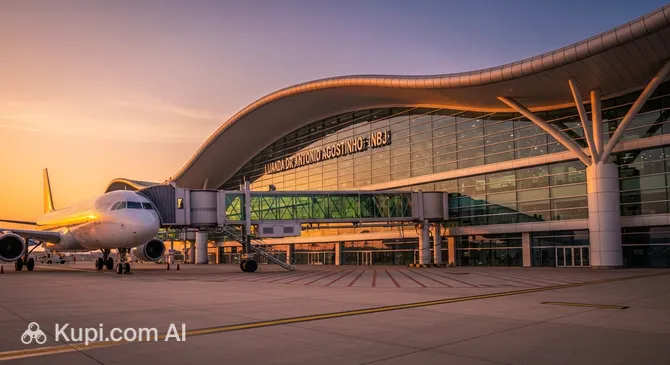
Luanda (Dr Antonio Agostinho Neto). Source: Kupi.com Binoculars

Welcome to Dr. António Agostinho Neto International Airport — the newest and most state-of-the-art gateway to Luanda and all of Angola. This ambitious project, which opened its doors to passengers in 2024, is set to become one of the key aviation hubs on the African continent. Located approximately 40 kilometres from the capital's centre, the airport features a futuristic design and is gradually replacing its predecessor, Quatro de Fevereiro, offering travellers world-class service and a completely new experience of the country. It symbolises a new era in Angola's development, opening up greater opportunities for tourism and business connections.

IATA Code NBJ
ICAO Code FNBJ
City Luanda
Distance to Centre 40 km
Status International
Annual Passengers up to 15,000,000 (design capacity)
Popular Airlines TAAG Angola Airlines, Emirates, TAP Air Portugal
Schedule online board "Luanda (Dr. António Agostinho Neto)"

Dr. António Agostinho Neto Airport stands out not only for its scale but also for its advanced facilities. It features two parallel runways measuring 4,000 and 3,800 metres, capable of accommodating the world's largest passenger aircraft, including the Airbus A380. The terminal complex, covering an area of approximately 160,000 square metres, is designed to ensure maximum passenger comfort, while the cargo terminal's capacity reaches 130,000 tonnes per year. For the convenience of travellers, a dedicated railway line has been launched connecting the airport to the centre of Luanda, significantly simplifying the journey to the city. All of this makes the new airport not just a transport facility, but a vital infrastructure element contributing to the growth and development of the entire region.

Contact Information

As Dr. António Agostinho Neto International Airport (NBJ) is new and being commissioned in phases, it is recommended to verify information through official channels and directly with airlines. Below are the key contact details and communication recommendations.

  • Official Website: Currently, the airport is managed by SGA (Sociedade Gestora de Aeroportos). Up-to-date information can be found on their corporate portal or on the official resources of the Ministry of Transport of Angola.
  • Information Desk Phone: A direct public telephone number for the new airport has not yet been published. For all enquiries regarding flight schedules, check-in, and tickets, it is strongly recommended to contact your airline directly.
  • Address: Aeroporto Internacional Dr. António Agostinho Neto, Município de Icolo e Bengo, Província de Luanda, Angola.
  • Email: For general enquiries not related to a specific flight, you may use the contact forms on the management company's website. Booking enquiries should be directed to the airline.
  • Social Media: Official social media pages for the airport may be launched at a later date. Please follow updates on Angola government portals.
  • Lost & Found Information: For all issues related to lost, delayed, or damaged baggage, you must contact your airline's Lost & Found service exclusively.
  • Passenger Support Contacts: Support regarding flights, including assistance for passengers with reduced mobility, is provided by airline representatives. General information desks are available within the airport terminals.

Getting to the Airport

Dr. António Agostinho Neto International Airport (NBJ) is the newest and main aviation hub of Luanda, located approximately 40 km southeast of the city centre. Due to the significant distance and heavy traffic characteristic of the capital of Angola, the journey to the airport can take from 1 to 2 hours, and sometimes longer. Plan your departure with plenty of extra time, especially during peak hours.

The most reliable and convenient way to reach the airport is by taxi or pre-booked transfer. Official taxis can be found throughout the city, however, it is recommended to use the services of reputable companies or book a car through your hotel. The cost of the trip will be relatively high, but this is compensated by comfort and safety. It is extremely important to agree on the price with the driver before starting the journey if the vehicle is not equipped with a taximeter. Online transfer services often offer a fixed price, which helps avoid unpleasant surprises.

The public transport system connecting the city centre with the new airport is currently under development. Although buses and shared taxis (known as "candongueiros") operate in the city, this option can be extremely inconvenient and difficult to navigate for tourists with luggage. A railway link to the airport is planned for the future, which will significantly simplify the journey. At this moment, public transport is not a recommended method for travelling to the airport.

If you are confident in your driving skills amidst intense African traffic, you can use a rental car. Offices of international and local rental companies operate at the airport and in central Luanda. The new airport is equipped with modern and spacious parking zones where you can leave a vehicle for both short and long terms. This option provides maximum flexibility but requires good preparation and navigational skills.

Terminals and Map

The new international airport of Luanda, named after Dr. António Agostinho Neto (NBJ), represents a modern and large-scale aviation complex. Its key feature is one large passenger building, which is functionally divided into two main zones, essentially serving as separate terminals: one handles international flights, and the other handles domestic flights. This integrated structure simplifies navigation and passenger movement.

The building's architecture is designed for intuitive movement. Departure zones are typically located on the upper floor and include check-in counters, security and passport control points, as well as spacious waiting lounges. Arrival zones are situated on the lower floor, where baggage claim belts and customs control are located.

Since all flights are serviced in one building, transitions between the international and domestic zones are made on foot. If you have a connecting flight, you will simply need to follow the signs inside the terminal. Please note that the building is very large, so be prepared for long walks between gates. Navigation is facilitated by numerous signs, typically in Portuguese and English.

Airport procedures are standardised. For departure, you must first check in for your flight, then pass through security screening. Passengers on international flights will also need to undergo passport control. It is recommended to allow sufficient time to complete all formalities. For international flights, it is best to arrive at the airport at least 3 hours before departure, and for domestic flights — 1.5–2 hours. This will allow you to go through all procedures without rushing, even in the event of queues.

For easy navigation through the airport, always pay attention to the information boards — they display up-to-date information on check-in counter numbers and boarding gates. Follow the signs to your gate and do not hesitate to ask airport staff for assistance if you have any questions. Thanks to the modern layout, getting lost in NBJ airport is quite difficult.

Airport History

The history of Dr. António Agostinho Neto International Airport (NBJ) is the story of one of the most ambitious and modern infrastructure projects in Angola. The decision to construct it was made to replace the old Quatro de Fevereiro Airport (LAD), which could no longer cope with the growing passenger traffic and did not meet modern requirements. The new airport was named after the first president of Angola, highlighting its national significance.

Construction began in the mid-2000s, but the project faced a number of delays and revisions. The active phase of work resumed in subsequent years, and the airport became a symbol of the country's modernisation. The opening took place in stages: in November 2023, cargo operations were launched, and in 2024, servicing of domestic passenger flights began. The full-scale launch of international flights is scheduled for a later date, marking the completion of this grand project.

NBJ Airport is designed with the future in mind and aims to become one of the largest aviation hubs on the African continent. Its design capacity is approximately 15 million passengers and 130,000 tonnes of cargo per year. The air harbour is equipped with two runways, one of which is capable of accepting the world's largest passenger aircraft, including the Airbus A380. This makes it a key element for the development of tourism and the economy not only of Luanda, but of the entire country.

Among interesting facts, it is worth noting that the airport is located approximately 40 kilometres southeast of central Luanda, which was done to ensure the possibility of further expansion. The project was implemented in cooperation with Chinese companies, making it one of the largest such facilities built outside of China. Its modern design and technological equipment are intended to ensure a high level of comfort and safety for passengers, opening a new chapter in the history of Angolan aviation.

Services and Facilities

Dr. António Agostinho Neto International Airport in Luanda (NBJ) offers passengers a wide range of services to make their stay as comfortable and convenient as possible. Before your flight or while waiting for a connection, you will be able to find everything you need right within the terminal building.

For those wishing to have a snack or do some shopping, the airport features various restaurants and cafes serving both local cuisine and familiar international snacks. In shops, including Duty Free, you can purchase souvenirs, perfumes, and other goods at attractive prices. For a comfortable wait for your flight, there are general halls and exclusive VIP lounges offering an elevated level of service, a secluded atmosphere, beverages, and snacks.

To stay connected, passengers can use free Wi-Fi throughout the terminal. Numerous charging stations with sockets and USB ports are equipped for recharging gadgets. Financial services are also available at the airport: there are bank branches, ATMs, and currency exchange points where you can easily exchange money for Angolan Kwanza.

The airport cares for all categories of travellers. For passengers with children, mother and child rooms are provided, and if necessary, you can contact the medical point for first aid. Special assistance is provided to passengers with reduced mobility, including accompaniment and adapted facilities. For business travellers, conference rooms and business centres are available, and for those needing rest between flights, several hotels are located in the immediate vicinity of the airport.

Dining

The new international airport of Luanda named after Dr. António Agostinho Neto (NBJ) is a modern aviation complex where infrastructure, including catering establishments, is in the formative stage. Consequently, detailed information about available restaurants and cafes is currently limited, and their number will increase as the airport becomes fully operational.

At the moment, passengers should plan for basic options for a snack. It is highly likely that coffee shops offering beverages and light snacks, such as sandwiches and pastries, are already operating or will open soon in the terminal. These establishments will likely be available both in the public area (landside) and in the departure area after passing security (airside).

Since the choice of dining establishments may not be extensive, travellers are recommended to eat beforehand in the city, especially if you prefer a full hot lunch or dinner. This is also an important tip for passengers with strict dietary requirements (e.g., vegan, gluten-free, or Halal options), as their availability at the airport in the initial phase is not guaranteed.

It is expected that in the future, NBJ Airport will feature many more options, including à la carte restaurants, food courts with international cuisine, and establishments where you can taste local Angolan delicacies. We advise travellers to check the current list of operating cafes and restaurants closer to their departure date.

Travel Tips

Planning a trip through Luanda airport requires a little preparation. To ensure your journey goes smoothly, follow these tips. It is recommended to arrive at the airport at least 3 hours before international flights and 2 hours before domestic ones. This will give you enough time in case of queues at check-in and security control, which can be lengthy.

To save time, many airlines offer online check-in. This will allow you to avoid one of the queues if you are travelling with hand luggage only. Have your passport and boarding pass ready when passing through security. Remember the standard rules for carrying liquids in hand luggage: containers no larger than 100 ml each, packed in a transparent bag. All electronic devices, such as laptops and tablets, will need to be removed from your bag for separate scanning.

Consider your preferences when choosing a seat on the plane. Window seats will give you the opportunity to admire the views during take-off and landing, especially if your route lies along the coast of Angola. Aisle seats are convenient for those who want to stand up freely and stretch their legs during a long flight. If you wish to save money, bring an empty reusable water bottle (it can be filled after passing security) and light snacks, as prices at the airport can be high.

Passengers connecting in Luanda should check in advance whether their luggage will be automatically transferred to the next flight. If you have separate tickets, you will likely have to collect your luggage and check in again. Ensure you have enough time between flights — allow at least 3-4 hours in case of possible delays and the need to go through all procedures again.

Upon arrival in the country, you will undergo customs control. Be prepared to fill out a declaration indicating valuable items or large amounts of cash being imported, if required by local laws. To avoid misunderstandings, it is better to familiarise yourself with Angola's customs regulations in advance. Booking a transfer from the airport beforehand often helps not only save money compared to taxis on the spot but also avoid unnecessary stress after a long flight.

In the event of a flight delay or cancellation, first and foremost, remain calm. Approach your airline's counter for up-to-date information. Depending on the length of the delay and the carrier's rules, you may be provided with vouchers for meals or even hotel accommodation. Keep all receipts for unforeseen expenses — they may be needed to claim compensation.

Airports in nearby cities

Reached the end of the page?

That means the route is fully explored