Support

Great Court

About

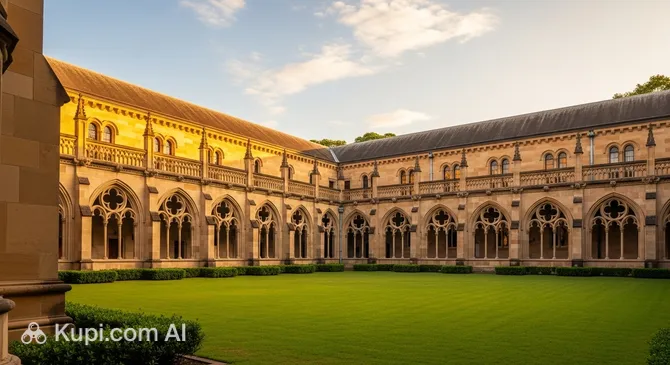
At the heart of the University of Queensland campus in St Lucia lies the Great Court—a majestic architectural ensemble that has become a true symbol of the state's academic traditions. This monumental complex, located in Brisbane, represents a harmonious blend of classical European forms and a unique Australian character. Designed in the mid-1930s, it was intended as a modern interpretation of the university quadrangles characteristic of Oxford or Cambridge.
Great Court
Great Court. Иллюстрация. Источник: Kupi.com AI

One of the most striking features of the complex is the use of multi-colored Helidon sandstone. The building walls shimmer with shades of lavender, cream, brown, and soft purple. The Great Court looks especially impressive immediately after rain, when the moisture brings out the depth and richness of the natural stone, making the facade appear visually vibrant and mottled.

The centerpiece of the ensemble is the five-story Forgan Smith building with its recognizable central tower, which serves as a landmark for all visitors. In 2002, this site—which unites the Duhig Library and several science wings under a continuous, elegant colonnade—was added to the Queensland Heritage Register, confirming its status as a vital cultural asset of which all of Australia is proud.

Contacts

To inquire about events or organize group visits, you can contact the campus administration. Below are the main contact details for the site:

How to contactContact
Address63 Mansfield Pl, St Lucia QLD 4067, Австралия
Phone+61 7 3365 1111
Websitecampuses.uq.edu.au

What to Do

The main adventure here begins with a simple stroll beneath the arches of the endless colonnade. The Great Court is a kind of open-air museum where history and culture are etched into the walls and column capitals. Be sure to look for the stone carvings: there are over 1,200 of them. Sculptor John Theodore Muller created a true stone chronicle depicting the state's flora and fauna, scenes from Indigenous life, and portraits of great thinkers—from Plato and Confucius to Shakespeare and Darwin.

For those who appreciate architectural aesthetics, it will be interesting to trace the influence of American planning principles. The design of the complex was inspired by Thomas Jefferson's "academic village" concept, where the space encourages the exchange of knowledge and quiet reflection. The spacious grassy lawns in the center of the court are the perfect place to sit and watch the lively student life while feeling part of this majestic atmosphere.

Photographers and fans of beautiful views are recommended to visit the complex in overcast weather or immediately after a downpour. It is at this time that the wet Helidon sandstone most fully reveals its unique palette, creating an incredible play of light and color on the facades of the historic buildings. This is the perfect moment to capture unique shots without harsh solar glares.

Getting There

The landmark is located in the suburb of St Lucia, approximately 7 kilometers from the Central Business District. The most convenient way to get here from the center of Brisbane is by public transport. Popular options include buses to the UQ Lakes or UQ Chancellor's Place terminals, as well as the CityCat ferry, which stops at the university wharf, offering a scenic trip along the river.

If you prefer the train, you can travel to Toowong or Park Road station and then transfer to a bus going directly to the campus. A taxi or rideshare trip from the city center will take about 15–20 minutes depending on traffic.

For those traveling by car, there are paid visitor parking zones on campus. However, please note that parking spaces can be limited during semester time, so it is recommended to check the parking map on the university's official website in advance.

Ближайший город: Brisbane

History & Facts

The history of this monumental complex began in 1937, when Queensland Premier William Forgan Smith laid the foundation stone of the building that would later bear his name. The project was one of the government's largest initiatives at the time, designed not only to create an academic hub but also to provide jobs for the state's residents during the Great Depression.

Interestingly, the construction and decoration of the ensemble spanned several decades. Although the main work began in the late 1930s, the final section of the colonnade that enclosed the courtyard was not completed until 1975. The land for the St Lucia campus was acquired thanks to a generous donation from Dr. James O'Neil Mayne and his sister Mary Emelia Mayne, whose contribution is forever inscribed in the university's history.

During World War II, the Great Court traded academic silence for military discipline. From 1942 to 1945, the Forgan Smith Building served as the Advanced Land Forces Headquarters, playing a critical role in coordinating military operations in the region. Today, only the solemn grandeur of the architecture remains to remind us of those times, having returned to its original educational mission.

Time Needed

To leisurely explore the Great Court, study the intricate carvings on the columns, and soak up the campus atmosphere, most tourists need about 1 to 2 hours. This is enough time for a relaxed stroll around the perimeter and a visit to the central lawn.

If you plan to visit the university museums or libraries located within the complex buildings, or if you want to have a small picnic on the grass, it is worth setting aside about half a day. In sunny weather, the sandstone architecture looks particularly striking, inviting a longer stay.

Working Hours

The Great Court is an open public space within the university grounds, so it is accessible for viewing 24 hours a day, 7 days a week. You can walk here early in the morning or in the evening hours when the buildings are illuminated.

Nevertheless, if you wish to visit the university museums or libraries located within the complex, it is recommended to check their operating hours on the official university website, as they have their own visiting hours distinct from the general access to the courtyard.

Круглосуточно

Nearby

A walk through the university grounds is just the beginning of your exploration of the area. The surroundings of St Lucia and the adjacent areas along the Brisbane River offer many opportunities for relaxation, sports, and cultural enrichment.

You can visit nearby parks, sports clubs, or head closer to the city center to see the main administrative and entertainment sites of the state capital. Below is a list of interesting places located nearby:

NameDistance
West End Markets2.3 km
Streets Beach2.4 km
The Wheel of Brisbane2.6 km
Queensland Performing Arts Centre2.7 km
Brisbane Sign2.8 km
Kangaroo Point Cliffs Park3 km
Gallery of Modern Art3.1 km

Reached the end of the page?

That means the route is fully explored