Support

Barimunya

About the Airport

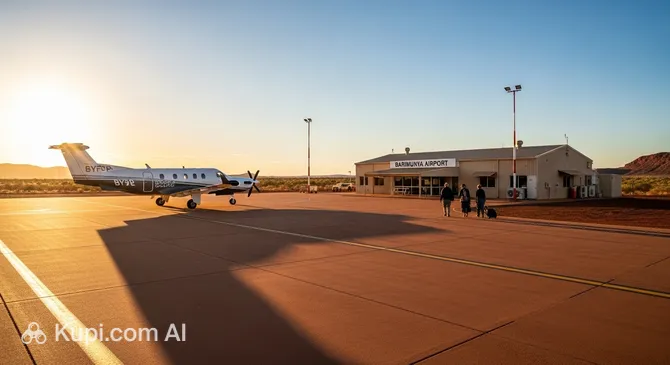
Barimunya. Source: Kupi.com Binoculars
Imagine a runway laid right in the middle of the endless red sands of Western Australia, where the hot air shimmers above the horizon and the silence is broken only by the roar of turbines. Barimunya Airport is not a typical tourist gateway with shops and bustle, but a rugged and vital industrial hub, serving as the sole link to the outside world for thousands of workers at one of the continent's largest mines. Here, in the heart of the Pilbara region, aviation meets heavy industry, creating a unique atmosphere of austerity, precision, and the power of human labour against the backdrop of wild nature.
IATA Code BYP
ICAO Code YBRY
City Yandicoogina
Distance to centre ~10 km (to the accommodation village)
Status Private (corporate)
Annual Passengers Data confidential (personnel only)
Schedule Closed schedule (charter flights)

Features and advantages of Barimunya Airport:

Exclusive access and no queues. The main advantage of Barimunya is its closed status. The airport exclusively serves charter flights (Fly-In Fly-Out systems) organised by the mining company. This means there are no random passengers, crowds of tourists, or long checks. All processes, from baggage unloading to boarding the bus, are streamlined to automation so that workers can reach their place of rest or shift as quickly as possible.

Strategic location in the heart of the Pilbara. The airfield is located in immediate proximity to the Yandicoogina mine, which eliminates the need for multi-hour journeys across the desert from major civil airports (the nearest town, Newman, is located more than 100 km away). This saves the energy and time of the staff, making logistics maximally efficient in the region's harsh climatic conditions.

High safety standards. Being part of the infrastructure of the global giant BHP, Barimunya Airport adheres to the strictest corporate safety standards. The runway is capable of accommodating modern jet liners (such as the Fokker 100 or Boeing 737), and the maintenance of ground vehicles and navigation equipment is conducted at the level of the best international airports, despite the remoteness from civilisation.

Contact Information

Finding direct contact details for small regional airports like Barimunya (BYP) can be difficult. Often, the main support and information for passengers are provided by the airlines operating flights to this airport. Here are general recommendations for finding the necessary information:

  • Official Website: Small airports typically do not have their own website. The most up-to-date information on flight status and services is best sought on the official websites of the airlines.
  • Help Desk Phone: For information about flights, schedules, and airport operations, it is best to contact your airline directly. A public help desk phone number for Barimunya Airport is generally not listed in open sources.
  • Address: Barimunya Airport (BYP) is located near the settlement of Yandicoogina, Pilbara region, Western Australia.
  • Email: A direct email address for contacting the airport administration is usually not published. For all questions related to the flight, it is recommended to use the communication channels of your air carrier.
  • Social Media: It is unlikely that Barimunya Airport maintains official pages on social media. Follow news and updates on your airline's pages.
  • Lost Luggage Information: In case of loss or damage to luggage, you must immediately contact the representative office or the Lost & Found service of your airline. It is the carrier that bears responsibility for the checked belongings of passengers.
  • Passenger Support Contacts: For all inquiries, including ticket changes, special services on board, and flight information, you should contact the support service of the airline you are flying with.

How to Get to the Airport

Barimunya Airport (BYP) primarily serves the industrial area of Yandicoogina, so the ways to get to it have their own specifics, oriented towards workers and business trips. When planning your route, it is important to consider the remoteness and features of this region of Australia.

Public Transport

Due to its industrial purpose and remote location, regular city buses, trains, or metro services do not run to Barimunya Airport. Public transport in the usual sense is absent here. Movement is carried out mainly via corporate or private transport.

Taxi and Transfer

Standard taxi services that can be called by phone or found at a stand are not common in this area. The main way to get to the airport is a pre-booked transfer. As a rule, such transport is organised by companies working in the region for their employees. If you are arriving for work, be sure to check the transfer organisation details with your employer. The cost of such a trip is usually included in the corporate package.

Car Rental

Renting a car directly at the small Barimunya Airport will likely not be possible. The nearest rental points are located in larger towns, for example, in Newman, which is about 105 km away. Travellers often fly into Newman Airport, rent a four-wheel-drive vehicle there, and drive to Yandicoogina. This option requires preparation for driving in Australian outback conditions.

Parking and Travel Time

The airport has a small car park intended for both short-term and long-term parking. It is used mainly by personnel working on a shift basis. Considering that the "city centre" is essentially the industrial facility itself, the drive from the residential camp or offices to the terminal takes only 5–15 minutes. It is a short and direct journey.

Key Recommendations

The most important advice for travellers heading to Barimunya Airport is to coordinate all transport matters with the hosting party or your employer in advance. Independent travel without prior arrangement can be extremely difficult. Ensure you have a clear plan and a confirmed transfer to or from the airport.

Terminals and Map

Barimunya Airport (BYP) is a compact and highly specialised aviation hub. It operates one terminal, which primarily serves charter and private flights related to the activities of local industrial enterprises. Its structure is simplified to the maximum for the quick and efficient processing of passengers arriving or departing for work purposes.

The terminal layout is extremely simple and intuitive. It is a single-storey building where all main zones—check-in, security screening, waiting, and baggage claim—are located in immediate proximity to each other. Thanks to the compact size, there are no long walkways or needs for shuttles here, and navigation causes no difficulties. It is practically impossible to get lost.

Departure and arrival zones are located in the same building and are clearly demarcated. After entering, passengers immediately proceed to the check-in counters. Pre-flight control procedures usually take a minimal amount of time due to the small passenger flow and limited number of flights. This significantly distinguishes it from major international airports with their long queues.

The main recommendation for passengers is to follow their airline's instructions regarding arrival time. All necessary infrastructure is located in one place, so orienting yourself is very easy. It is worth noting that the terminal is focused on functionality, not entertainment: there is a basic waiting lounge, but shops, restaurants, and other services characteristic of large airports are absent.

Airport History

The history of Barimunya Airport (BYP) is closely intertwined with the development of the mining industry in the Pilbara region, Western Australia. The airport was founded and opened in the late 1990s not as a public transport hub, but as a specialised facility to serve the large Yandicoogina iron ore mine owned by BHP.

The main stage of the airport's development coincided with a period of active growth in production at the mine. Its main task from the very beginning was to support the fly-in fly-out (FIFO) logistics model. This system allows for the transport of thousands of workers for shifts from major cities, such as Perth, to remote industrial zones. Therefore, the entire history of Barimunya's modernisation is a systematic improvement of infrastructure for the safe reception of aircraft and comfortable service for personnel.

There are no loud passenger traffic records or events of global scale in the history of this airport. Its main achievement is decades of stable and accident-free operation, which ensures the functioning of one of the country's key industrial facilities. An interesting fact is that Barimunya is a vivid example of how aviation becomes a vital bridge connecting industrial centres with remote and inaccessible territories, making their economic exploitation possible.

Services and Amenities

Barimunya Airport (BYP) is a small regional airport serving mainly industrial needs, so the range of services for passengers is basic and corresponds to its size. Travellers should plan their needs in advance, as the terminal infrastructure is limited.

In the airport building, you will find a main waiting area. Opportunities for dining and shopping here are minimal. Typically, they are limited to vending machines with drinks and snacks. There are no specialised restaurants, cafes, or duty-free shops at Barimunya Airport. Separate VIP lounges or enhanced comfort waiting rooms are also absent.

For passenger convenience, basic services such as free Wi-Fi and charging stations for electronic devices may be available in the terminal. However, one should be prepared for the connection speed and number of sockets to be limited. There are no bank branches or currency exchange points at the airport, so all financial matters are recommended to be settled beforehand.

In case of necessity, a first aid point is provided at the airport. For passengers with children, basic amenities such as a mother and child room may be available. The airport is equipped to serve passengers with reduced mobility, including ramps and specially equipped restrooms, ensuring barrier-free access to main zones.

There are no specialised hotels on the territory of Barimunya Airport. Travellers needing overnight accommodation should look for options in the nearest settlements. Business centre services or conference rooms are not provided at the airport.

Where to Eat

When planning a trip through Barimunya Airport (BYP), it is important to consider its specifics. It is a small airfield serving primarily charter and private flights related to industrial activity in the region. In this regard, the infrastructure for passengers, including food outlets, is minimal here and not comparable to major commercial airports.

At Barimunya Airport, you are unlikely to find full-service restaurants or cafes. There is no separation into airside/landside zones with various establishments. Opportunities for a snack are usually limited to vending machines with drinks and packaged snacks (crisps, chocolate, biscuits). Sometimes a small kiosk with a very basic assortment may operate.

Given the limited choice, it is strongly recommended to bring food and drinks with you. Sandwiches, fruits, nuts, and a bottle of water will be the best solution to wait for your flight comfortably. This is especially important for passengers requiring special diets (Halal, vegetarian, gluten-free, etc.), as finding such options on-site is practically impossible.

Thus, for a full lunch or even a quick but filling snack, it is worth preparing in advance. Do not count on the presence of establishments with hot meals or a diverse menu. Your trip will be significantly calmer if you prudently take care of provisions before arriving at the airport.

Traveller Tips

To ensure your journey through Barimunya Airport goes smoothly, it is important to understand its specifics. It is not a standard commercial airport, but a private airfield serving primarily charter flights for shift workers (FIFO) heading to industrial facilities in the Yandicoogina area. Preparation considering these features is the key to a calm trip.

Coordination with the employer. All information about your flight—departure time, baggage allowances, check-in procedure—is provided by your company. Definitely follow the instructions received from the travel coordinator. Arrive at the airport at the time specified by the employer, as the entire process is calculated for an organised group of passengers.

Check-in and Screening. The check-in process for a charter flight is usually simplified to the maximum and may essentially be a verification against lists. Security control is conducted according to standard rules but, as a rule, passes very quickly due to the small number of passengers. Nevertheless, do not forget about the ban on carrying sharp objects and other dangerous substances in hand luggage.

Absence of standard services. Please note that at Barimunya Airport there are no shops, cafes, or vending machines with substantial food. All necessary infrastructure is minimal. It is strongly recommended to take a sufficient amount of water and a snack with you for the waiting time and flight. Download films, music, or books to your devices in advance to pass the time while waiting.

In case of flight delay. If the schedule changes or the flight is cancelled, your main contact person is the representative of your company, not the airport staff. It is the employer who will provide information about the new departure time or alternative options. Keep the contacts of your coordinator or manager at hand.

Reached the end of the page?

That means the route is fully explored