Support

Koodaideri Mine (Gudai-Darri Mine) Airport

Airports in the city

About the Airport

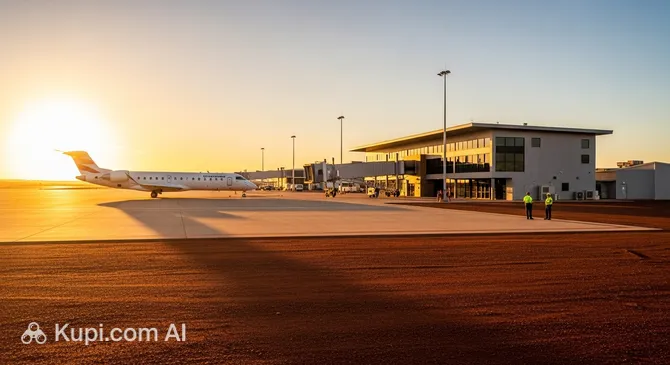
Koodaideri Mine (Gudai-Darri Mine) Airport. Source: Kupi.com Binoculars

Welcome to Koodaideri Mine (Gudai-Darri Mine) Airport, which serves as the aerial gateway to one of Australia's most technologically advanced mining projects. Located amidst the endless red sands of the Pilbara region, this modern airfield is a vital artery connecting the remote mine with the continent's major cities. For thousands of specialists working on a rotational basis, their shift begins here, and it is here that it ends with a long-awaited return home. The airport embodies a blend of the rugged beauty of the Outback and advanced engineering solutions, ensuring the uninterrupted operation of this industrial giant.

IATA Code OOD
ICAO Code YKDD
City/Location Yandicoogina (mine territory)
Distance to Centre 0 km (located directly at the accommodation village)
Status Domestic / Private (FIFO)
Annual Passengers Closed corporate statistics (serves employees only)
Schedule Closed (corporate charters)

Features and Advantages of the Airport

Koodaideri Mine Airport (OOD) is unique in that it was designed and built from scratch as part of the Gudai-Darri "mine of the future". This influences its entire operation, making it one of the most efficient private aviation hubs in the country.

  • Modern Infrastructure: As the airport was commissioned very recently (in the early 2020s), its terminal and runway, capable of accommodating jet liners such as the Boeing 737 and Airbus A320, are in pristine condition and meet the latest aviation safety standards.
  • Maximum Integration: Logistics are thought out to the smallest detail. The distance from the aircraft steps to the bus and onwards to the residential campus or workplace is minimal. This allows employees to save energy and time, avoiding the long transfers characteristic of older mining sites.
  • High Safety Standards: As a Rio Tinto facility, the airport operates under the strictest safety protocols, which often exceed generally accepted norms in civil aviation.
  • Technological Advancement: The airfield is part of the mine's digital ecosystem, where automation and autonomous systems are widely used, making it a showcase of Australia's advanced industrial technologies.

Contact Information

It is important to note that Koodaideri Mine (Gudai-Darri Mine) Airport (OOD) is a private airfield serving the mine of the same name. Consequently, most standard contact details typical of commercial airports are not publicly available, as the airport is intended for corporate use.

  • Official Airport Website: There is no separate public website for this airfield. All information is usually distributed through the internal corporate channels of the operating company.
  • Help Desk Phone: A public telephone number for enquiries is not provided. Communication for authorised personnel is conducted via corporate lines.
  • Airport Address: The airport is located in the Pilbara region, Western Australia, and is tied to the location of the Gudai-Darri mine. An exact postal address for general use is not published.
  • Email: There is no public email address for general enquiries.
  • Airport Social Media: Private industrial airfields typically do not maintain public pages on social media platforms.
  • Lost Luggage Information: Issues regarding lost luggage are resolved directly between the passenger (employee) and the airline operating the charter flight, or through the enterprise's internal services.
  • Passenger Support Contacts: Passenger support is organised at the internal level of the company operating the mine and is not a public service.

How to Get to the Airport

Koodaideri Mine (Gudai-Darri Mine) Airport serves the mine of the same name in the remote Pilbara region of Australia. It is not a typical tourist airport, but rather a functional transport hub for Fly-in Fly-out (FIFO) workers. Consequently, options for getting there from the nominal "centre" of Yandicoogina (which is itself an industrial zone rather than a town) have their own specificities.

Public Transport

In the conventional sense (regular buses, trains, or metro), public transport to Koodaideri Mine Airport is non-existent. Transport is primarily organised by the mining companies themselves for their employees. If your trip is not related to work at the mine, do not rely on this mode of transport.

Taxi, Transfers, and Car Rental

Standard taxi services do not operate here. The only reliable option is a pre-booked private transfer. Such services are provided by specialised companies working in the Pilbara region, but their cost can be quite high due to the vast distances and the nature of the terrain. It is crucial to arrange a transfer well in advance of your trip.

Car Rental is the most practical method for independent travellers. However, you will need to rent a vehicle in larger settlements such as Newman or Port Hedland. Given the road conditions in the Outback, it is recommended to choose a four-wheel drive (4WD) vehicle. The drive from Newman (about 125-140 km) will take approximately 1.5-2 hours. Always check fuel levels, water supplies, and the vehicle's condition before setting off.

Parking and General Recommendations

Parking at Koodaideri Mine Airport is likely limited and designated for service vehicles and personnel cars. Opportunities for long-term tourist parking may be unavailable. Before travelling, be sure to clarify all details regarding access and transport with the hosting party or the company associated with your visit. This airport is not designed for independent tourists, and all logistics require careful preliminary planning.

Terminals and Map

Koodaideri Mine (Gudai-Darri Mine) Airport is a small private airfield serving primarily charter flights for workers of the eponymous mine. Its structure differs significantly from large commercial airports, focusing on functionality and speed of service.

The airport operates one small terminal, which is a modern yet compact building. Its main purpose is to service passengers arriving and departing as part of work (fly-in fly-out) shifts. There is no separation into international and domestic flights, as the airport is intended exclusively for official purposes.

The terminal layout is maximally simple and intuitive. Departure and arrival zones are located in the same building and in immediate proximity to each other. After disembarking the aircraft, passengers immediately enter the arrival zone, from where transport takes them to their workplace or accommodation. The departure zone includes check-in counters (if required for a specific flight) and a small waiting lounge. Naturally, there are no transfers between terminals.

Check-in and security screening procedures proceed very quickly, as the passenger flow is low and consists of employees listed on pre-approved manifests. The entire process from entering the terminal to boarding the aircraft usually takes minimal time. Nevertheless, it is always worth following the instructions provided by the air carrier or employer.

The main recommendation regarding navigation is not to worry. It is practically impossible to get lost in this compact terminal. All key areas — the entrance, waiting lounge, and boarding gate — are within sight, making the time spent at the airport comfortable and free from the stress typical of large aviation hubs.

Airport History

The history of Koodaideri Mine Airport (OOD) is inextricably linked with one of the most modern and technologically advanced mining projects in Australia — the Gudai-Darri iron ore mine. Unlike airports with a multi-year history, this is a young and purely functional facility whose history is being written right now.

The airport was designed and built as a key infrastructure element to service the mine owned by Rio Tinto. Its main task is ensuring the rotation of personnel via the Fly-in Fly-out (FIFO) principle, transporting thousands of workers to their shifts and back. The construction and opening of the airport took place in the early 2020s, synchronised with the launch of the mine itself. Therefore, it is too early to speak of developmental milestones in the classical sense — it was built to the most modern standards from the outset.

The main "historical event" for the airport was its launch, which enabled the full-scale operation of one of the largest new mines in the Pilbara region. The runway was designed to accept medium-haul jet aircraft, such as the Boeing 737 and Airbus A320, which is a significant achievement for a private airfield in such a remote location.

An interesting fact is that Koodaideri Mine Airport is not just a runway, but a vital artery ensuring the functioning of the "smart" mine of the future. It serves as a prime example of how modern logistics and aviation make the realisation of ambitious industrial projects possible in the harsh and sparsely populated regions of the planet.

Services and Facilities

Koodaideri Mine (Gudai-Darri Mine) Airport (OOD) is a private airfield serving the Rio Tinto mining complex of the same name in the Pilbara region, Western Australia. Its primary purpose is to ensure personnel rotation based on the fly-in fly-out (FIFO) principle. Consequently, the range of services at the airport differs significantly from those offered at commercial passenger terminals and is oriented towards the needs of workers rather than tourists.

Restaurants, Shops, and Lounges. There are no restaurants, cafes, or Duty-Free shops at the airport. A functional and modern waiting lounge is equipped for passengers for a comfortable, though brief, stay before departure. Vending machines with snacks and drinks may occasionally be installed. There are no VIP lounges or business lounges.

Connectivity and Technical Amenities. Facilities for charging electronic devices are generally available in the waiting lounge. However, access to public Wi-Fi is likely to be limited or non-existent, as the network infrastructure is intended for official use.

Financial and Medical Services. There are no bank branches, ATMs, or currency exchange points at the airport. For emergency cases, medical posts capable of providing first aid are available on the territory of the industrial facility served by the airport.

Special Services and Accommodation. The airport is not designed to accommodate passengers with children, so there are no playrooms or mother-and-child rooms. Basic accessibility is ensured for passengers with disabilities, but the air carrier or employer should be informed in advance about the need for special assistance. There are no hotels in the traditional sense at the airport or its vicinity; personnel accommodation is provided in the residential complex at the mine. Conference halls or business centres for general use are also absent.

Where to Eat

Koodaideri Mine Airport (OOD), also known as Gudai-Darri Mine, is a private airfield primarily serving the staff of the eponymous mining enterprise. Due to its specific nature, one should not expect the variety of restaurants and cafes typical of large commercial airports. The infrastructure is focused on functionality and rapid service for charter flight passengers.

Passengers departing from this airport should note that dining options here are extremely limited. Typically, full-service restaurants, bars, or chain coffee shops are absent from such facilities. The most one can count on are vending machines with drinks (water, soda) and light snacks (crisps, chocolate bars, biscuits). Sometimes there may be a small buffet or kiosk operating immediately before departure or upon flight arrival.

In view of this, finding specialised meals, such as vegetarian, vegan, gluten-free, or Halal options, is practically impossible. Travellers with specific dietary requirements are strongly advised to bring food with them. When planning a trip through Koodaideri Mine Airport, the best solution is to have a full meal beforehand or stock up on your own snacks and drinks for the waiting period.

Traveller Tips

Flying to Koodaideri Mine Airport is not a tourist trip, but an integral part of working on a rotational (FIFO) basis. It is a private airfield serving exclusively corporate charters for mine employees. To ensure your trip to the site and back is as efficient as possible, familiarise yourself with these tips, compiled with the specifics of such flights in mind.

Trip Coordination. Forget standard commercial airline rules. All information regarding departure time, meeting points, check-in procedures, and baggage allowance will be provided directly by your employer or the chartering company. Your main task is to strictly follow these instructions.

Check-in and Security. The check-in process for charter flights is centralised and managed by the company. You will require identification and possibly a site pass. Security screening procedures are standard; however, remember that you are heading to a secure industrial facility with its own internal regulations.

Baggage and Hand Luggage Rules. Baggage allowances are set by your company and are generally very strict. Usually, one bag with personal items and workwear of a limited weight is permitted. It is strongly recommended to clarify permissible dimensions and weight, as well as the list of prohibited items, in advance. Please note that transporting alcohol onto the mine territory may be strictly prohibited.

Quarantine Control. Despite this being a domestic flight, strict biosecurity rules apply in Australia. It is forbidden to transport fresh fruit, vegetables, plants, and certain food products between states. Do not take such products with you to avoid fines and confiscation.

Arrival in Yandicoogina. Koodaideri Mine Airport is a private airstrip. There are absolutely no public services here: no taxis, car rental counters, or public transport. Upon arrival, you will be met by a staff bus that will transport the entire shift directly to the accommodation or work site.

In Case of Flight Delay. If your charter is delayed or cancelled, all information and instructions will come from your company representative. It is the employer who is responsible for organising waiting time, providing meals, or accommodation in case of long delays. Having a book, a charged power bank, and headphones with you is always a good idea.

Personal Items and Comfort. There are no shops or cafes at the airport or on board the aircraft. Bring an empty water bottle that can be filled in the departure terminal after security, as well as light snacks. Since the flight is part of the working day, seat selection is generally not available — seating may be free or pre-assigned.

Reached the end of the page?

That means the route is fully explored