Support

Qal'at al-Bahrain (Bahrain Fort)

About

Qal'at al-Bahrain, which translates from Arabic as "Fort of Bahrain," "Fort of the Two Seas," or "Fort of the Two Rivers," is an outstanding archaeological monument. This unique site is located on the country's northern coast, just 5.5 kilometers west of Manama, in the cozy village of Karbabad. This place is a true gem for lovers of history and ancient civilizations.
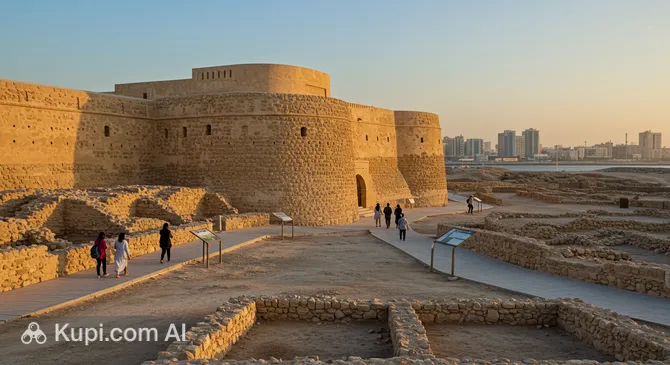
Qal'at al-Bahrain (Bahrain Fort). Illustration.
Source: Kupi.com AI

Traveler photos:

Essentially, Qal'at al-Bahrain is an artificial mound, or tell, that formed over thousands of years. It consists of many cultural layers testifying to continuous human presence at this site from approximately 2300 BC until the 16th century AD. Imagine nearly 4,000 years of history concentrated in one place, with each layer telling its own unique story!

The upper layers of the mound hold the remains of urban developments dating back to the island's Islamic period. However, the most impressive and well-preserved part of the complex is the imposing Portuguese fortress, which gave its name to the entire site. Due to its immense historical and cultural value, Qal'at al-Bahrain (Bahrain Fort) was rightfully included in the UNESCO World Heritage list in 2005, highlighting its global significance.

Contacts

Qal'at al-Bahrain (Bahrain Fort) is primarily a significant archaeological and historical monument, so specific contact details such as a phone number or email for general inquiries may not be available. You can reach the fort from Manama; it is located approximately 5.5 kilometers west of the capital in the village of Karbabad. For the latest information on visiting hours, possible tours, or other details, we recommend contacting the official Bahrain tourism portals or on-site information centers.

How to contactContact
Address892 3618, Karbabad, Bahrain
Phone number+973 1756 7171

What to Do

Visiting Qal'at al-Bahrain (Bahrain Fort) is a unique opportunity to literally touch centuries of history. You can explore the area where approximately one-quarter of the ancient city has been excavated to date, and see the ruins of residential, commercial, defensive, public, and religious structures. Walking through this archaeological complex, visitors can trace the succession of seven cultural layers left by ancient civilizations, including the Sumerians, Kassites, Ancient Greeks, Persians, and Portuguese, each of whom contributed to the appearance of this place.

One of the main attractions definitely worth seeing is the impressive 16th-century Portuguese fortress. Its massive bastions, built in the so-called "Genoese style," are perfectly preserved and allow you to imagine the defensive power of the structure. Exploring the fortress itself and its interior rooms provides a vivid insight into the later history of this strategically important location.

In addition to touring the ancient ruins and the fort, visitors can delve into the rich archaeological heritage, particularly associated with the Dilmun civilization, previously known mainly from Sumerian written sources. The exhibition accompanying the archaeological site features a variety of artifacts: ancient inscriptions, coins, and exquisite jewelry, including pieces made from precious metals. Of particular interest are imported items such as vessels from Mesopotamia, Iran, the Mediterranean, and even China, as well as "Harappan" style stone seals, which testify to the region's ancient trade links.

Getting There

Getting to Qal'at al-Bahrain (Bahrain Fort) is quite straightforward, especially if you are planning a trip from the capital of Bahrain, Manama. The fort is strategically located on the island's northern coast, just 5.5 kilometers west of Manama, in the small village of Karbabad. This proximity makes it easily accessible for a day trip.

The most comfortable and fastest ways to get from Manama to Qal'at al-Bahrain (Bahrain Fort) are by taxi or rental car. A taxi ride from central Manama to the fort takes about 15-20 minutes, though this may vary depending on traffic conditions. If you prefer more independence and flexibility in your itinerary, renting a car is an excellent choice, allowing you to explore other interesting nearby sites at your own pace.

Regarding public transport, although it exists in Bahrain, its network and frequency might not be the most convenient for tourists wanting to visit specific attractions outside the city center. Therefore, most travelers prefer taxis or car rentals for a trip to Qal'at al-Bahrain (Bahrain Fort) as more predictable and efficient options.

Nearest city: Manama

History & Facts

The history of Qal'at al-Bahrain (Bahrain Fort) is rooted in antiquity, spanning over 4,000 years. The earliest discovered layers represent an urban settlement dating back to around 2300 BC. Scholars have identified this site as the capital of the ancient Dilmun civilization, which the Sumerians considered sacred. Large-scale archaeological excavations that revealed the secrets of this site began in 1954 by a Danish expedition led by Geoffrey Bibby.

During the research, archaeologists identified seven successive cultural layers left by various civilizations, indicating continuous habitation of the area. Qal'at al-Bahrain (Bahrain Fort) served not only as a capital but also as the most important port of the Dilmun state for centuries. Its significance persisted through the early Islamic period, confirming the strategic importance of this site over millennia.

The most prominent part of the modern complex is the impressive fortress. Although its history began with the construction of a new fortification southwest of the ancient city in the early 15th century, it acquired its current appearance in 1586. It was then that the Portuguese, who had captured the island, significantly renovated and strengthened the fort, adding characteristic bastions in the so-called "Genoese style." This Portuguese fortress is the structure that attracts visitors today and dominates the archaeological landscape.

Archaeological investigations at Qal'at al-Bahrain (Bahrain Fort) continued for many years. In addition to the Danish expedition of Geoffrey Bibby and P.V. Glob, who worked here from 1955–1970 and in 1978, French archaeologists led by M. Kervran and P. Lombard joined the research in 1977. Thanks to their meticulous work, a wealth of archaeological material was discovered, significantly expanding our understanding of the history and culture of the ancient civilizations that inhabited Bahrain.

Time Needed

To fully enjoy Qal'at al-Bahrain (Bahrain Fort) and immerse yourself in its centuries-old history, it is recommended to set aside 2 to 3 hours for your visit. This time is usually sufficient to leisurely explore the impressive surviving parts of the fortress itself, walk through the archaeological site where the ancient capital of Dilmun once bustled with life, and view the exhibition of artifacts found here.

If you plan to use the services of a guide who can share deeper knowledge and interesting details about the history and significance of this place, your visit might take longer. In that case, expect to spend about 4 hours to study all aspects of this unique UNESCO World Heritage site without rushing. Remember that Qal'at al-Bahrain (Bahrain Fort) is not just ancient stones, but an entire book of history that requires time and attention to read.

Working Hours

Qal'at al-Bahrain (Bahrain Fort) is usually open to visitors year-round; however, exact opening hours may vary depending on the season and day of the week. Generally, archaeological sites and museums of this type operate during daylight hours. To get the most up-to-date information on visiting hours, ticket prices, and whether advance booking is necessary, it is highly recommended to check the official website of the Bahrain Authority for Culture and Antiquities or contact local tourist information centers before your trip to Manama.

Sometimes, for visiting major tourist sites, especially during peak seasons, it may be necessary to purchase tickets online in advance or book a tour. Checking this beforehand will help you plan your visit and avoid potential inconveniences. It is also worth considering that during the summer months, opening hours may be adjusted due to high temperatures.

8:00 – 20:00

Nearby

After immersing yourself in the centuries-old history of Qal'at al-Bahrain (Bahrain Fort), your journey through Manama can become even more fulfilling if you take the time to explore the surroundings. Near this iconic site, there are many other interesting attractions that can offer new experiences and a deeper introduction to the culture and modern life of Bahrain.

Exploring nearby sights will give you a more complete picture of Manama, allowing you to see the contrast between antiquity and modernity, and find something of interest for every taste—from bustling shopping centers to tranquil parks and unique cultural sites. Below is a list of some places located near Qal'at al-Bahrain (Bahrain Fort) that may interest you.

NameDistance
Trader Vic's2.3 km
Tasneem Zoo2.5 km
City Centre Bahrain3.3 km
Bagh Restaurant & Café3.9 km
Al Khamis Mosque4 km
Jumpup Trampoline Park5 km
Kids Kingdom5.1 km

Have you reached the end of the page?

So the route has been studied inside and out