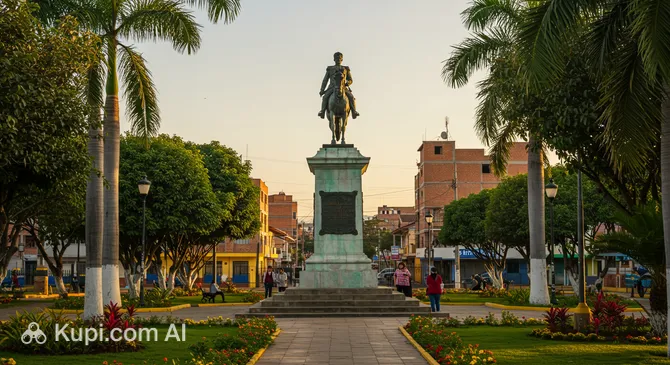
In the heart of Cobija, located in the north of the amazing country of Bolivia, lies a significant historical site — the Monument to General José Manuel Pando. This is a classic monument dedicated to one of the most influential military and political leaders in the nation's history.
General José Manuel Pando Monument. Illustration.
Source: Kupi.com AI
Traveler photos:
The sculpture presents a majestic depiction of General Pando, who not only led the country as president but also made an invaluable contribution to the development of this tropical region. The monument is considered one of the city's main landmarks and serves as a point of attraction for everyone wishing to touch the country's heroic past.
Situated in a public space, the monument is not just a tourist spot but also an important symbol of regional identity. It is worth visiting to appreciate the craftsmanship of the sculptors and feel the spirit of history in this remote corner of the Amazon, right on the border with Brazil.
Contacts
For those planning to visit this historical site in Cobija, the following contact information will be useful.
When visiting the monument in Cobija, guests have an excellent opportunity for a relaxed and informative leisure experience. The first thing to do is to examine the statue in detail and study the memorial plaques, which tell the story of José Manuel Pando's life. This will help you better understand why he is so revered in this region.
Photography enthusiasts will find great angles here: the monument looks striking against the backdrop of local vegetation and the cityscape. After exploring, you can simply relax on a nearby bench and watch the steady rhythm of local life. This place is perfect for a short break during a busy sightseeing day.
A walk near the monument can easily be complemented by getting to know the local flavor. The Acre River flows very close by, and on the neighboring streets, you can stop by cozy cafes to try traditional Bolivian salteñas. This comprehensive approach will allow you not only to see the monument but also to fully immerse yourself in the atmosphere of the country's northernmost department.
Getting There
Getting to the monument in Cobija is easy, as it is located within the city limits. The most comfortable way is to take a taxi or go for a leisurely walk on foot if you are staying in the central part of the department's capital.
For travelers arriving by air, the Captain Av. Selin Zeituna Airport will serve as a landmark. It is located about 10–15 kilometers from the monument, and a car ride from there will take about 20–30 minutes. A cross-border trip from neighboring Rio Branco in Brazil is also possible, with international transport running from there.
Due to the tropical climate of the region, many tourists prefer renting a car or taking a taxi to move around the city with maximum comfort. For precise navigation, it is recommended to use the coordinates -11.0298841, -68.7716895.
Nearest city: Cobija
History & Facts
The figure of José Manuel Pando holds a special place in the annals of Bolivia. This prominent military and political figure, who lived at the turn of the 19th and 20th centuries, served as the country's president from 1899 to 1904. He entered history as an energetic reformer who sought to strengthen national unity and develop the country's transport network.
Interestingly, the entire department, of which Cobija is the capital, is named after this general. This emphasizes the immense scale of his personality for regional development. The monument serves not just as a city ornament but as an important symbol of recognition for a national hero's achievements.
The monument recalls the times when the foundations of modern Bolivian statehood were being laid. Although the exact date of the sculpture's installation is not widely publicized, it has long been an integral part of the cultural heritage of the country's north.
Time Needed
For a regular viewing of this attraction, 30 to 60 minutes is quite enough. This time is sufficient to slowly examine the details of the sculpture, take commemorative photos, and read the information plaques.
If you are a true history buff and plan to combine your visit with studying the surrounding context or strolling through the adjacent streets, allow about 1.5 hours for your visit. The place invites quiet contemplation and a bit of rest in the shade.
Working Hours
Since the monument is located in an open public space, you can view it at any time. However, according to official data, the surrounding area and information services operate on the following schedule:
From Monday to Saturday, visits are possible from 08:00 to 19:30. On Sunday, opening hours are reduced — the site is open from 08:00 to 13:00. It is recommended to check official tourist resources before your trip, as schedules may change on holidays.
Day
Working hours
Monday
08:00–19:30
Tuesday
08:00–19:30
Wednesday
08:00–19:30
Thursday
08:00–19:30
Friday
08:00–19:30
Saturday
08:00–19:30
Sunday
08:00–13:00
Nearby
Exploring the monument's surroundings will allow you to deeper experience the atmosphere of this border city and get to know its daily life. There are several interesting places nearby where you can relax or have a bite after seeing the monument.