Support

Garanhuns

About the Airport

Garanhuns. Source: Kupi.com Binoculars

Aeroporto de Garanhuns is the compact air gateway to the "Brazilian Switzerland", as the city of Garanhuns is often called due to its cool climate and European architecture. The airport plays a key role for the region, especially during the famous Winter Festival, when tourists flock here from all over the country. Despite its modest size, the air hub has undergone significant modernisation to ensure a comfortable connection with the coast of Pernambuco and the state capital.

For travellers, this airport is convenient primarily due to its location: it is situated practically within the city limits, allowing you to reach your hotel or local attractions in a matter of minutes. There is no hustle and bustle of giant hubs here, making arrival and departure procedures as calm and quick as possible.

AirportGaranhuns
IATAQGP
ICAOSNGN
CityGaranhuns
TimezoneAmerica/Recife
ScheduleOnline board

Features and Advantages of the Airport:

The main advantage of Garanhuns Airport is its intimate atmosphere and efficiency. Following recent infrastructure updates, the airport has begun receiving regular small aviation flights (for example, by Azul Conecta), connecting the city with Recife. This is an excellent alternative to a long journey by bus or car along mountain roads.

The terminal is easy to navigate: it is difficult to get lost here, and check-in and baggage claim procedures take minimum time. The airport comes alive particularly in July, becoming a vital logistics point for guests of the Festival de Inverno de Garanhuns, one of the largest cultural events in Brazil.

Contact Information

  • Airport Address: Rodovia BR-423, Km 98, Magano, Garanhuns — PE, 55293-000, Brazil.
  • Official Website: The airport does not have a separate official website. All current information regarding flights, check-in, and tickets is available on the web resources of the airline operating the flights (mainly Azul Conecta).
  • Information Desk Phone: A direct public phone for the terminal is not provided. It is recommended to contact the airline's call centre.
  • Email: There is no public email for passenger enquiries.
  • Lost & Found Information: The Lost & Found service is managed by the airline. In case of lost items, you must contact the carrier's representative in the arrivals area or via their support service.
  • Passenger Support Contacts (Azul): To check flight status, you can use the airline support phone: +55 11 4003 1118.
  • Social Media: Official social media accounts for the airport are not maintained.

How to Get to the Airport

Garanhuns Airport is located just 7–8 kilometres from the city centre, in the Magano district, next to the federal highway BR-423. Due to its close proximity, the journey to the terminal does not take much time, although the choice of transport options here is somewhat limited compared to large metropolises.

Taxi and Transfer

This is the most convenient and common way to get to the airport. Popular mobile ride-hailing apps operate in Garanhuns (such as Uber or 99), as well as local taxi services.

  • Travel Time: A trip from the city centre (for example, from Ruben van der Linden Park) takes about 15–20 minutes without traffic.
  • Cost: A taxi ride via an app usually costs between 20–35 Brazilian Reals (BRL), depending on the time of day and demand. A regular city taxi may cost slightly more; it is better to agree on the price in advance or ask for the meter to be switched on.

Public Transport

Public transport options for tourists with luggage are not the most comfortable here. There is no metro or rail connection to the airport in Garanhuns.

Intercity and suburban buses pass by the airport along the BR-423 highway, but they do not have a dedicated stop directly at the terminal. You would have to get off on the highway and walk to the entrance, which is inconvenient with suitcases. Therefore, the bus is recommended only as a last resort or if you are travelling light.

Car Rental

Renting a car is an excellent option for those planning to explore not only the "City of Flowers" but also the surrounding Agreste region. Car rental offices are mainly concentrated in the city centre. It is recommended to book a car in advance so that it can be delivered for your arrival (meet & greet service), as there may not be permanent counters for rental agencies inside the small terminal.

The route to the airport in your own vehicle is simple: you need to take Av. Rui Barbosa avenue, which turns into the BR-423 highway. Road signs will help you find your way.

Car Park

An open parking area is provided in front of the small terminal building. Since passenger traffic here is low, finding a free space is usually not difficult. The car park is within walking distance of the check-in area entrance.

Alternative Routes via Neighbouring Airports

Since Garanhuns Airport receives a limited number of small aviation flights, many tourists prefer to fly into major hubs in neighbouring states and reach the city by ground transport (bus or rented car).

The nearest major hub is Maceió International Airport - Zumbi dos Palmares (about 105 km). The drive from there takes approximately 2–2.5 hours, making it a convenient alternative.

Recife/Guararapes–Gilberto Freyre International Airport in Recife (about 187 km) is also frequently used. Comfortable intercity buses run regularly from Recife to Garanhuns; the journey time is about 3.5–4 hours.

For travellers planning a complex route across northeastern Brazil, other airports may also be relevant, such as João Suassuna Airport in Campina Grande or Aracaju Airport, although they are located significantly further away.

Terminals and Map

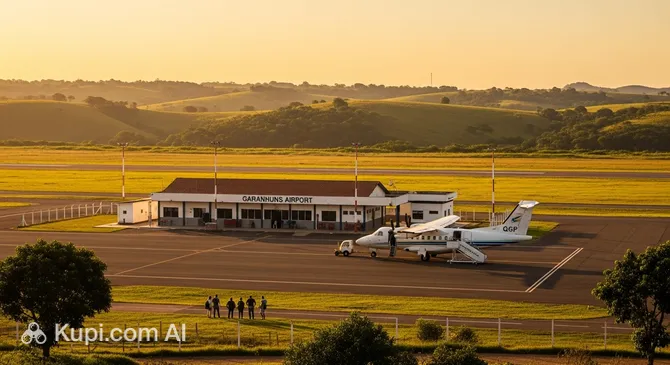
Garanhuns Airport (QGP) represents a classic example of a regional air hub where functionality prevails over scale. All infrastructure is concentrated in a single compact passenger terminal. The building has one floor and serves both arrivals and departures of domestic flights.

The terminal structure is extremely simple and intuitive even for an inexperienced traveller:

  • Public Zone: Airline check-in counters are located here. Given that flights are operated by small aircraft (e.g., Cessna Caravan), there are practically no queues.
  • Security Zone: Located in immediate proximity to the check-in counters. The security screening procedure is standard but much faster than in large hubs.
  • Departure Lounge (Sterile Area): A small space with seating for passengers waiting to board. Basic amenities, including toilets, are available here.

Navigation and Transfers

Due to the fact that the airport consists of a single terminal, there is no complex navigation system. Transfers between terminals are not required. All key points — entrance, check-in counter, security zone, and boarding gate — are within direct line of sight of each other.

Departure and Arrival Zones

Passenger flow organisation is arranged as efficiently as possible:

  • Departure: Boarding is done on foot. Passengers exit the terminal and, accompanied by airline staff, walk across the apron to the aircraft. Jet bridges are absent due to the type of aircraft serviced.
  • Arrival: Upon arrival, passengers also walk from the aircraft to the terminal building. The baggage claim area is located right at the entrance. Luggage is often unloaded and delivered manually or on a small belt, which takes minimum time.

Processing Times

The main feature of Garanhuns Airport is the speed of service. You do not need to arrive 2–3 hours before departure as you would at international airports.

  • Check-in and Baggage Drop: Usually takes from 5 to 10 minutes.
  • Pre-flight Security: Completed in 2–5 minutes.
  • Recommended Arrival Time: It is optimal to arrive at the airport 45–60 minutes before the departure time indicated on your ticket. This is sufficient to check in luggage calmly and pass through control without unnecessary haste.

Recommendations for Passengers

Considering the specifics of a regional terminal, it is worth remembering a few simple rules for a comfortable journey:

  • Keep your e-ticket and documents to hand as soon as you enter the building — distances here are short, and checks begin almost from the threshold.
  • The terminal may have a limited choice of food, so if you plan to eat, it is better to do so in the city before travelling to the airport or bring a light snack with you.
  • Listen carefully to voice announcements from staff, as the number of information screens is minimal.

Airport History

The history of Garanhuns Airport (Aeroporto de Garanhuns) is inextricably linked with the development of the city itself as a tourism gem of the Agreste region. For many years, this air harbour played a modest role, serving mainly private planes, government aircraft, and emergency services. However, for local residents, the airfield always remained a symbol of hope for a fast connection with the coast and the state capital.

Period of Quiet and Private Aviation

Throughout most of its history, up until the early 2020s, the airport did not receive regular commercial flights. Travellers had to rely exclusively on road transport, covering hundreds of kilometres along mountain roads. During this period, the airport came alive only once a year — during the famous Winter Festival (Festival de Inverno), when the runway filled with private jets of artists, politicians, and wealthy tourists.

Large-scale Reconstruction of 2022

A turning point in the recent history of the air hub was the year 2022. The government of the state of Pernambuco initiated a large-scale modernisation project aiming to include Garanhuns in the national air transport network. This was a strategic decision directed at developing tourism in the "Brazilian Switzerland".

During the reconstruction, the following works were carried out:

  • Complete restoration and reinforcement of the runway to accommodate heavier aircraft.
  • Renovation of the passenger terminal, which became more comfortable and modern.
  • Installation of new night lighting and navigation equipment, which improved flight safety in conditions of frequent fog typical for this region.

Return of Regular Flights

A historic event was the resumption of commercial flights. In July 2022, just in time for the start of the 30th Winter Festival, the airline Azul Conecta (a subsidiary of Azul Linhas Aéreas) operated the first regular flight on the Recife — Garanhuns route. This event marked a new era for the city, reducing travel time to the state capital from several hours of driving to a short flight.

Interesting Facts

A curious feature of the airport's history is its climatic context. Garanhuns is located on a highland, and it is often cool and foggy here. In the past, thick morning fogs frequently caused cancellations of private take-offs or landings, creating a reputation for the airport as a "moody" place. Modern modernisation was aimed, among other things, at minimising the impact of weather on the flight schedule.

Services and Facilities

Since Garanhuns Airport (QGP) is a small regional hub oriented primarily towards receiving small aviation, the range of services here is limited to a basic set. Passengers should not expect the developed infrastructure characteristic of large international hubs. The terminal is designed on the principle of maximum functionality for quick dispatch and reception of flights.

Restaurants, Cafés and Shops

There are no full-service restaurants or cafés inside the terminal. The commercial zone is minimal. Depending on the season and flight load, a small sales point or a vending machine selling coffee, soft drinks, and light snacks might be operating. Duty-Free shops, souvenir stalls, or newsstands are absent from the building.

Tip for tourists: We recommend having a meal in the city before leaving for the airport. If you plan to take local souvenirs with you, such as the famous chocolate or local delicacies of Garanhuns, purchase them in advance in the city centre.

Waiting Halls and VIP Service

The airport operates a single general waiting hall. Dedicated VIP halls, business lounges, or zones of increased comfort are not provided. Given the small capacity of the aircraft serviced (usually up to 9–12 passengers), there are always enough seats in the general hall, and the atmosphere remains calm.

Connectivity and Device Charging

  • Wi-Fi: The availability of free public Wi-Fi in the terminal is not guaranteed, or the signal may be unstable. It is recommended to rely on your mobile operator's internet (4G coverage in the airport area is generally good).
  • Charging Stations: There are no specialised stands with USB ports for charging gadgets. Access to electrical sockets may be limited (standard wall outlets), so it is better to fully charge your phone before leaving or bring a portable power bank.

Financial Services

There are no ATMs or currency exchange points in the terminal building. All financial transactions must be completed in the city. The nearest branches of major banks (Banco do Brasil, Caixa, Bradesco) are located in the centre of Garanhuns, approximately 7 km from the terminal.

Medical Services

There is no permanent medical centre or pharmacy in the terminal. In emergency cases, first aid can be provided by airport staff who have appropriate training, or a city ambulance service will be called. The nearest hospitals are located within the city limits, just a 10–15 minute drive away.

Services for Passengers with Children

Specialised infrastructure for families with children (mother and child rooms, changing tables, play areas) is not developed at the airport. Only standard restrooms are available. Considering that check-in and boarding take place very quickly, a long stay in the terminal with children is usually not required.

Services for Passengers with Reduced Mobility

Despite its modest size, the airport ensures basic accessibility:

  • The terminal is single-storey, eliminating the need for lifts or stairs.
  • Entrances and exits are equipped with ramps or are at ground level.
  • When boarding the aircraft on the apron, airline staff provide necessary assistance to passengers with limited mobility.

Hotels and Accommodation

There are no hotels directly on the airport territory or within walking distance. However, thanks to the proximity to the city, the transfer to hotels takes minimum time. Tourists usually choose accommodation in the centre of Garanhuns or in the area of Rui Barbosa Avenue. Popular options include Garanhuns Palace Hotel, Hotel Tavares Correia, and the Sesc Garanhuns complex.

Business Services

Conference halls, meeting rooms, or business centre services (printing, fax) are not provided at Garanhuns Airport.
Where to Eat

Dining Options at the Airport

Travellers flying from Garanhuns Airport (QGP) should plan their meals in advance, as opportunities for gastronomic discoveries directly in the terminal are extremely limited. The airport is a compact regional hub, and there are no full-service restaurants, cafés, or bars here. The building's infrastructure does not include food court zones familiar to large air harbours.

Available Services and Assortment

The only option for a snack on the terminal premises may be a small sales point or vending machine located in the public zone (landside) before passing pre-flight security. Their availability and opening hours often depend on seasonality and the flight schedule.

  • Assortment: Usually limited to bottled water, carbonated drinks, machine coffee, crisps, chocolate bars, and biscuits. Hot meals are not offered.
  • Average Cost: Prices for snacks and drinks are standard for such kiosks; a snack will cost between 10–20 Brazilian Reals (BRL).
  • Opening Hours: If a sales point is functioning, it opens approximately one hour before the flight departure and closes immediately after the aircraft leaves.

Special Dietary Requirements

Due to the absence of a kitchen in the terminal, it is not possible to order Halal meals, vegetarian, or vegan dishes. Passengers with specific dietary needs or gluten allergies are strongly advised to bring food with them in their hand luggage. Security rules on domestic flights are usually lenient regarding the carriage of solid food items.

Recommendations: City Gastronomy Before Departure

Since Garanhuns is known as a gastronomic centre of the region, the best solution would be to have a proper lunch or dinner in the city before travelling to the airport. The city centre is just a 15-minute drive away, and there you can enjoy local culinary hits.

As a "packed lunch" for the flight, we recommend purchasing items from local confectioneries:

  • Locally Produced Chocolate: Garanhuns is famous for its chocolate factories (for example, Chocolates Sete Colinas). This is an excellent high-energy snack.
  • Bolo de Rolo: A traditional roll for the state of Pernambuco with very thin layers of dough and a guava filling (goiabada). It travels well.

Summary

Garanhuns Airport is a place for quick transit, not for long lunches. Arrive here well-fed, carrying a bottle of water and a light snack if you are travelling with children or are used to frequent meals.

Travel Tips

Travelling through the regional Garanhuns Airport has its own specifics, distinct from flying through major international hubs. Since flights here are operated primarily by light aviation (for example, Cessna Grand Caravan aircraft by Azul Conecta), passengers should consider a number of nuances for a comfortable flight.

Optimal Arrival Time

Unlike large airports, there is no point arriving here 2–3 hours in advance. The terminal is small, and all procedures are very quick.

  • Recommended Time: Arrive 40–50 minutes before departure. This is quite sufficient to check in and drop off luggage without rushing.
  • Risk of Lateness: Despite the intimacy of the airport, check-in counters close strictly according to schedule (usually 20–30 minutes before departure). The aircraft will not wait for latecomers, as the flight schedule is strictly regulated.

Check-in and Seat Selection

Flights to and from Garanhuns are often also a panoramic tour over the picturesque hills of the state of Pernambuco.

  • Seating Specifics: On small aviation flights, advance online seat selection may be unavailable or changed by the crew. Pilots often seat passengers based on the centring (balancing) of the aircraft. Be prepared to move seats if requested by the captain.
  • Best Views: Since planes fly at a relatively low altitude, the view from the window is stunning. If there is a choice, ask for a window seat (although in the 1+2 configuration of the Cessna Caravan, almost all seats have a good view).

Hand Luggage and Baggage: Important Information

This is the most critical point when flying on small aircraft.

  • Hand Luggage Dimensions: In the cabin of Cessna-type aircraft, there are no familiar large overhead luggage bins. Hard "cabin size" suitcases that fit in a Boeing or Airbus will not fit here.
  • Tip: Use soft bags or medium-sized backpacks. If you have a small hard suitcase, be prepared to hand it over to the luggage compartment right at the steps (Gate Check service).
  • Restrictions: Standard Brazilian security rules (ANAC) apply here too. Sharp objects, flammable substances, and large volumes of aerosols are prohibited.

Recommendations for Transit Passengers

Most flights from Garanhuns go to Recife, from where tourists fly on to the rest of Brazil or the world.

  • Allow Time for Connections: The weather in Garanhuns is changeable, and morning fogs can delay departure by 30–60 minutes. If you have a connecting flight in Recife, leave a buffer between flights of at least 2.5–3 hours to avoid stress due to a potential delay of the first segment.
  • Baggage: Check at the registration counter whether your luggage will be checked through to the final destination or if you need to collect it in Recife and check it in again.

Customs Control

Garanhuns Airport serves exclusively domestic flights. There is no customs or passport control for crossing the border here.

  • To fly, you will only need an identification document (passport) or another official photo ID valid within Brazil.
  • Phytosanitary control may operate selectively: if you are carrying fruit or plants, ensure they are not prohibited for transport between regions, although for ordinary tourists this rarely becomes a problem.

Tips for Economy and Comfort

  • Food: Since there is no café at the airport and snack prices may be inflated (if available at all), buy water and a snack in advance at a city supermarket.
  • Charging Gadgets: Bring a fully charged power bank (external battery). There are few sockets in the waiting hall, and small aviation aircraft do not always have USB ports.
  • Restroom: Use the restroom in the terminal before boarding. In small planes, the toilet is either absent or very cramped and intended only for emergency cases.

What to Do in Case of Flight Delay

Due to the climate specifics ("city of rain and mist"), flight delays or cancellations happen more often than in lowland cities.

  • Have a Plan B: If the flight is cancelled due to non-flying weather, you can get to Recife by bus. The bus station (Rodoviária) is located within the city limits. The trip will take about 3.5–4 hours.
  • Entertainment: There is no Wi-Fi (or it is unstable) and no entertainment infrastructure at the airport. Download films, books, or music to your smartphone in advance to pass the waiting time.

Reached the end of the page?

That means the route is fully explored